

LATEST NEWS
October 7, 2026 • 09:02
September 24, 2026 • 15:12
September 23, 2026 • 09:02
17 Sep 2026
The European Space Agency (ESA) has signed 18 consolidation contracts, worth a total of €20 million, to support the future evolution of the European Union’s Infrastructure for Resilience, Interconnectivity and Security by Satellite (IRIS²), an upcoming multi-orbital constellation designed to provide reliable connectivity for governments, commercial businesses and European citizens across Europe.
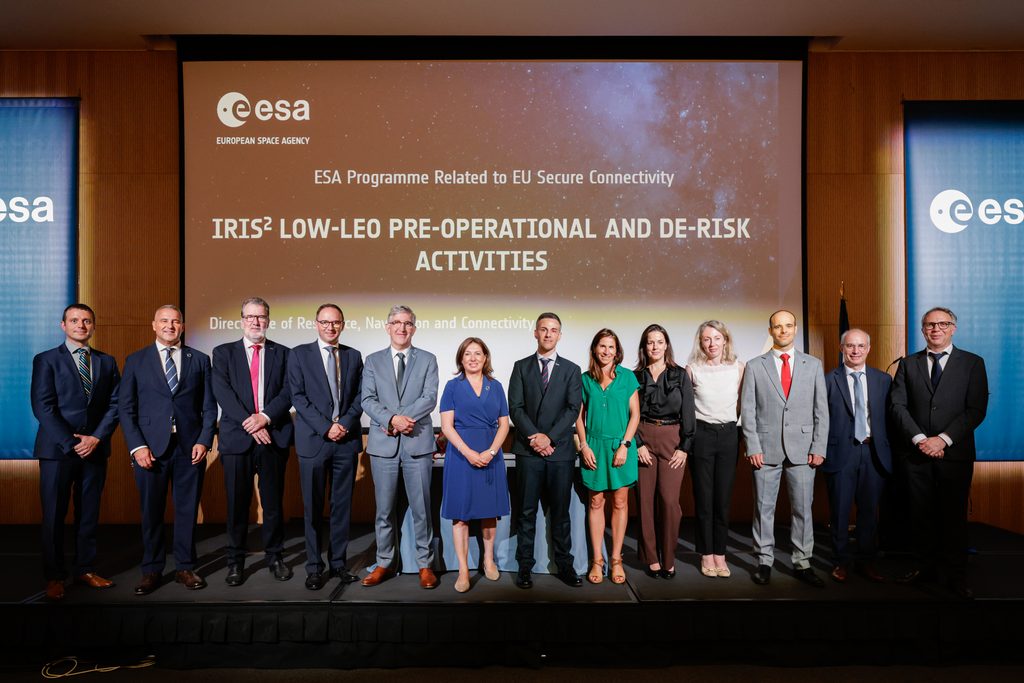
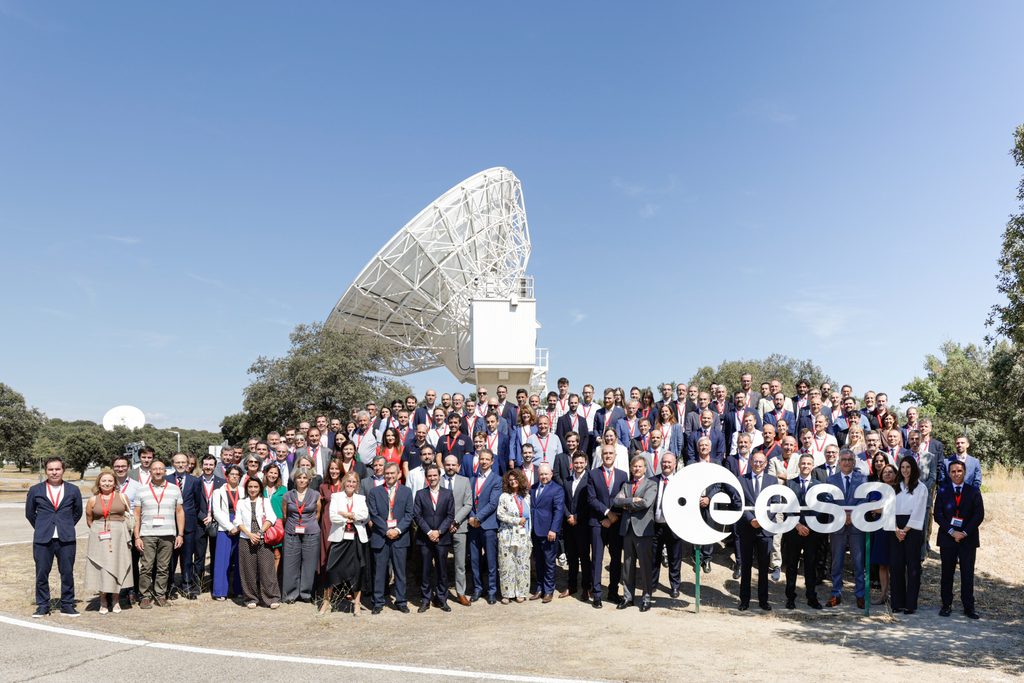
The signatures, which launch the consolidation phase of ESA’s Low-LEO component for new governmental services and associated mission concepts, range from secure broadband, maritime operations and safety, aviation and airspace to data relay and tasking, among others, and took place at ESA’s European Space Astronomy Centre (ESAC) in Madrid, Spain.
ESA Director of Resilience, Navigation and Connectivity, Laurent Jaffart, signed the agreements in the presence of representatives of the European Commission, and the selected industrial consortia. The contracts, which bring together nearly 80 European industrial partners, makes a move to strengthen the industrial base of ESA Member States, particularly Small- and Medium-Sized Enterprises (SMEs) and Midcaps.
Low-LEO serves as the low Earth orbit layer of IRIS², operating below approximately 750 km above Earth. The proximity will be able to support lower-latency connectivity and capabilities such as direct connections between satellites and user devices, as well as Internet of Things (IoT) services. It also offers Europe the opportunity to develop and test new capabilities in-orbit without waiting for major lengthy changes to the constellation’s system. It is envisaged that 338 satellites will be in LEO (High LEO and Low-LEO).
The Low-LEO layer has two complementary components. The EU Low-LEO component, led by the European Commission, focuses on strategic government services. ESA’s component – which is being supported through the Agency’s Programme Related to EU Secure Connectivity – provides a rapid and recurrent mechanism for validating complementary governmental services and associated mission concepts in orbit, supporting their maturation and later integration into the operational EU IRIS² baseline.
As part of these activities, ESA, working with the European Commission, will assess the potential of key services and the suitability of associated mission concepts, including their added value, technical feasibility, and interoperability aspects with IRIS² and other European programmes.
Based on the outcomes of the consolidation phase, in terms of maturation and subject to future programme priorities, ESA will initiate several procurements for an implementation phase that will feature a concrete set of missions, planned for implementation between 2027–2029, to validate the targeted services in orbit up to a pre-operational level.
The future of secure connectivity will not be defined by a single technology or a single orbit. It will come from combining complementary capabilities and having the flexibility to adapt as Europe’s needs evolve. Through its Low-LEO activities, ESA looks forward to working hand-in-hand with the European Commission and European industry to explore what comes next for IRIS²; to shape the capabilities that will support Europe’s future connectivity needs,” said Laurent Jaffart, Director of ESA’s Resilience, Navigation and Connectivity.