PAGE CONTENTS
Objectives
The objective of the project is to build an optical receiver for high-speed free-space optical (FSO) communications which combines the two functions of 1) data receiver and 2) optical beam tracker in a single detector. It is based on a specifically developed high-speed, low noise, long wavelength avalanche photodiode together with commercially available electronics. An evaluation board is developed as part of the project, containing all the input/output connectors needed to easily test the receiver functionalities in a laboratory environment.
The primary application of the receiver is in the Optical Ground Stations (OGS) used for LEO direct-to-Earth connections. However, given the similarity of the requirements, the receiver developed here could be also used for inter-satellite and terrestrial FSO communications. FSO links transmit information from point to point using a narrow beam of light. This type of networks is becoming more and more widespread because of some unique advantages compared to conventional radio frequency wireless networks and fibre connections. These include immunity to spectrum congestion and interference, improved security, lower power consumption and rapid deployment in difficult-to-reach areas.
Benefits
The role of the product in the context of the overall system/service of its target users is to combine the two functions of tracking sensor and data receiver to improve sensitivity and reduce cost and complexity in optical ground stations for high-speed satellite-to-ground optical links. Any FSO data link between satellites and the ground requires a constant adjustment of the receiver orientation, in order to track the signal from the fast-moving satellite in orbit. This is normally accomplished by employing an optical system where the light beam is collected by a telescope and split in two branches: one is sent to a segmented detector, the other to a fast receiver.
The detector is connected to the beam steering system of mirrors, and is used to track the light source and maximize the amount of light collected onto the receiver, which actually detects the data stream. The product under development in this activity combines these two functions in a single device.
This brings several key advantages:
- Improved data sensitivity;
- Reduced material budget, simplifying its integration into satellites;
- Reduced complexity of the optical system;
- Higher data rate compared to existing solutions, up to ≥10 Gbps.
Features
The core of the receiver is a hybrid detector: combining the four-quadrant PD/APD tracking detector and 10 Gbps APD data detector. The chip will have an effective light-collecting area of at least 200 µm diameter. The chip sub-assembly is then incorporated in a hermetic package together with individual transimpedance amplifiers (TIAs), limiting amplifiers (LIAs) and passive electrical components (capacitors, resistors, inductors…).
The precise package form factor definition is covered as part of the project. The receiver is designed to be suitable for different data rates, including 155 Mbps; 1 Gbps and 10 Gbps, with a dedicated filter for each data rate. The operation wavelength is 1550 nm.
Challenges
Main challenge of AO-RETINA project is to find an optimum balance between the high data rate for data receiving and the large light sensitive area for beam tracking.
Main technical requirements are the following:
- Multiplied responsivity > 9.0 A/W at 1550 nm;
- High data rate operation up to 10 Gbps;
- Low noise multiplication to obtain high sensitivity operation;
- At least four independent segments for beam tracking with total detecting diameter of 200 µm.
System Architecture
The following product tree is a hierarchical breakdown of the product into the hardware and software elements:
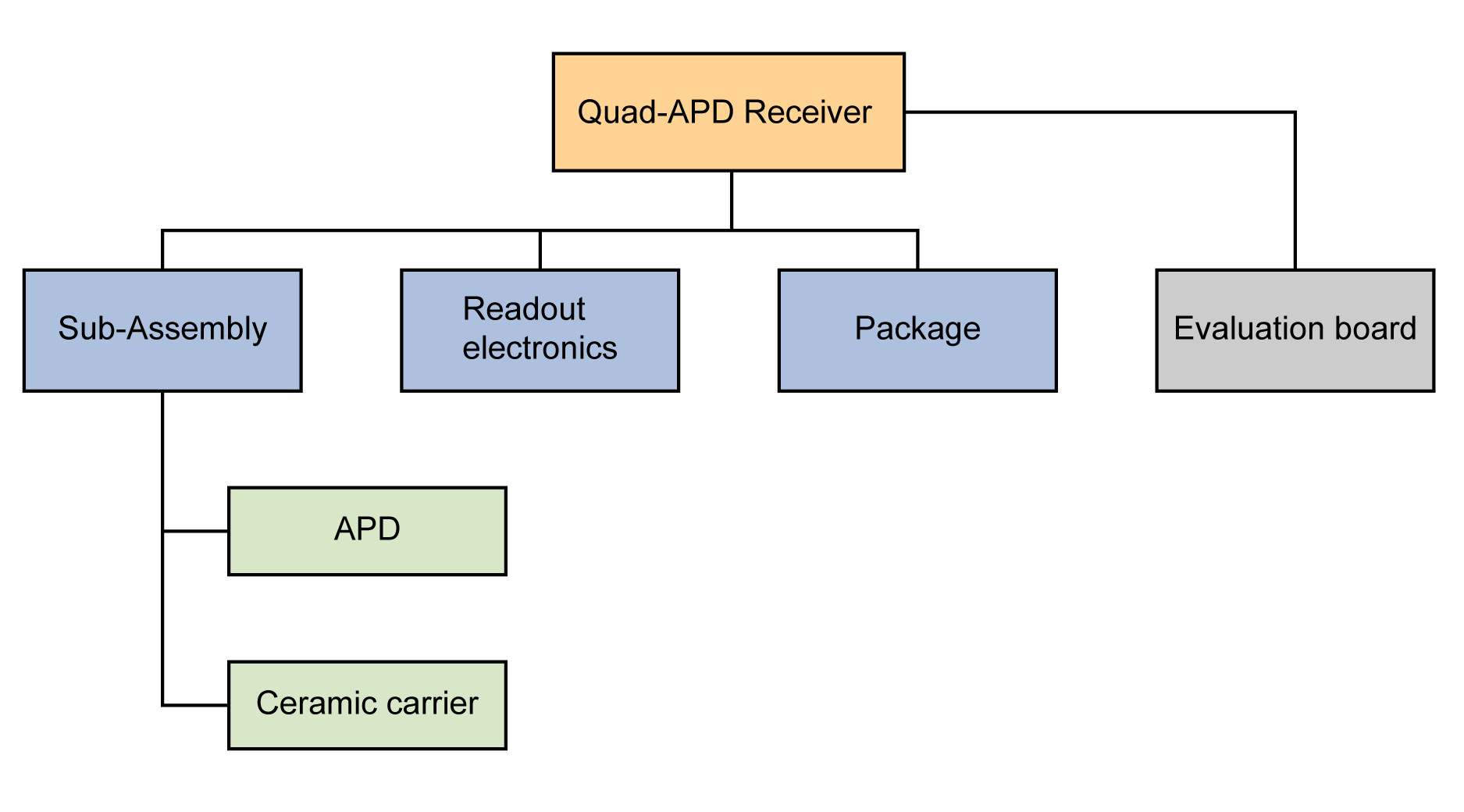
The key products or elements are described below:
Hybrid Detector
In the hybrid approach, two detectors are arranged into the stack assembly: positioned at the top is a backside illuminated quadrant PD/APD for tracking, while at the bottom there is a backside illuminated, lensed 10G APD for data acquisition, as illustrated in the image below:
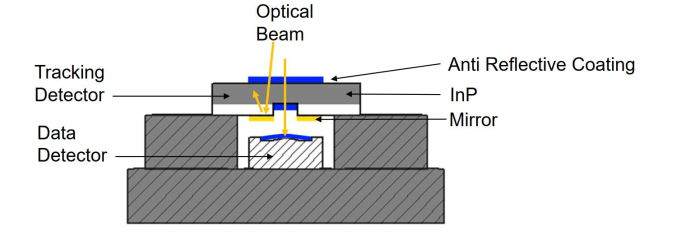
The key advantage of this approach lies in the ability to individually optimize both the 10 Gbps APD data detector and the quadrant PD/APD tracking detector.
Evaluation Board
To minimise crosstalk between tracking and data signals and to allow independent testing and modification of the data evaluation circuitry and tracking receiver circuitry, the electrical circuit board is divided into two parts. First includes a small RF evaluation board for convenient data signal read-out. Second or a main board, serves for amplifying and reading tracking signals, as well as powering the electronics.
The RF evaluation board can be used alone, or in combination with the main board.
Plan
The technology development of this project is divided into two phases: a ‘Technology – preparation’ phase and a ‘Technology – development’ phase. In the preparation phase, we cover the following tasks: conducting literature research to review the state of the art, preparing the device design, and running simulations. In the development phase, we design and measure tests to validate the simulation models, verify compliance with project requirements, and define the final design. The final design is then manufactured and tested.
Current Status
Mission accomplished!
The AO-RETINA project has officially concluded with a successful final review at the European Space Agency’s (ESA) European Space Research and Technology Centre (ESTEC) in Noordwijk, the Netherlands, and we are very proud of the result.
AO-RETINA delivers a first-of-its-kind hybrid data and tracking detector for optical ground stations at 10 Gbps, enabling high bandwidth free space optical communication between LEO-to-Earth. The hybrid detector, combining a quadrant position tracking sensor and an avalanche photodiode, is highly versatile and makes efficient use of every photon available.
A big thank you to our Technical Officer, Dean Yeoman, and the entire ESA team for the outstanding collaboration throughout this journey. Their positive evaluation of the final receiver reflects the high quality of work the Albis Optoelectronics team:
Wei Quan
Michal Latzel
Hektor Meier
Dmitri Makhrov
Felix Fischer
The future of space communication is bright and we’re building the eyes to see it.
Related Links
Companies