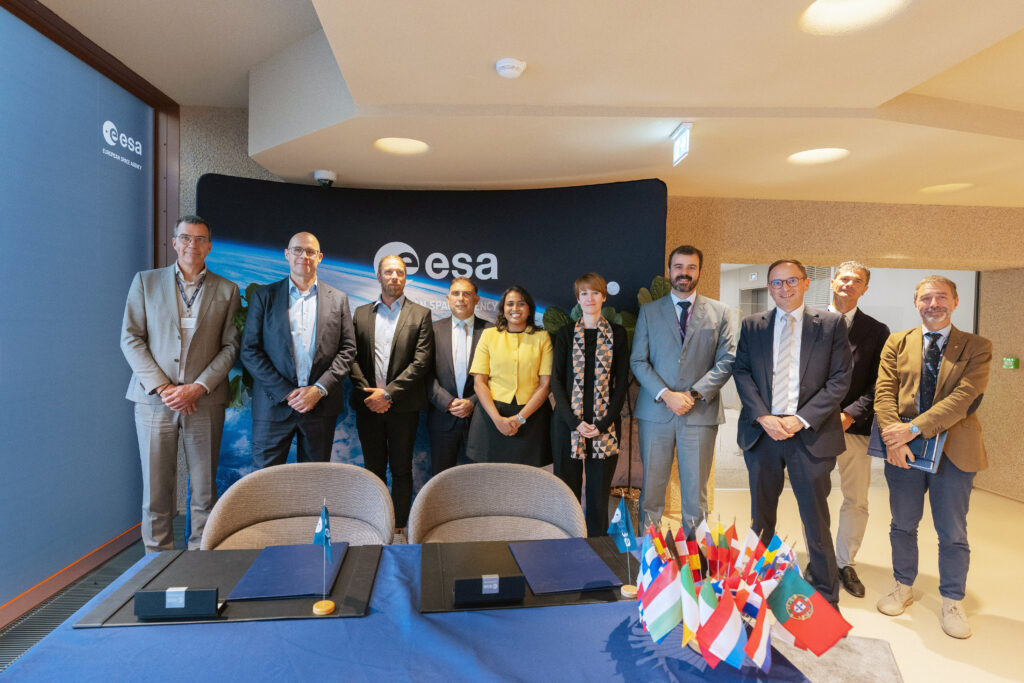
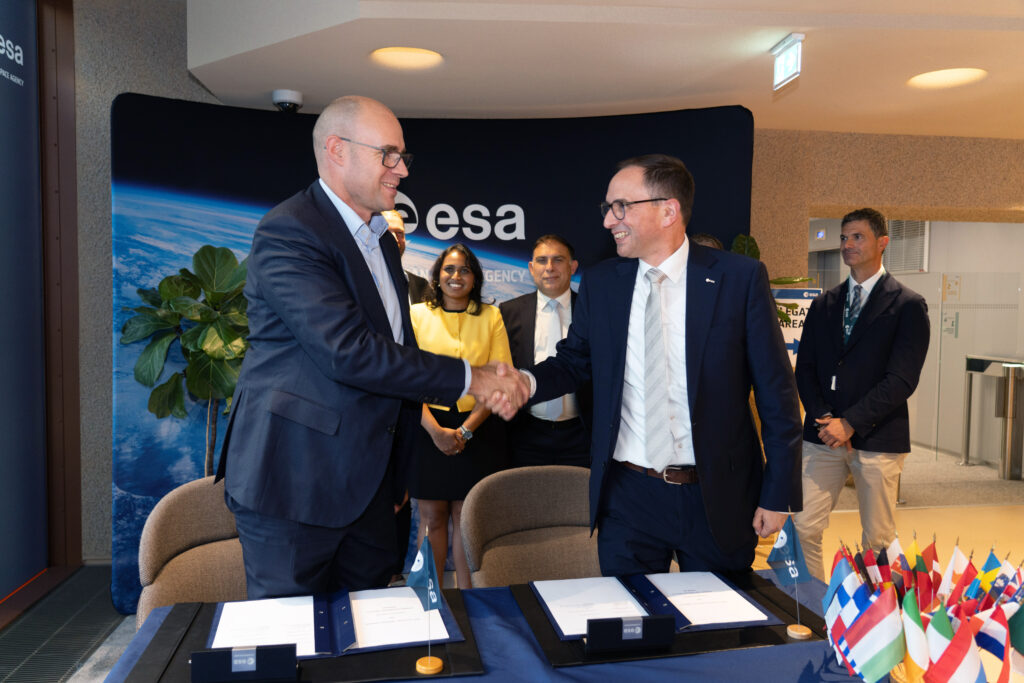
The European Space Agency (ESA), in collaboration with the European Commission held a workshop dedicated to User Terminal technology and products, on 6 July 2026 in the Agency’s European Space Research and Technology Centre (ESTEC), in the Netherlands.
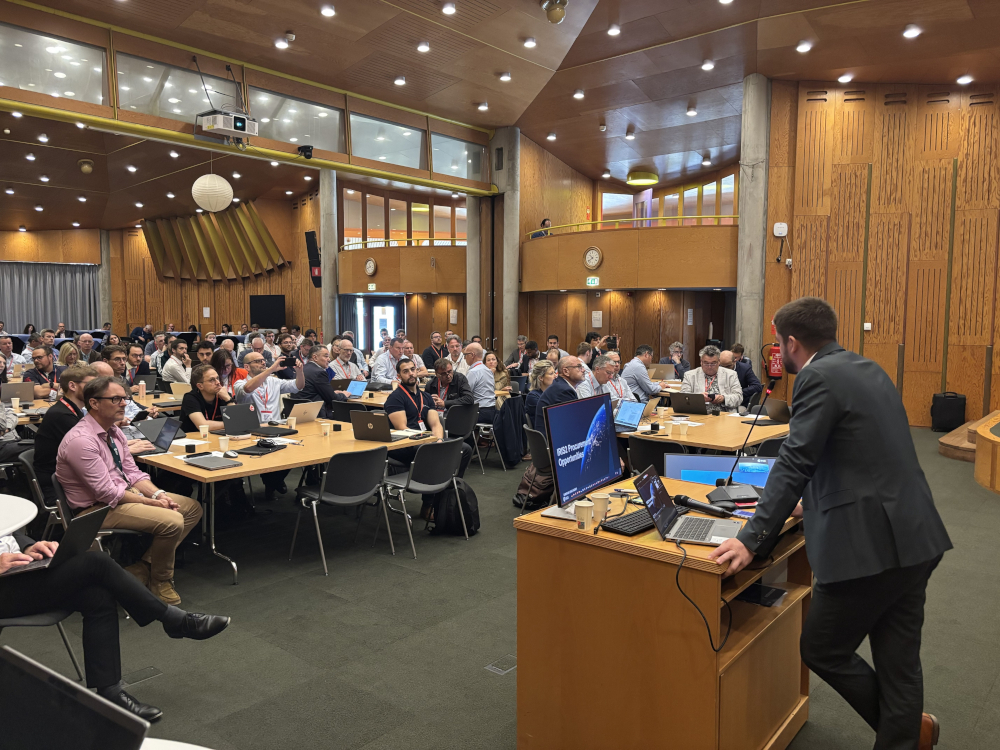
ESA User Terminal Workshop. Image credit: European Space Agency
The event convened over one hundred technology and business experts from representatives of ESA Member States’ industry and institutions, with a hundred more joining online. The workshop featured presentations on ESA’s Advanced Research in Telecommunications Systems (ARTES) Flat Panel User Terminal Roadmap, and upcoming User Terminal Procurement Opportunities under the Infrastructure for Resilience, Interconnectivity and Security by Satellite (IRIS²) programme.
IRIS² is the next flagship programme of the European Union, and a strategic asset for the EU, in support of its strategic autonomy, resilience and competitiveness. Through the ESA Programme Related to EU Secure Connectivity, ESA plays a pivotal role by serving as the technical backbone, industrial orchestrator and oversight authority that bridges the EU’s policy ambition with industrial delivery.
ESA’s ARTES programme enables European and Canadian industry to develop innovative, market-leading satellite communications products, strengthening their global competitiveness while creating new business opportunities, jobs, and economic growth across multiple sectors of the space economy.
Over the day-long workshop, industry and delegates from ESA Member States were invited to discuss pathways to the development of competitive user terminal solutions and their deployment – a crucial component that will support future European satellite constellations.
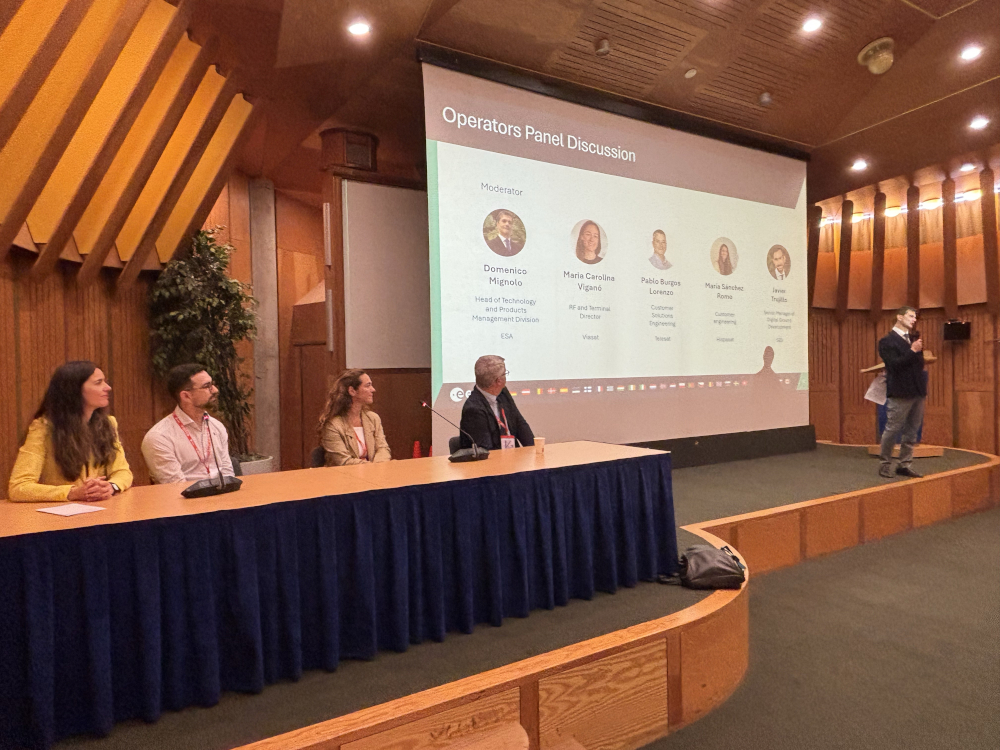
Panel session at ESA User Terminal Workshop. Image credit: European Space Agency
ESA and the European Commission showcased IRIS² and ARTES, two key programmes accelerating the development and industrialisation of Europe’s resilient and secure communications infrastructure. The outlook was complemented with a panel discussion featuring panellists from Viasat, TELESAT, Hispasat and SES, and moderated by Domenico Mignolo, Head of Technology and Products Management Division at ESA’s Resilience, Navigation and Connectivity directorate.
The centrepiece of the workshop were three round table sessions, enabling industry participants to exchange experiences, network openly, and discuss challenges and opportunities across the entire user terminal value chain.
“The European satellite ecosystem is entering a new phase. As future constellation takes shape, and resilient infrastructures are being built for European citizens. Competitive user terminal solutions have become a critical enabler of the satellite connectivity,” said Laurent Jaffart, Director of Resilience, Navigation and Communication at ESA, in the workshop’s inaugural address. “At ESA, we are working in close cooperation with the Commission and our industrial partner, SpaceRISE, to ensure that we will have cost-competitive, cutting-edge terminals covering diverse operational scenarios such as fixed, mobile, and maritime use.”
The workshop event helped to bring European strategic priorities into focus and kickstart discussions among institutional and industry stakeholders. Both the panel and round table sessions provided valuable insights into the global satellite communication user terminal market and its competitive dynamics.
Home
/ ESA signs contract to co-fund VDES constellation ...
ESA signs contract to co-fund VDES constellation for maritime safety communications with UK Space Agency and AAC Clyde Space
Image: illustration of satellite connection. Credit: Shutterstock
The European Space Agency (ESA) has signed a contract with UK company, AAC Clyde Space, to fund the development and building of the in-orbit demonstration phase for the Very High Frequency Data Exchange System (VDES) network of its industry-led INFLECION initiative, a space-based maritime communication and surveillance network, with co-funding from the UK Space Agency. Testing and demonstration of the VDES services are expected to be completed by 2029, with a total of 12 satellites planned for the constellation.
Maritime traffic is crucial to Europe and Canada’s economies. With nearly 90 percent of all goods in international trade conveyed by sea, growing security concerns have increased the need to make supply chains more resilient – as well as to pursue stricter environmental and safety requirements. ESA is working closely with industry to boost the resilience of its Member States and Canada’s international supply chains with space-based maritime communication and monitoring solutions that can help to address these safety requirements. Such capabilities will enhance routing, safety and security for ships, and improve environmental monitoring, thereby reinforcing compliance with international regulations.
AAC Clyde Space’s INFLECION initiative is designed to provide European maritime institutional users and shipping companies with dedicated communications between ships, shore and satellites for critical services. In addition, it will build towards future capabilities for maritime monitoring and situational awareness for vessel movement and anomalous behaviour detection. This solution leverages the company’s previous experience with maritime services and VDES, which enables automated ship identification as wells as ship-to-ship, ship-to-shore and shore-to-ship communications.
INFLECION is structured around a first definition phase, successfully completed, to be followed by the development and demonstration phases of a VDES satellite communications network – the object of AAC Clyde Space’s new contract with ESA. The contract for the VDES constellation is co-funded equally by a consortium led by AAC Clyde Space, and by the UK Space Agency through ESA’s Advanced Research in Telecommunications Systems (ARTES)Space Systems for Safety and Security (4S) strategic programme line.
This approach allows the consortium to de-risk technology development, whilst starting to deploy its proven VDES technologies, and demonstrating capabilities that build towards a scalable service.
“INFLECION is an important element in our global effort to advance Europe’s capabilities in satellite-enabled maritime services,” says Christophe Allemand, Head of Safety & Security from Space Programme Office, European Space Agency. “By providing dedicated connectivity for critical maritime operational services and more timely and reliable information from space, the programme will support safer, more resilient and more sustainable maritime operations. ESA is pleased to support initiatives like INFLECION, that strengthen Europe’s position and autonomy in a strategically important domain.”
“We are proud to lead a consortium of highly qualified partners to advance this next generation service in maritime intelligence from space,” says Luis Gomes, CEO of AAC Clyde Space. “The programme allows us to develop a service that is in high demand, and it is a key step towards delivering operational services that support safer, more efficient and more sustainable maritime operations.”
“The INFLECION programme is an important step for the UK in developing new space-enabled maritime capabilities,” says Henny Sands, Head of Satellite Communications, UK Space Agency. “The programme brings together leading industrial and academic partners to develop capabilities that will improve maritime safety and awareness, and support more resilient and efficient global shipping.”
Home
/ ESA, Airbus Defence and Space and Weeroc move to a...
ESA, Airbus Defence and Space and Weeroc move to accelerate commercialisation of made-in-Europe electrical component vital to satellite operations
The European Space Agency (ESA), with French company, Weeroc, and European aerospace prime, Airbus Defence and Space, is supporting the development and commercialisation of a programmable latching current limiter crucial to spacecraft power distribution: the CONAN Application Specific Integrated Circuit (ASIC). This sophisticated product showcases a wholly European solution accelerated through ESA’s Advanced Research in Telecommunications Systems (ARTES) 4.0 programme.
Stable electrical power is indispensable to the normal operation of spacecraft components, as well as their mission-specific payloads. However, orbital conditions are notoriously hazardous, subjecting spacecraft to taxing temperatures and radiation, and limiting access to power to onboard solar panels and batteries. When configured as a latching current limiter, the CONAN ASIC functions much like a circuit breaker in a common household fuse box, preventing dangerous power surges – caused by radiation, in this case – from damaging or destroying electronic equipment.
Because of its importance for spacecraft operations, ESA initially identified latching current limiter technology as integral to the resilience and sovereignty of Europe’s space industry. Through the Advanced Technology (AT) stage of its ARTES 4.0 programme, ESA partnered with industry to respond to this need by setting a shared goal: to develop a programmable latching current limiter and its corresponding value chain in Europe.
The Agency provided technological mentoring, programmatic guidance and funding, acting as a catalyst for collaboration between Weeroc, an agile SME, and Airbus Defence and Space. This support, accessed through the ARTES 4.0 programme, helps to de-risk technological development and to maximise market impact.
A view of of the CONAN ASIC. Image credit: Weeroc
Through the framework of ARTES 4.0, CONAN’s development demonstrated the characteristic attributes of the European space sector: institutionally supported transfer of know-how, and effective cooperation across the value chain. This particular blend of cooperation delivered a competitive, technically advanced and programmatically versatile technology, boasting high power density as well as adaptability to both institutional missions and flexible NewSpace architectures. These features are crucial to enabling increasingly power-hungry payloads and demanding on-orbit applications.
Rigorous testing and validation, carried out by Weeroc with ESA support, proved the robustness of the ASIC’s architecture. During testing, the CONAN ASIC was shown to be especially effective in preventing failure propagation on high-voltage power buses, making it well suited for modern satellite payloads with high energy demands. The ASIC also proved its ability to withstand high radiation dosage – up to 100 krad – whilst maintaining stable behaviour with no blocking or failure modes. This resilience is further boosted by modern telemetry and on-the-fly reconfiguration capabilities. Crucially, this programmable functionality is what allows the ASIC to be reset and resume normal operations after a power surge that would otherwise spell disaster for the spacecraft. In addition to its built-in toughness and flexibility, the ASIC’s small footprint reduces mission complexity, and helps to save on mass and volume, both of which are at a premium on spacecraft. Overall, the CONAN ASIC offers a fully European power distribution solution, contributing to the resilience of both future spacecraft, and the wider value chain.
Upon the completion of AT activities, the CONAN ASIC was awarded a co-funding contract under the Competitiveness and Growth (C&G) stage of ARTES 4.0 to translate the technology achieved under AT into a market-ready product. Presently, the ASIC is undergoing iteration and refinement with the goal of bringing it to flight worthiness at TRL-7, following optimisation pathways revealed during testing at the AT stage.
“I am very pleased this activity has led from laboratory experiments to the establishment of a credible foundation for a new product line, enabling European industry to bring a competitive offering on the global space market,” said Domenico Mignolo, Head of Technology and Products Division, ARTES Industrial Competitiveness at the European Space Agency. “The advancement of CONAN through successive stages of ARTES 4.0 demonstrates how, with the support of ESA Member States, it is possible to strengthen collaboration between European actors and deliver a competitive solution.”
ESTEC, Keplerlaan 1, 2201 AZ Noordwijk, Netherlands
The European Space Agency (ESA) and the European Commission invite European and ESA Member states industry to a User Terminal workshop including a presentation of the ARTES and IRIS² User Terminal Roadmap, industry panels, and round tables.
The European satellite ecosystem is advancing its capabilities to support the deployment of future satellite constellations and resilient infrastructures for European citizens. This workshop will focus on the development and deployment of competitive European user terminal solutions as a key enabler of satellite connectivity. It will address the complete user terminals technology and value chain, from key components (flat panel antennas, interfaces, chipsets) through terminal integration, regulatory certification, and scalable production.
The objective is to align stakeholders on targeted priorities and capabilities, initiate discussions on upcoming procurement opportunities within the ARTES and IRIS² Programmes, and enable structured networking (B2B sessions) between ESA, the European Commission (EC), and industry participants.
PROGRAMME
09:30-10:00
Registration / Welcome Coffee
10:00-10:30
Opening (ESA/EC)
10:30-11:15
ARTES and IRIS2 Roadmap and procurement opportunities (ESA/EC)
The European Space Agency (ESA), together with the Italian Space Agency (ASI), has announced the start of a new activity led by Italian small satellites manufacturer, Tyvak International, to enable enhanced 5G broadband connectivity for satellites on non-geostationary orbits.
This experiment aims to address the issue of synchronisation, a key challenge to the widespread deployment of a hybrid network comprising both terrestrial and non-terrestrial (TN/NTN) infrastructure. TIDE will develop and test technologies to demonstrate the feasibility of using time division duplexing (TDD) mode to replace the traditional frequency division duplexing mode. To do so, the in-orbit experiment’s objectives will be twofold: to test communications between the planned in-orbit demonstrator and ground stations over Ka-band using TDD; and to explore the benefits of TDD for 5G-enabled satellite communications for satellite on non-geostationary orbits (NGSOs).
The project’s all-Italian consortium builds on successful relationships fostered by Tyvak International and ESA on the LIDE activity, and includes Celeste Technologies, experts in satellite systems for non-terrestrial networks, as well as PICOSATS. PICOSATS will contribute its know-how in telecom payload implementation and advanced satellite communications solutions, while Celeste Technologies will develop mission-critical smartgNB software, compliant with international 3GPP standard and enabling communications with terrestrial 5G networks.
“The Space for 5G/6G and Sustainable Connectivity programme line continues to deliver significant value for the future of satellite telecommunications, and TIDE represents a concrete example of how industry in Italy and other ESA Member States is able to lead this transformation. The collaboration with Tyvak International and its partners confirms the advantage of a cohesive and highly specialised industrial ecosystem in strengthening Europe’s autonomy,” said Antonio Franchi, Head of ESA’s Space for 5G/6G & Sustainable Connectivity programme.
“This new contract with ESA represents the natural continuation of the work begun with the LIDE mission, whose excellent results have confirmed the effectiveness of our technological approach and our ability to deliver,” said Margherita Cardi, VP Programs and Business Development of Tyvak International. “This renewed trust testifies to the strength of a well-established partnership and the value of Italian expertise in the development of miniaturised satellite solutions for telecommunications. For years, we have been working continuously with our partners on the design and development of advanced systems, contributing to the evolution of connectivity infrastructure. In this context, our commitment to enabling 5G services via satellite plays a strategic role for both government and commercial applications.”
TIDE will add a stepping stone to the development of hybrid space-Earth infrastructure capable of supporting future networks. With growing interest from the market, TIDE will help position Europe in a leadership role and answer demand with market-ready solutions, mature products and technical expertise for global TN/NTN connectivity.
Home
/ ESA supports new Optical Ground Station in Greece ...
ESA supports new Optical Ground Station in Greece to advance Europe’s secure space connectivity
The European Space Agency (ESA), together with the Greek Ministry of Digital Governance, has supported the development and commissioning of the Holomondas Optical Ground Station (OGS) in Greece, marking another important milestone in Europe’s efforts to build next-generation optical connectivity infrastructure.
The Holomondas station is now operational and ready to support in-orbit demonstration and validation activities for Greek CubeSat missions carrying laser communication payloads. Image credit: Astrolight
Developed under the PeakSat project led by the Aristotle University of Thessaloniki, and implemented with space and defence company Astrolight, the Holomondas station is now operational and ready to support in-orbit demonstration and validation activities for Greek CubeSat missions carrying laser communication payloads.
The project forms part of ESA’s Greek Connectivity Programme, carried out on behalf of the Hellenic Ministry of Digital Governance under the Greek IOD/IOV CubeSat initiative. The programme is designed to strengthen Greece’s and Europe’s capabilities in secure, high-speed optical communications from space.
PeakSat and ERMIS-3, two Greek CubeSats supported by ESA, successfully reached orbit on 30 March 2026 as part of a wider launch campaign involving eight ESA-backed spacecraft. Both missions carry optical communication payloads that will demonstrate high-throughput laser links between satellites in orbit and the Holomondas OGS on Earth. Astrolight supplied both the ground segment and the ATLAS-1 laser communication terminals onboard the satellites, creating a complete end-to-end optical communications system for in-orbit testing.
The Holomondas station, originally an astronomical observatory, has been upgraded with advanced laser communication capabilities, including an 808-nanometre laser beacon and a compatible C-band optical receiver. These systems enable precise laser beam alignment and optical data reception at speeds of up to 2.5 Gbps under varying atmospheric and operational conditions.
The project also demonstrates how innovative engineering approaches can help reduce the size, weight and infrastructure requirements traditionally associated with optical ground stations, helping pave the way for more scalable and cost-effective deployment of optical communication networks across Europe.
Unlike traditional radio-frequency systems, optical communications use narrow infrared laser beams to transmit data at significantly higher rates of up to 100 times, while offering resilience against interference and congestion.
“ESA is proud to support the joint efforts of Astrolight and the Aristotle University of Thessaloniki in advancing Europe’s next generation of optical communication infrastructure. The commissioning of the Holomondas Optical Ground Station marks an important step towards enabling faster, more secure, and resilient connectivity, while strengthening Greece’s role within Europe’s expanding optical communications ecosystem,” said Frederic Rouesnel, Greek Connectivity RRF Project Manager at ESA. “As the Greek CubeSats move into their demonstration phase, they will help validate innovative laser communication technologies that will provide alternatives to scarce radio frequencies and shape the future of high-capacity connectivity in space.”
“We are happy to apply our technical expertise to commission the Holomondas station and support the Aristotle University of Thessaloniki’s efforts to advance Greece’s and Europe’s optical communication infrastructure,” said Laurynas Mačiulis, CEO of Astrolight. “By providing an end-to-end communication system, with ground and space segments designed to work together from the start, we helped streamline the mission’s path from integration to in-orbit testing.”
“Holomondas is moving closer to becoming an internationally recognised optical communication hub and contributing to the future global network of optical ground stations,” said Kleomenis Tsiganis. “This progress has been made possible through close collaboration between academia and industry, and our joint endeavor shows how such partnerships can accelerate the development of laser communication infrastructure.”
The initiative contributes to ESA’s broader efforts to develop secure, resilient and high-capacity communications infrastructure that will support future satellite services, Earth observation missions and Europe’s long-term connectivity ambitions.
Home
/ Final in-orbit-demonstrators launched to validate ...
Final in-orbit-demonstrators launched to validate direct to Earth optical links in close out of ESA-implemented Greek Connectivity Programme
The European Space Agency (ESA) has supported the launch of two satellites in the Hellenic Space Dawn mission, the final CubeSat mission in the Greek Connectivity Programme implemented by ESA on behalf of the Hellenic Ministry of Digital Governance. The Hellenic Space Dawn satellites were launched to low Earth orbit on a SpaceX Falcon 9 from Vandenberg Space Force Base, California, at 08:00 a.m. BST (09:00 a.m. CET) on 3 May 2026.
One of the two Hellenic Space Dawn Satellite. Image credit: EMTech Space
Hellenic Space Dawn comprises two 8U-size CubeSats, HELIOS and SELENE, managed by EMTECH SPACE and equipped with CubeCAT laser communication terminals provided by AAC Clyde Space. This mission will also carry high-resolution cameras with the intention of leveraging optical links to enable low-latency support for applications such as cartography and land-use monitoring. In addition, the satellites will support the validation of in-space data processing hardware as well as a radiofrequency inter-satellite links. Once operational, this mission will validate robust direct to Earth (DTE) optical links, offering significant improvements over conventional radio frequency systems for transmission speeds and resistance to interference.
Hellenic Space Dawn is the culmination of the space segment in the Greek Connectivity Programme, an ambitious programme initiated in 2023 to fast-track Greek In-Orbit Demonstration (IOD) missions. Implemented by ESA with funding from the European Union, the programme aims to boost the country’s space industry – from design, manufacturing, operation and ground station communications – and strengthen its place in the European space ecosystem.
Long exposure of launch vehicle carrying Hellenic Space Dawn. Image credit: SpaceX
Hellenic Space Dawn is the last of the seven IOD missions in the programme. Alongside three similarly specialised missions launched earlier this year, Hellenic Space Dawn will help to validate next-generation optical terminals in support of Greece’s expanding capabilities in resilient optical communication technologies. Altogether, the seven IOD missions in the Programme feature a total of 11 satellites launched to low Earth orbit between 2025 and 2026. Each spacecraft is currently either performing its nominal mission or progressing through its Launch and Early Operations Phase (LEOP) during which its operators meticulously check the satellites’ systems’ health in anticipation of commissioning and commencement of normal mission operations.
Together with the expected completion of the Hellenic Assembly, Integration and Testing Facility (HAITF), as well as multiple optical ground stations, the IOD missions contribute to building up the country’s end-to-end space capabilities and foster competitive European solutions.
Home
/ Study: What would happen to ESA Member States if s...
Study: What would happen to ESA Member States if satellite communications disappeared for seven days?
…EUROPE AND CANADA LOST SATELLITE COMMUNICATIONS FOR SEVEN DAYS?
In late 2025, ESA commissioned a study from London Economics to illustrate the critical role of satellite communications (satcom)
The study examined the positive economic and social impact of satcom across five key sectors
Maritime
Aviation
Consumer
Energy
Payment
To capture the scale of Europe and Canada’s reliance on satellite communications and their positive contributions, London Economics’ study estimates the cost of satcom’s absence. The study applies a hypothetical scenario wherein satellite communications are disrupted over seven days during an average week of the year. In this scenario, satellite communications are inhibited across all orbits – with no identified cause – leading to an immediate and global loss of satcom while other space-based services remain operational. The total monetised impacts from this hypothetical loss of satellite communications were estimated at up to €20 billion over the seven-day period.
The London Economics study maps the use of satellite communications across the maritime, aviation, consumer, energy and payment sectors, as well as their related use cases, taking into consideration their dependence on satcom versus terrestrial alternatives. To do so, London Economics undertook 48 stakeholder consultations with customers and end-users of satellite communications, as well as satellite operators and connectivity providers, national regulators, expert stakeholders, financial institutions and academics. The estimate yielded by this study focuses on the economic and social costs of a disruption, quantifying the number of households and businesses affected through:
LOSS OF REVENUE
OPERATIONAL DELAYS
CONSUMER WELFARE LOSS
ENVIRONMENTAL COST
This study illustrates the importance of sustaining resilient satellite communications that support the economic growth and maintenance of social norms across Europe and Canada.
KEY FINDINGS
The result of this study estimates the total monetised impacts from loss of satellite communications in a bracket ranging from €10.2 billion up to as high as €20 billion, as suggested by a sensitivity analysis. In particular, the maritime sector accounts for more than 90% of losses – as high as €19 billion. These findings represent a snapshot of losses based on the current usage of satellite communications in Europe and Canada – a figure that is expected to grow in the medium term as new technologies make their way to market, driving adoption of space-based communications. The socio-economic benefits principally affected by this loss are considered to be (click on the tabs below to cycle through entries):
DIGITAL INCLUSION
Households with no terrestrial infrastructure become cut-off
CARBON SAVINGS
Maritime and aviation routes can no longer be optimised and shortened
SHIPPING
Disrupted vessel and port operations, as well as knock-on effects result in major losses across supply chains
THE RESULTS – MARITIME
CONSERVATIVE
€9.6 billion
SENSITIVE
€19 billion
GMDSS
Inoperative
The total estimated impacts for the maritime sector range from €9.6 billion to €19 billion. The loss of economic activity in transport, warehousing and port support services, as well as the wider knock-on effects across supply chains affect ESA Member States and Canadian domestic industries due to their dependence on maritime imports for key inputs. What’s more, disrupted vessel operations – including for the Global Maritime Distress and Safety System (GMDSS) – go on to affect the safety of transiting cargo and of roughly 178,000 cruise passengers.
THE RESULTS – AVIATION
CONSERVATIVE
€307.6 million
SENSITIVE
€558.7 million
CANCELLED FLIGHTS
4,000 flights
The estimated impact for aviation ranges from a €307.6 million to €558.7 million, with loss of satellite communications impacting ESA Member States and Canadian airlines and Air Traffic Management and operations control centres. Within the seven-day timeframe of the study’s scenario, no less than 4,000 transatlantic flights are delayed or cancelled. The delays cost airlines €69.2 million, with 1,800 aircraft hours of cascading delays at major hubs valued at €63.8 million. European and Canadian passengers lose a collective 2.2 million hours at a cost of €58.4 million. In addition, the delays incur an environmental impact – with 200,000 tonnes of CO2 emitted at a cost of €44.1 million.
THE RESULTS – CONSUMER
CONSERVATIVE
€262.8 million
SENSITIVE
€352.7 million
FORCED OFFLINE
2.2 million
The estimated cost to consumer activities ranges from €262.8 million to €352.7 million, with 2.2 million citizens in ESA Member States and Canada losing their connectivity. The disruption of satellite communications has broad social consequences: users in remote and mountainous regions lacking coverage suffer the greatest impact, becoming completely cut-off. Digital isolation and reduced access to online education, remote work and healthcare delays are also compounded by the absence of satellite communications. Satellite-enabled emergency messaging in particular is estimated to reach a cost of €4.5 million in societal impact due to disrupted emergency responses.
THE RESULTS – ENERGY
CONSERVATIVE
€73.9 million
SENSITIVE
€89.8 million
FORCED OFFLINE
1,860
Estimated loss for the energy sector ranges from €73.9 million to €89.8 million. Offshore rigs in particular are impacted – pausing operations to the cost of €70.7 million, with standby costs incurred by stack warming reaching €3.1 million. Furthermore, the lack of terrestrial coverage and of alternative infrastructure affect the connectivity for 1,860 offshore crew, with consequences on welfare and mental health.
THE RESULTS – PAYMENTS
Although no monetisable impact was found for the payment infrastructure in ESA Member States and Canada, the consequences of a satellite communications disruptions are nevertheless tangible. ATM and Point of Sale (POS) machines in isolated communities with no terrestrial connectivity lose functionality. Additionally, Canada’s community aggregator model is found fully dependant on satellite operations. In contrast to other sectors however, strong contingency plans exist for payment infrastructure to mitigate loss of communication, enabling operations within seven days even if POS and ATMs become fully reliant on satellite communications in the future.
LIMITATIONS AND NEXT STEPS
The overall monetised impacts estimated by the study are expected to be higher than the brackets illustrated above. Indeed, multiple known users of satellite communications were excluded from the scope of this study – including media, government and defence. Moreover, monetised impacts do not account for financial transfers within Member States and can result in monetised impacts appearing lower than expected in this report.
Future research should explore the role of satellite communications as a back-up to terrestrial communication infrastructure, additional and emerging use cases, as well as evolving dependencies. This information will be invaluable to better inform resilience planning, investment decisions, and policy development.
CONSULT THE FULL REPORT
The full report is accessible for free on the London Economics website.
ESA’s European Centre for Space Applications and Telecommunications (ECSAT)
Fermi Avenue
Harwell Campus, Didcot, Oxfordshire, OX11 0FD, United Kingdom
Ben.Colton@esa.int
Home
/ ESA chooses Kepler to build satellite for in-orbit...
ESA chooses Kepler to build satellite for in-orbit interoperability demonstration of three ‘made-in-Europe’ optical communications terminals and space situational awareness camera
The European Space Agency (ESA) has selected the Canada-based Kepler Communications Inc. as prime contractor to build its demonstration satellite for multi-orbit, secure, real-time optical communications under the Agency’s High-thRoughput Optical Network (HydRON) project.
The HydRON Element 3 signature took place at the 41st Space Symposium in Colorado Springs. From right to left: ESA Director General, Josef Aschbacher; ESA Director of Resilience, Navigation and Connectivity, Laurent Jaffart; President of the Canadian Space Agency, Lisa Campbell; Kepler Communications’ CEO and Co-Founder Mina Mitry; Director General of the German Space Agency, DLR, Walther Pelzer; and Head of the Optical and Quantum Communication Office, Harald Hauschildt. Image credit: Kepler Communications
The contract agreement was signed by Laurent Jaffart, Director of Resilience, Navigation and Connectivity at ESA, and by Mina Mitry, Co-founder and CEO of Kepler, on 14 April 2026 at the 41st Space Symposium in Colorado Springs. The signature was witnessed by ESA Director General, Josef Aschbacher, and Canadian Space Agency President, Lisa Campbell, the German Aerospace Center (DLR), and executive representatives from Astrolight, TESAT, Vyoma and MBRYONICS, who form Kepler’s industrial consortium.
This agreement will see Kepler provide one of its standard satellite platforms – already deployed within the company’s own network – as well as launch preparations and in-orbit operations for the mission. Kepler’s platform will host a space situational awareness payload and optical communication terminal hardware, provided by additional partners from ESA Member States: Vyoma and TESAT from Germany, MBRYONICS from Ireland and Astrolight from Lithuania, illustrating the advanced capabilities of the European ecosystem.
Under ESA’s Optical & Quantum Communications – ScyLight programme, HydRON responds to the long-term need of ESA Member States to develop, implement and operate a secure space communications infrastructure capable of handling the growing demand for fast and secure transmission of space data. Optical links meet these requirements by functioning through direct line-of-sight between two terminals. This characteristic enables gigabit-speed data transfers that are inherently more difficult to intercept and disrupt than traditional satellite communications using radio frequency.
The HydRON project is being implemented as a Demonstration System comprising three elements: Element 1 consists of a low Earth orbit constellation of ten satellites, which can link optically with one another and to several optical ground stations; Element 2 extends the network across multiple orbits, including geostationary orbit; and Element 3 focuses on validating data-transmission uses cases with commercial users through the HydRON network.
ESA Director of Resilience, Navigation and Connectivity, Laurent Jaffart (right), signed the contract to kick-start HydRON’s Element 3 with Kepler Communications’ Co-Founder and CEO Mina Mitry (left). Image credit: Kepler Communications
Within the framework of Element 3, Kepler’s mission will aim to demonstrate interoperability between various commercial optical terminal systems and across multiple orbits. These capabilities are crucial to boosting the resilience of European communications infrastructure with a high-capacity optical data relay network across low and medium Earth orbits.
“HydRON will serve as the world’s first multi-orbital optical communications network with a terabit-per-second capacity, offering resilient and efficient data transfer to address the challenges of bringing connectivity to multiple users securely, quickly and reliably,” said Laurent Jaffart, Director of Resilience, Navigation and Connectivity. “Today’s signature with Kepler Communications continues our collaboration on the project, as they contribute their expertise in concert with their consortium to deliver within Element 3; the component of HydRON that’s key to building new industrial capabilities, demonstrating new service concepts, fostering system extensions, and promoting international cooperation and interoperability.”
“HydRON is a key initiative in advancing sovereign optical communications and enabling high-capacity data transport,” said Mina Mitry, CEO and Co-Founder of Kepler. “Element 3 represents a critical step in broad interoperability testing and delivering real-time access to data for various applications.”
“With HydRON Element 3 and further HydRON evolutions, ESA will respond to the needs of its Member States for high speed and secure communications across air, High-Altitude Pseudo-Satellites (HAPS), maritime and – in the longer term – deep space communications,” said Harald Hauschildt, Head of the Optical and Quantum Communication Office in charge of ESA’s Optical and Quantum Communications – ScyLight programme line.
This contract builds on Kepler’s previous contribution to HydRON Element 1 and comes on the heels of earlier announcement within the framework of Element 3, highlighting the strategic importance of HydRON for ESA and its Member States. This mission will help build on-orbit heritage and operational experience for several payload providers – accelerating the integration of optical communication technologies into future HydRON capabilities.
Home
/ ESA’s quantum satellite to be built by Redwire t...
ESA’s quantum satellite to be built by Redwire to advance ultra-secure communications for Europe
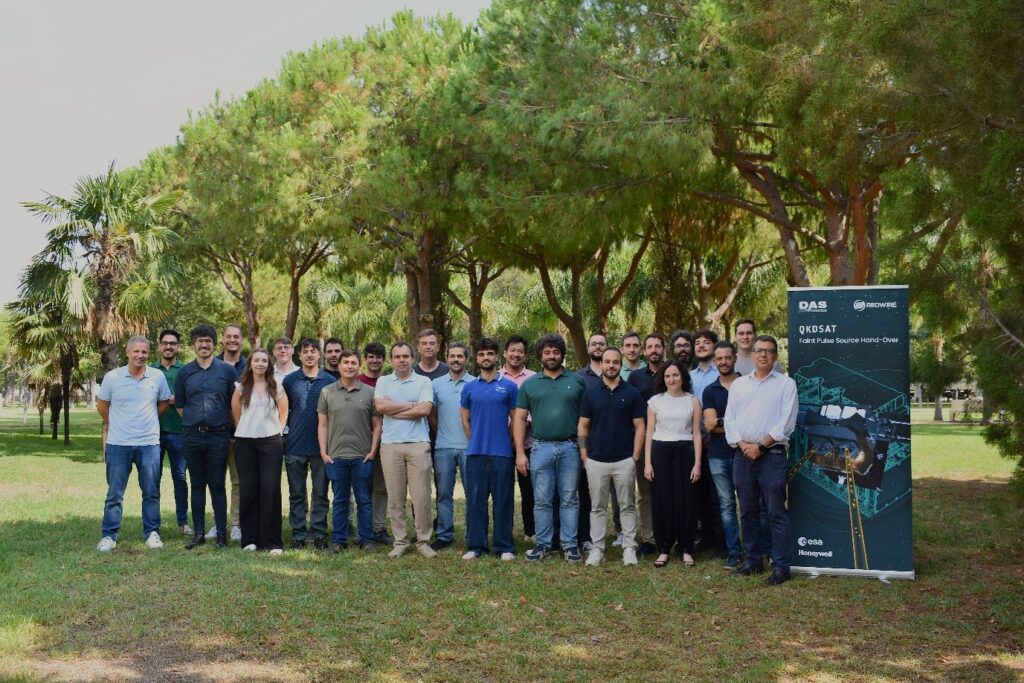
The European Space Agency’s (ESA) Quantum Key Distribution Satellite (QKDSat) spacecraft will be provided by Redwire, in Belgium, to accelerate the development of ultra-secure communication infrastructure in space. This announcement is part of a larger contract awarded to a consortium led by Honeywell UK, in September 2025.
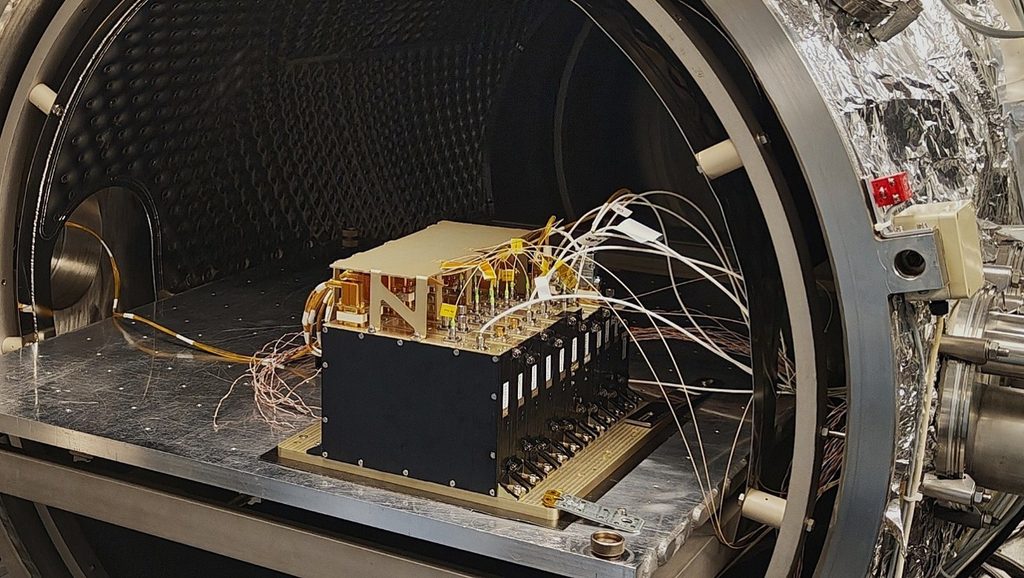
QKDSat responds to ESA’s Member States’ need for resilient, secure and sovereign communications. Image credit: European Space Agency
QKDSat, a project under ESA’s Advanced Research in Telecommunications Systems (ARTES) Partnership Projects programme, responds to ESA’s Member States’ need for resilient, secure and sovereign communications. The project aims to provide quantum key distribution capabilities via satellite to help safeguard against communication data breaches. QKD makes use of photons to generate truly random encryption keys and distribute them to relevant parties. Due to its sensitivity, the system is capable of detecting interference from attempts to intercept the quantum encryption key and immediately cease distribution to maintain security. Using satellites for this purpose will allow QKD implementation over long distances, overcoming a notable limitation of ground-based QKD systems. Redwire will manufacture and deliver the spacecraft, based on its Hammerhead platform and supported by its advanced ADPMS-3 avionics suite. In addition, the company will design the mission-critical QKD payload that will work alongside the optical terminals developed by Honeywell Canada.
“With QKDSat, we will take a leading role in ensuring resilient and secure commercial and governmental communications across our Member States, particularly against a backdrop of ever-increasing cyber threats. We look forward to collaborating closely with Redwire and partners as we utilise their high-class expertise to deliver the future of satellite communications,” said Laurent Jaffart, Director of Resilience, Navigation and Connectivity at ESA.
“Quantum secure communications is critical to the future of European autonomy. We are proud to leverage Redwire’s expertise in spacecraft development and avionics to support QKDSat,” said Marc Dielissen, Executive Vice President of Redwire Europe. “Satellite quantum key distribution enables truly global, long-distance secure communication, overcoming the range limitations of terrestrial fibre-based quantum networks.”
ESA is developing QKDSat in collaboration with a consortium led by Honeywell Aerospace, and which includes Redwire, QTLabs, Craft Prospect, British Telecom, COLT, Lumino Technologies as well as multiple participants across Europe’s space ecosystem. QKDSat convenes no less than six of ESA’s Member and Participating States, including the UK, Belgium, Austria, Canada, Czechia and Switzerland.
To provide the best experiences, we use technologies like cookies to store and/or access device information. Consenting to these technologies will allow us to process data such as browsing behaviour or unique IDs on this site. Not consenting or withdrawing consent, may adversely affect certain features and functions.
Functional
Always active
The technical storage or access is strictly necessary for the legitimate purpose of enabling the use of a specific service explicitly requested by the subscriber or user, or for the sole purpose of carrying out the transmission of a communication over an electronic communications network.
Preferences
The technical storage or access is necessary for the legitimate purpose of storing preferences that are not requested by the subscriber or user.
Statistics
The technical storage or access that is used exclusively for statistical purposes.The technical storage or access that is used exclusively for anonymous statistical purposes. Without a subpoena, voluntary compliance on the part of your Internet Service Provider, or additional records from a third party, information stored or retrieved for this purpose alone cannot usually be used to identify you.
Marketing
The technical storage or access is required to create user profiles to send advertising, or to track the user on a website or across several websites for similar marketing purposes.