ESA selects ClearSpace to advance recurring geostationary orbit servicing through Phoenix Partnership Project

Publication date

23 Sep 2026

The European Space Agency (ESA) has signed a contract with ClearSpace Luxembourg for the Agency’s Phoenix Partnership Project to advance the development of a European in-orbit servicing spacecraft and its related commercial service for satellites in geostationary orbit. The signature took place under the auspices of the inaugural communications programme board meeting of ESA’s Resilience, Navigation and Connectivity directorate.

Artist’s impression of Phoenix approaching a client satellite © ClearSpace.
Artist’s impression of Phoenix approaching a client satellite. Image credit: ClearSpace.

The new contract, signed at ESA Headquarters in Paris, France, kick-starts the next phase of Phoenix with a partnership between ESA and an industrial consortium led by Prime ClearSpace in Luxembourg, with planned contributions from Critical Software in Portugal and Spherical Systems in the Netherlands. With the overall goal of establishing the groundwork for a fully-fledged, recurring commercial service, ESA and the consortium will take key technologies to Technology Readiness Level (TRL) 5 and mature the system, platform, payload, software and ground segment through applicable Preliminary Design Reviews (PDRs).

Geostationary satellites are critical space infrastructure providing communications, broadcasting and weather monitoring services. These satellites’ operational life is often limited by the depletion of their embarked propellant, even if their mission-critical components are still operational. Consequently, in-orbit servicing capabilities enabling continued station-keeping and attitude-control manoeuvres have emerged as a crucial element to reinforce Europe’s resilience in space. Such services could also reduce the need for expensive replacement satellites, helping to preserve industrial and launch capacity.

To fulfil this strategic capability, the Phoenix Partnership Project consolidates several existing collaborations and offers continuity under the banner of a single European service. The consortium will build on system definition and requirements outlined in the project’s previous phase to realise its baseline concept: an innovative, non-intrusive docking interface, compatible with satellites not initially conceived for life-extension.
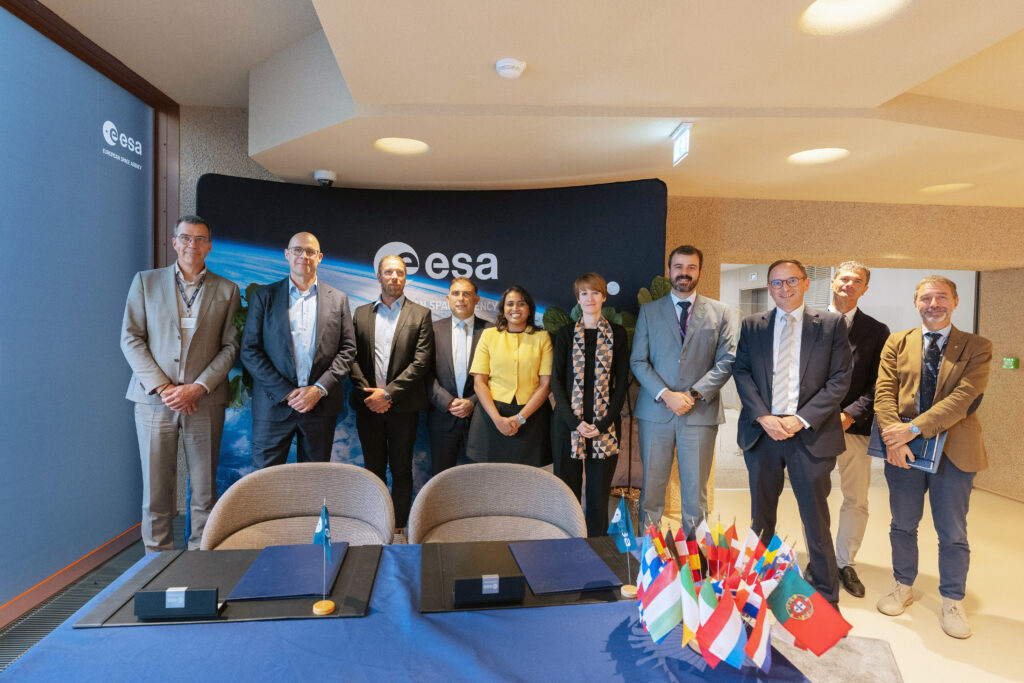
Phoenix is supported by several ESA Member States, including Luxembourg, The Netherlands, and Portugal. Pictured with the ESA and ClearSpace teams are Bert Meijvogel of the Netherlands Space Agency, Gaëlle Jimenez of the Luxembourg Space Agency (sixth from left), and Tiago Peres of the Portuguese Space Agency (seventh from left). Image credit: ESA

The project brings together several existing investments, advancements and strong relationships, including the Luxembourg Space Agency’s (LSA) LuxIMPULSE programme, funded by LSA and implemented by ESA under Article 9.2 of the Agency’s Convention. The project leverages the initial mission and docking-system baselines defined by LuxIMPULSE, as well as ClearSpace and Critical Software’s experience working on ongoing European servicing missions including ClearSpace-1, CLEAR and PRELUDE.

The Phoenix Partnership Project is implemented by the ESA Resilience, Navigation and Connectivity directorate’s Space Resilience Office and co-funded by the Agency’s Advanced Research in Telecommunications Systems (ARTES) Industrial Competitiveness programme line, with ClearSpace providing the remaining industry contribution. The ARTES investment and its support framework will help to de-risk the maturation and development of the technologies at the heart of the servicer’s mission.

The Phoenix end-to-end architecture combines a spacecraft platform with a servicing payload developed by ClearSpace, featuring the mission-critical docking system and guidance, navigation and control (GNC) subsystem. The programme also foresees contributions from Critical Software and Spherical Systems for payload flight software and robotic control electronics respectively. In addition, the partnership project includes development of ground segment for mission operations and navigation functions.

The structure of the partnership project will enable the consortium to mature the assembly, integration and verification procedures (AIV) strategy, procurement baseline and overall industrial capabilities required for subsequent implementation and ultimately for the establishment of a recurring commercial servicing capability in geostationary orbit.
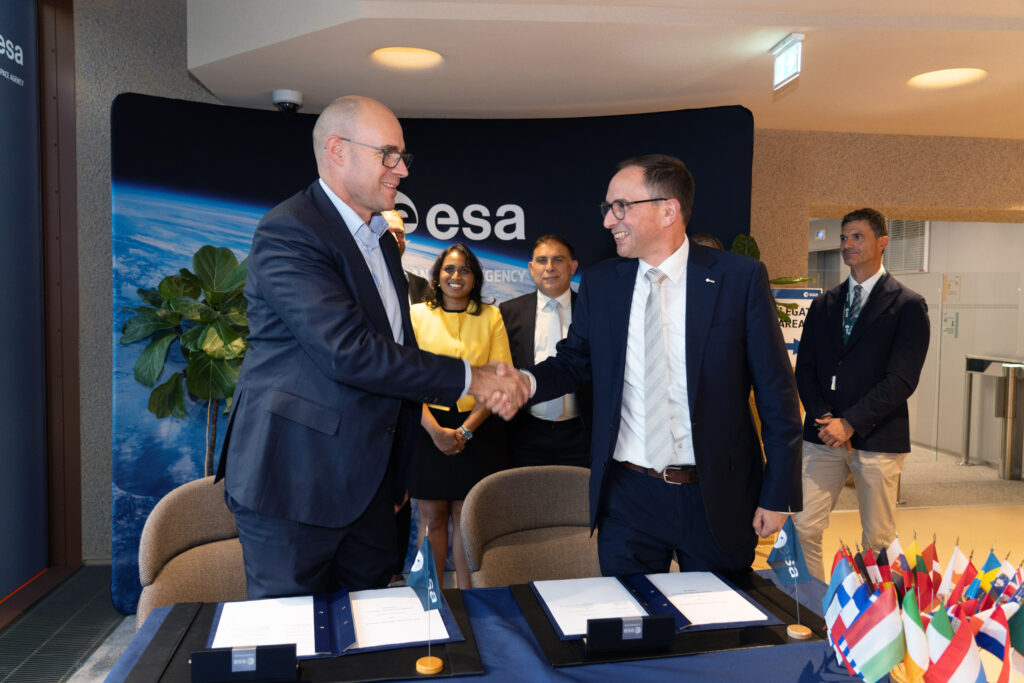
Director of Resilience, Navigation and Connectivity, Laurent Jaffart, signed the agreement with Luc Piquet, CEO and co-founder of ClearSpace. Image credit: ESA

Laurent Jaffart, Director of Resilience, Navigation and Connectivity at ESA said: “ESA is dedicated to helping Europe build the capabilities needed for the next generation of in-orbit services. In cooperation with our Member States and European industry, we’re taking Phoenix to the next level by working to mature the dual-use technologies that will deliver clear benefits for sustainability, resilience, and the competitiveness of Europe’s space sector. Together, we will strengthen our position in this emerging market.”

Luc Piguet, CEO and co-founder of ClearSpace, said: “Phoenix is the result of a shared ambition to make in-orbit servicing a practical and valuable capability for satellite operators. We are deeply grateful to ESA, to Luxembourg and the Luxembourg Space Agency, and to the Member States whose continued commitment to European space capabilities has made this progress possible. Their support has allowed ambitious ideas to be transformed into technologies, missions and increasingly tangible services. We are fully committed to the mission: working with ESA, its Member States, our industrial partners and our customers to build a safe, competitive and commercially sustainable European in-orbit servicing capability.”

The technology, flight heritage and operational experience established through the Phoenix commercial service are intended to pave the way to further in-orbit logistics applications. In particular, the core rendezvous and docking capabilities could be extended to relocation, inclination correction, end-of-life disposal, inspection and bring-into-use services and, in the longer term, refuelling and other servicing capabilities.

First-of-its-kind optical ground station commissioned in Luxembourg to demonstrate international quantum-secure communications 

Publication date

26 Jul 2026

A new optical ground station (OGS), developed under the European Space Agency (ESA) and built by HITEC in a consortium led by Starion Luxembourg, has been commissioned in the presence of Luxembourg’s Ministers of Economy and Defence, Lex Delles and Yuriko Backes, the Luxembourg Space Agency, and representatives of ESA.

The optical ground station (OGS), which is located in Windhof, Luxembourg, will test an ultra-secure, international communications network using Quantum Key Distribution (QKD). Image credit: Starion Luxembourg/HITEC

The OGS, located in Windhof, Luxembourg, will help to test an ultra-secure, international communications network using cutting-edge Quantum Key Distribution (QKD) and Post-Quantum Cryptography (PQC) technologies. The purpose-built network is designed to address Europe’s strategic imperative to elevate its institutional and commercial cybersecurity.

Developed by ESA’s International Use cases for Operational QKD Applications and Services (INT-UQKD) partnership project, through the Agency’s Advanced Research in Telecommunications Systems (ARTES) programme, the OGS is part of a solution addressing two challenges to current space-based communications. On the one hand, the Radio Frequency (RF) spectrum, widely employed for satellite communications, is vulnerable to disruption and interception. On the other, the advent of quantum computing poses an urgent risk to cryptographic techniques used to secure critical terrestrial and space-based data communication services and IT infrastructure.

This technological vulnerability to telecommunications poses a clear socio-economic risk and underlines the strategic importance of securing satellite communications from current and future threats. In order to achieve an elevated degree of security and safeguard communications against quantum computers, INT-UQKD integrates both QKD and PQC into existing communications networks. This integrated approach will help to remove single points of vulnerability and increase resilience against complex attempts to disrupt or intercept encryption keys.

Representatives from Sopra Steria (owners of Starion Group), the Department of Media, Connectivity and Digital Policy (SMC) of the Luxembourg Ministry of State, ESA, and the European Parliament, were also present during the commissioning. Image credit: Starion Luxembourg/HITEC

QKD services offer a strong layer of security by creating encryption keys using the quantum properties of light. These keys are established between two trusted ‘nodes’, allowing them to respectively encrypt and decrypt the information. Whereas this can be done over land via optic fibre, applying this method across oceans requires satellites to be used as trusted nodes connected by laser terminals in lieu of fibres.

The Windhof OGS boasts a versatile design tailored to QKD and optical satellite communications. Rather than adopting alt-azimuth or equatorial mounts, traditionally employed for optical astronomy equipment, the OGS adopts an X/Y axis design carried over from HITEC’s work on RF ground stations. This design is more advantageous for tracking fast-moving satellites in the sky, in particular at low angles of elevation over the horizon. In addition, this mount helps to overcome a reversal in the polarity of the optical link which occurs as the satellite reaches its zenith, a specific challenge for optical communications that is resolved by allowing the optical terminal to rotate accordingly. The OGS will test this configuration in tandem with the experimental SpeQtral-RAL Space Quantum Communications Satellite, launched in late 2025, to establish a QKD link with Singapore and demonstrate its practicality for commercial applications.

INT-UQKD represents the convergence of multiple areas of technical expertise under ESA’s Advanced Research in Telecommunications Systems (ARTES) 4.0 programme: it is implemented as a partnership project with industry, as part of the Space Systems for Safety and Security (4S) strategic programme line (SPL), and managed by the Optical and Quantum Communications – ScyLight SPL. This project is the fruit of an international collaboration between ESA and the Luxembourg Space Agency (LSA), the Belgian Science Policy Office (BELSPO), the Canadian Space Agency (CSA), with contributions from SpeQtral and the National Space Agency of Singapore (NSAS). The latter have financed and managed the space segment of this project.

The commissioning of the Windhof OGS is part of the first phase of INT-UQKD, supported by POST Luxembourg, HITEC (Luxembourg), the Interdisciplinary Centre for Security, Reliability and Trust (SnT) of the University of Luxembourg, evolutionQ (Canada) and SpeQtral (Singapore). In this phase, the project will deploy a standalone hybrid terrestrial and space quantum communication infrastructure across Luxembourg, Belgium and Singapore to demonstrate a QKD service on a global scale.