PAGE CONTENTS
Objectives
The main objectives of the project are:
• System and software architecture definition and development as well as system operation and validation.
• System requirements definition and management.
• Antenna solutions with smallest possible size accordingly to the desired data rate.
• BiCMOS semiconductor technology upgrade to enable lower cost, smaller size, lower power consumption of NTN phased array antennas
• RF front-end beamforming ICs based on upgraded BiCMOS technology. Prior to that chipset version, a first test chip for manufacturing tests of the RFIC front-end will be available at the end of technology phase 1.
• Beamforming techniques and associated beamformer chipset solutions,
• Network Access Devices (NAD) solutions for NTN with focus on 3GPP based technology and terrestrial 5G as well as their corresponding roadmaps.
• Seamless transition solution between a terrestrial network and a non-terrestrial network and vice versa.
• Car integration solutions and procedures for passenger cars including cooling concept and power consumption analysis.
Benefits
User terminals for satellite communication with phased-array antenna in Ku-band are already state-of-the-art in other areas. The development of the next generation automotive user terminal covers the following advantages:
- 5G-like data rate with seamless transition between TN and NTN
- High flexibility for vehicle integration due to its optimized compact design.
- Optimised cooling solution to enable reliable performance in hot environmental conditions.
- Enabling communication in the car and autonomous driving in areas without terrestrial network coverage
Features
Product component and subsystem capabilities:
- Network access device hosting a modem chip which includes 3GPP Rel.18 NTN standards in the 10 to 14 GHz Ku-band.
- Beamforming subsystem including microcontroller to combine satellite system data from almanac and ephemeris data with vehicle information like speed, tilting, rolling and turning information, to ensure best possible link from UE to satellite.
- Small phased array antenna including new BiCMOS RF Front end IC with following features:
- 8x Channel Rx + Tx
- Wafer Level Packaging
Challenges
Main design challenges:
• 3GPP based NAD solution
• Targeted small size for NTN module 20 cm x 20 cm x 3 cm
• One aperture for Rx and Tx fulfilling the specifications (e.g. G/T)
• RF front ends design with lowest possible NF for the RF frontends
• Overall low power consumption (≤25W)
• Cooling concept and operation temperature up to 95°C
• Coexistence of all services
• Seamless transition between TN and NTN
Car Integration:
• Overall space/size needed
• Temperature at mounting position
• Fixation and cooling concept
• Vibration and inclination
Drive tests:
• Use case evaluation
• Car measurements
System Architecture
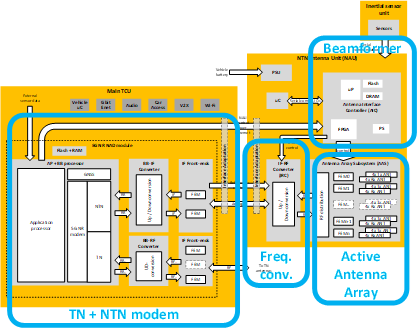
The system is based around a state-of-the-art Telematics Control Unit (TCU). Such units use Terrestrial Network (TN) modems to provide wireless Internet connectivity at frequencies under 6 GHz. The modem features are expanded to include 3GPP Rel.18 NTN standards in the 10 to 14 GHz Ku-band. To maximize achievable data throughput, an antenna beamforming architecture is employed.
TCU parts relevant to satellite communication are shown in the diagram.
- Active antenna array
This a network of hundreds of antenna elements, arranged in groups and fed by amplifiers whose individual gain and phase shifts can be programmed. When summed together, the antenna signals produce a narrow, steerable beam.
- Beamformer
This calculates where to focus the beam and based on this, the gain and phase parameters used in the amplifier array. For this, information about the satellite’s trajectory, together with the vehicle’s orientation is processed.
- Frequency Converter
Conversion between the carrier frequency used by the modem and the one used in the satellite link takes place here.
- TN + NTN modem
This is a chipset implementing the signaling and communication protocols used in 3GPP TN and NTN systems. It provides standard network and audio interfaces.
Plan
The current Technology Phase (T1) aims to mitigate risks for the future Technology Phase (T2) and Product Phase by defining the requirements and characterising a prototype based on COTS parts to support the design of the first version of the terminal.
To meet the defined project milestones, sub-milestones are defined for the terminal development on hardware, system and software levels. On RF front end development, sub-milestones are defined for the RF IC design and development, as well as for the BiCMOS technology upgrade.
Current Status
In the current phase of the project; the following achievements have been accomplished:
– Set-up of the link budget calculation
– Definition of the antenna element and phased array antenna design concept as well as first evaluations have been completed
– Identification of the specifications for RF front-end IC
– Kick-off of the RF FEM architecture and design
– Definition of the system architecture including beamforming technology
On-going work packages are related to the following items:
– Terminal evaluation assembly
– RF component evaluation
– BiCMOS; technology upgrade
Feasibility studies including mechanical, electrical design, software feature development and integration for the next generation automotive user terminal are carried out throughout the project.