PAGE CONTENTS
Objectives
The objective of this project is to design, develop and validate through testing a real-time scaled demonstrator of a regenerative digital processor that supports Non-Terrestrial Network 5G/6G waveforms for direct satellite-to-device communications.
We target power efficiency, high throughputs, manufacturability, the use of COTS elements and deployment in LEO space environments.
Benefits
The targets of the D2SAT demonstrator are:
- TRL 5
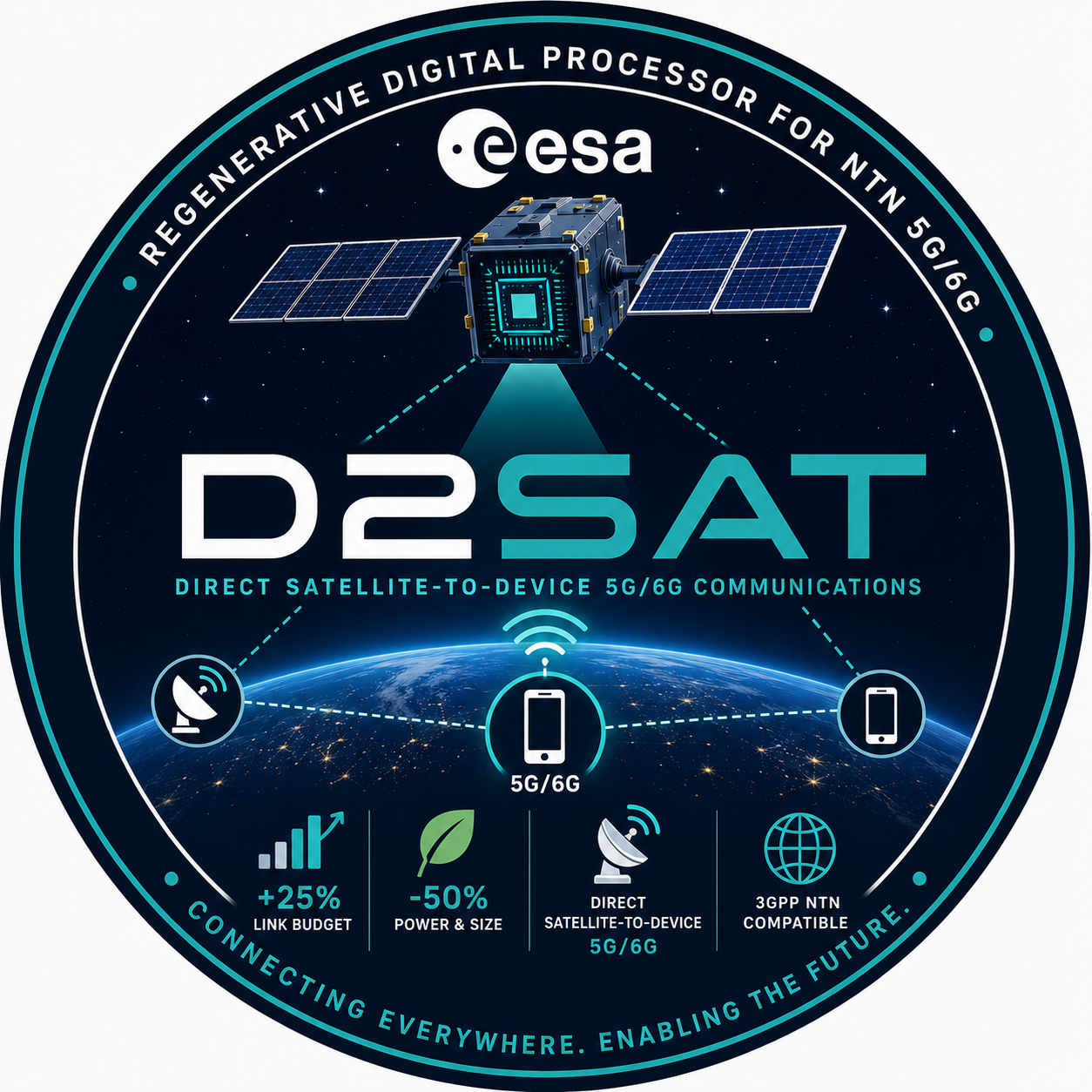
- 25% improvement in link budget.
- 50% reduction in power consumption and size.
- Advanced 3GPP Non-Terrestrial Network features.
- High-throughput dynamic scenarios
- Realistic channel conditions
- Demonstration of compatibility and real-time demonstration of a digital beamforming IC.
The main task of the demonstrator is to validate critical elements of the regenerative processor technology. The ultimate goal is to test the regenerative transponder in a multi-beam, multi-user, realistic and dynamic use-case set-up.
Features
- Real-Time TRL 5 demonstrator: The projects designs and validates a regenerative transponder supporting 5G/6G Non-Terrestrial Network use-cases for LEO satellites.
- Advanced NTN features: The project implements and demonstrates advanced 3GPP features tailored to non-terrestrial networks.
- Hybrid FPGA–GPP Architecture: We adopt a heterogeneous architectural approach, mapping different processing components to the most suitable hardware platforms.
- Dynamic Resource Allocation: We design and validate algorithms for dynamic user allocation across the time–frequency grid, targeting an estimated 30% gain in link budget.
- Beam Hopping, Steering, and Switching: We design and validate advanced beam management techniques, aiming to achieve improvements of up to 20% in power consumption and 30% in link budget compared to static beam configurations.
- Realistic Channel Modelling: We incorporate accurate models of NTN fading, Doppler effects, and inter-beam interference, enabling reliable validation of link budget enhancements and realistic user equipment behaviour.
Challenges
The D2SAT consortium, led by Antwerp Space and complemented by AccelerComm (UK), Lasting Software (Romania) and Imec (Belgium), is uniquely positioned to solve the critical challenges of direct satellite-to-device 5G/6G communications, including link budget, power consumption, 3GPP compliance and payload size—barriers that currently prevent viable 5G/6G communication through Non-Terrestrial Networks.
- Antwerp Space contributes with low-power SDR expertise and regenerative payload design, essential for minimizing energy demands and maximising spectral efficiency.
- AccelerComm’s L1 solutions offer compact, high-performance processing across FPGAs, AI engines, and CPUs.
- Lasting Software ensures lean, reliable L2/L3 implementations and emulation tools tailored for the Non-Terrestrial Networks environment.
- Imec complements the stack with intelligent resource allocation and beam management, optimizing system performance within tight power and size constraints.
Together, this consortium delivers a scalable, competitive architecture that unlocks true 5G/6G connectivity from space.
System Architecture
In the proposed hybrid architecture, the layers 2/3 (L2/L3) processing and layer 1 (L1) processing run on different devices. This is a deliberate design choice aimed at maximising performance.
Functionalities of the L1 (physical layer) account for a large share of the processing load, which makes them well suited to hardware acceleration in an FPGA. L2/L3 processing contain non-deterministic processing and more network adaptation – in this project, they are mapped on a GPP processor.
Plan
The project is planned for a duration of 26 months, starting with a kick-off in April 2026.
Key milestones include reviews on System, Design, and Testing. We close the project with a Final Review. All milestones are done in close collaboration with ESA.
The milestones cover requirements definition, preliminary and detailed designs, system implementation, and test readiness. The final stage consolidates results, assesses TRL, and outlines the industrialisation roadmap.
Current Status
D2SAT starts activities in Q2 2026.
Related Links
Companies