PAGE CONTENTS
Objectives
The project is to develop a unique laser source operating at a wavelength of 2.1 µm for optical free-space communication (FSO), primarily designed for long-distance ground-to-space communication links and to demonstrate its user benefits. Currently, commercially available FSO systems utilise standardised wavelengths like 1064 nm and 1550 nm, but the introduction of a laser at 2.1 µm offers significant advantages, namely:
- Lower attenuation in propagation in the Earth’s atmosphere due to lower absorption and scattering, under optically difficult conditions: rain, fog, dust, snowfall, etc;
- Lower fluctuation in atmospheric propagation delay and beam propagation, due to the lower atmospheric refraction index;
- Lower background photon flux caused by Solar radiation and its scattering in the atmosphere (crucial for quantum optical communication);
- Higher bandwidth of the transmitted data.
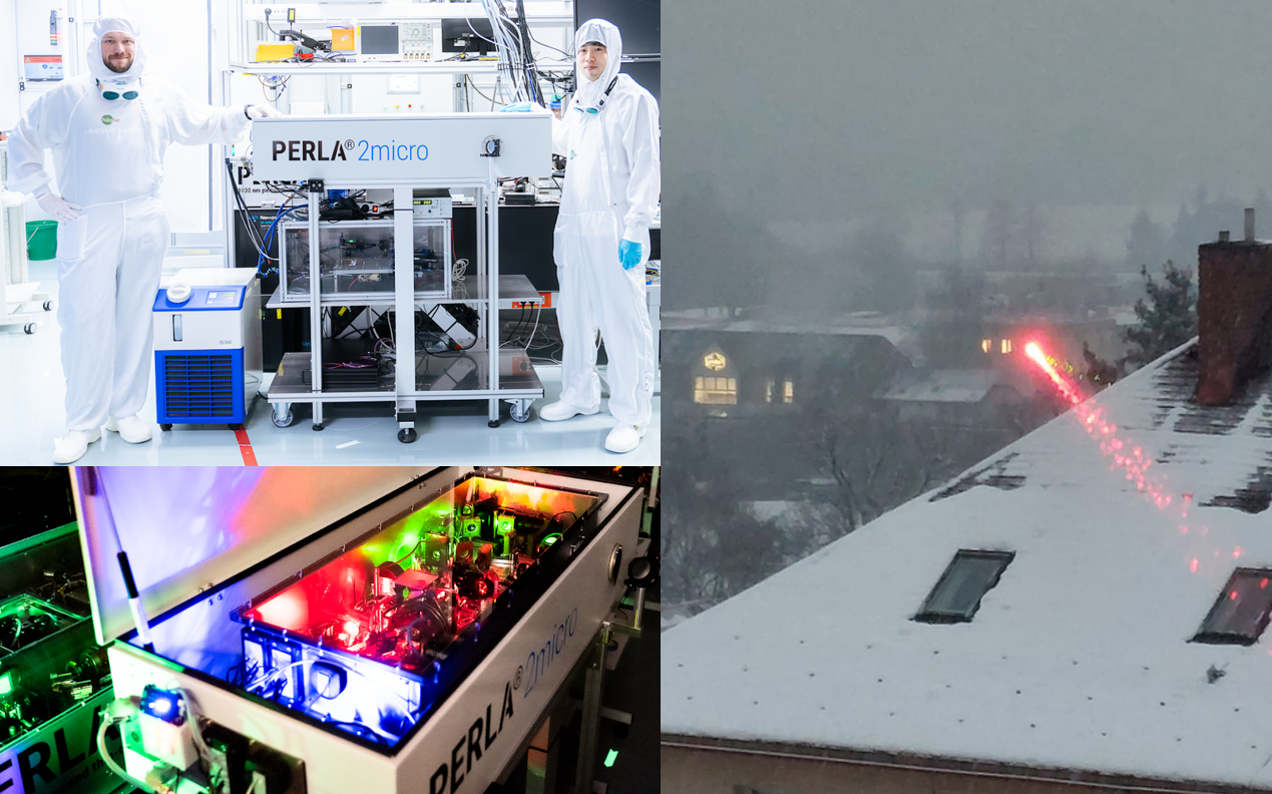
This innovation is proposed to experimentally explore and enhance the reliability and efficiency of future ground-to-space and potentially also the space-to-ground communication networks with the new 2.1 µm laser technology. The project sets a task to develop the laser source technology and to experimentally quantify the advantages of the longer wavelength laser radiation at 2.1 µm by comparing it with optical communication at conventional wavelengths.
Benefits
One of the most important benefits of the developed laser system is the unconventional wavelength range at 2.1 μm. In the most cases about 1064 nm or the C and L band (with about 1550 nm) are used for optical data transfer. The 1550 nm is widely used in fiber communication, due to the low loss rate.
Nevertheless, this is not necessarily true for free space communication. In a previous ESA-founded study, we were able to show, that the 2.1 μm has a lower attenuation in propagation in the Earth’s atmosphere due to lower absorption and scattering, under optically difficult conditions: rain, fog, dust, snowfall, etc. In addition, the lower refractive index also lowers the fluctuation in atmospheric propagation delay and beam propagation. Furthermore, the lower Solar radiation at this wavelength leads to a lower background photon flux (which could be crucial for quantum optical communication). We believe that all these benefits allow a higher bandwidth for data transmission.
In addition, the fiber- and solid-state-based system allows for high-power (40 W and more) while keeping a single-mode operation. This enables a stable link, even for extreme distances like deep space communication.
Features
In the realm of the ELSA21 project a hole transmission system is developed. The core part of this system is a laser system. This setup allows:
- High-power (40 W and more) modulated laser output;
- The generation of the high-power in a single-mode operation;
- The modulation of the seed laser, to enable data transmitter rates up to 10 Gbps;
- The possible use of the seed laser with fiber-amplifier in satellites for space-to-ground communication;
- 2.1 μm wavelength range operation (which is not only beneficial for the data transfer rate, but also necessary for the safety of the system. The 2.1 μm wavelength lies in the so-called “eye-safe” region, which ensure a higher level of laser safety).
Furthermore, the task of the project is not only to design and build the laser system, but to develop a complete system from light generation, over transmission to detection, including the data transferer layer. This ensures the functionality of data transfer and shows that it is possible to use the unconventional 2.1 μm wavelength region for communication.
Challenges
One of the biggest challenges is the wavelength of the system. The number of commercially available and suitable modulators, photodetectors, cameras and other needed parts at 2.1 μm are limited or they must be developed as part of this project. That also increases the challenge of modulating the laser in the tens of GHz region, which is needed for a data transfer rate of up to 10 Gb/s. The relative high modulation frequency bandwidth is crucial for the success of the product. Furthermore, the aspiration of TRL6 in combination with the high-power laser is another challenge of the project.
System Architecture
The system developed in the realm of ELSA21 project consists not only of a modulated high-power single-mode laser system but also of a transmitter, a receiver and a demodulator. The task is to build a transmitter for the 2.1 μm laser output, send it through different weather conditions (like, fog, rain or snow) and collect the light several kilometres away. On the receiver side the light is detected and the data extracted.
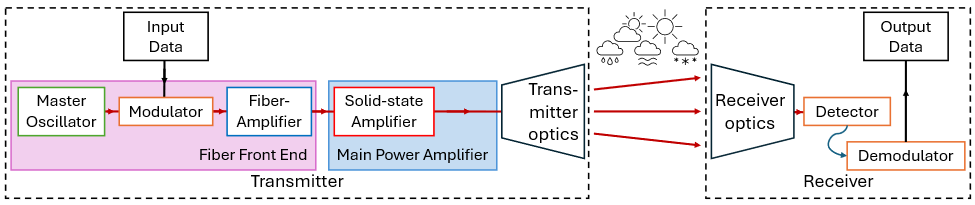
The heart of the system is the laser system, which can be split into a modulated seed-laser and a amplifier system. The seed-laser is modulated by a electro-optical modulator and pre-amplified in a Ho:fiber. The modulator is able to encode data up to 10 Gbps. The light is then further amplified in a solid-state amplifier, which is developed and build completely in this project (including the Ho:YAG rod). The project sets the task to build the whole product at TRL6 level, which means it runs in a relevant environment (outside of a laser laboratory) and is able to withstand different environmental conditions.
Plan
In the first step we design the architecture of the system. In the following steps we develop and produce the prototype of the fiber frontend and the main amplifier. This also includes the fabrication of the rod itself. After we produced the core components of the system, we are implementing the data transferer layer (inclusive FPGA) and the assembled transmitter optics. In addition, we design and produce a receiver inclusive optics. In the last step we demonstrate the laser in real weather (e.g., snow, rain, fog) environment over several kilometres (ground-to-ground).
Current Status
The ELSA21 project was kicked off in January 2026, and the first milestone was completed in June 2026.
The general design of the laser system is defined, as well as the demonstration test procedure. In the next month we will work on the realisation of the fiber amplifier, and the Ho:YAG rod-based solid-state amplifier. Furthermore, we are planning to start the production of the transmitter and receiver. In addition, we will realise the general data transfer layer.