PAGE CONTENTS
Objectives
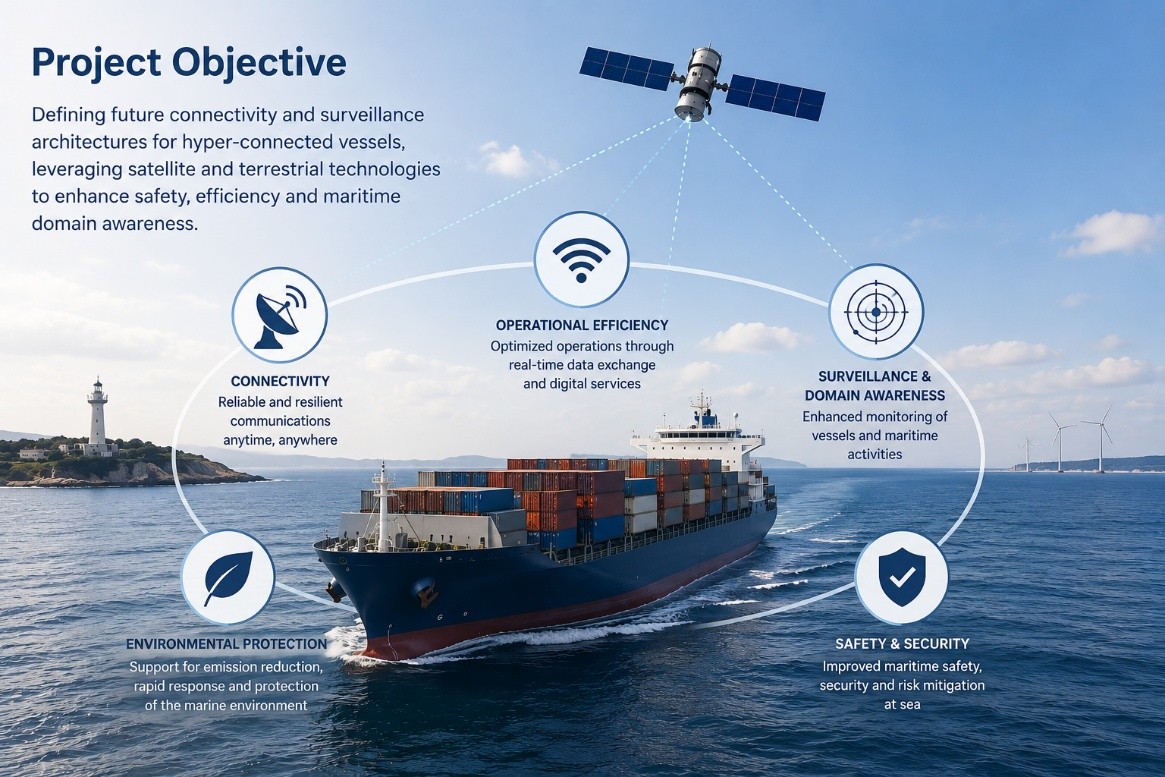
The project aims to define effective and competitive infrastructure architectures for a system of satellite communication systems supporting hyper-connected vessels. The study addresses European regulated and commercial maritime connectivity needs, including communication services and maritime domain awareness, with a focus on mid-term and long-term requirements.
The activities cover the analysis of maritime market segments, vessel categories, communication and surveillance technologies, user and mission needs, reference scenarios and use cases. The project also assesses technical, economic and regulatory aspects to identify suitable technology baselines and development roadmaps. The outcome supports the definition of future European capabilities for maritime safety, operational efficiency, strategic autonomy and competitiveness in the satellite-enabled maritime connectivity domain.
Benefits
The project supports the identification of future European satellite-enabled architectures capable of improving maritime connectivity, safety and domain awareness. The expected benefits include stronger European positioning in next-generation maritime connectivity, improved support to maritime safety, enhanced remote vessel monitoring, increased strategic autonomy and new opportunities for European industry.
The study also contributes to environmental protection by assessing capabilities relevant to rapid monitoring and response, where applicable within the project scope. In addition, it supports the evolution of connected and autonomous vessel operations by clarifying user needs, technology gaps and potential system benefits across different vessel segments and operating contexts.
Challenges
The maritime sector includes heterogeneous vessel categories, operating environments and connectivity needs. No single existing space system fully addresses all current and future requirements. The project therefore addresses the challenge of defining a coherent system-of-systems architecture across legacy and emerging technologies, while considering different time horizons, user needs, regulatory constraints, surveillance scope limitations and feasibility aspects such as dark vessel detection.
Plan
The project is structured as a phased study running from the kick-off in June 2026 to the final review in 2027. By Q3 2026, the project focuses on consolidating the market context, maritime segments, user and mission needs, reference scenarios and preliminary communication and surveillance requirements. By Q4 2026, the study will progress towards the definition of the technical specifications and the assessment of candidate connectivity and surveillance architecture options.
In early 2027, the preferred technical baseline is assessed from a feasibility, economic and regulatory perspective, including cost-benefit considerations. The final phase consolidates the technology development roadmap, deployment model and programmatic recommendations for future European hyper-connected vessel capabilities.
Current Status
The project has officially started, with the Kick-off Meeting taking place on 12 June 2026.