PAGE CONTENTS
Objectives
The main objective of the project is to provide a distribution module aimed for protecting power buses devoted for powering RF amplifiers elements within an active antenna. A latching current limiter (LCL) is implemented between main power buses and the active element. Thanks to the use of Gallium Nitride (GaN) technology and digital control, a switching LCL can be developed providing unpreceded performances in terms of voltage drop, reaction time, limitation levels and parameters programmability like current limitation and trip-off levels.
Benefits
IDEAA provides the means to increase by a factor of two the distribution density, i.e. number of distribution elements in a certain amount of volume.
It provides unpreceded flexibility in the protection parameters, allowing to change trip-off time and current limitation on the fly.
Last, but not least, IDEAA provide very low output impedance in a wide range of frequencies to provide high power buses quality.
Features
- Programmable current limitation
- Programmable trip-off time
- Low output impedance
Challenges
Main challenges of the project are:
- To provide low voltage drop Latching Current Limiters (LCL)
- To reduce LCL output impedance
- To allow flexibility in the LCL parameters (limitation current and trip-off time)
- To increase the number of LCLs per module in order to increase the distribution density
System Architecture
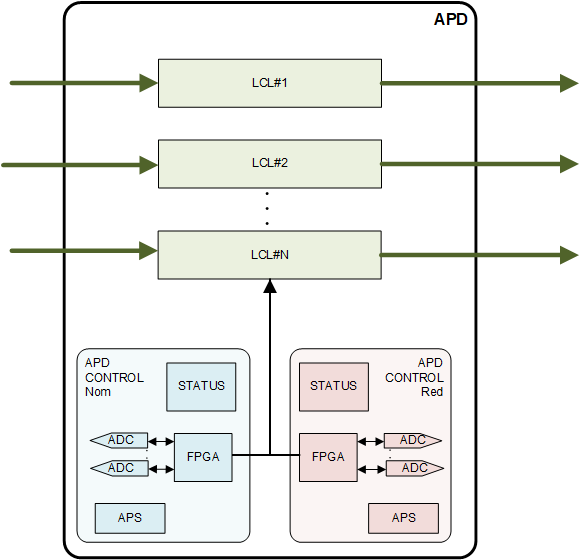
The following figure shows the high level IDEAA module architecture:
Plan
The project is divided in 3 phases:
- Phase I. Concept / Architecture. Up to RR.
- Phase II. Design. Up to PDR.
- Phase III. EM MAIT. Starts with EM MRR and finish with EM DRB
Current Status
The project is complete.
Airbus Crisa has successfully validated the IDEAA-APD Engineering Model, demonstrating a next-generation power distribution architecture for satellite applications. By utilizing GaN technology and digital control, the module provides 22 independent LCL nodes, achieving a 50% reduction in mass and cost compared to legacy systems.