PAGE CONTENTS
Objectives
The aim of the project Sat-DQC is to assess the potential of DQC enabled by satellite links. More specifically, the project addresses the question whether and how quantum computing capabilities can be improved by interconnecting quantum processing units (QPUs) via satellites. An important goal is finding suitable applications, quantum algorithms, and quantum computing platforms (e.g., trapped ions, neutral atoms, photonic circuits), DQC based on analysing the available literature.
In particular, the restrictions imposed by the satellite links are considered and the expected performance of the QPUs, the algorithms, and the satellite links for DQC is assessed via simulations. As one particular DQC use case, we investigate a small-scale demonstrator mission of satellite-enabled blind quantum computing (i.e., a client executing a computation on a remote quantum computer in an encrypted way). The final objective of the project is to set up a development plan describing the further steps necessary to achieve application-oriented DQC via satellite links.
Benefits
Our study and our simulations allow to evaluate the feasibility and the required resources of satellite-enabled DQC. In particular, we investigate the required methods and hardware components. Furthermore, our research allows to assess the expected amount of entanglement that can be provided by connecting quantum devices via satellite links. Based on these measures, the expected performance of DQC algorithms can be investigated. Bottlenecks in currently existing methods and devices are identified and our study aims at revealing necessary technology developments. As a particular application of spaceborne DQC, we consider Blind Quantum Computing to protect intellectual property during a remote access to a quantum computing centre.
In particular, we focus on a small-scale demonstration of a blind Grover’s search is evaluated for its feasibility and performance. There, a client of limited quantum computing power uses a remote quantum-computing server to find an item in a database, without revealing this item to the server. For ground stations across Europe, in particular in Oberpfaffenhofen and Nice, we find that the necessary entanglement for implementing this demonstrator calculation can be distributed with almost certainty within one satellite pass.
Features
The main components of our study are on the one hand a literature survey of hardware and algorithms for DQC and of satellite links for entanglement distribution. On the other hand, we perform small-scale simulations of DQC algorithms and of entanglement distribution via satellite links. The literature studies allow to identify promising DQC applications and algorithms, as well as possible hardware implementations, and possible configurations of satellites for entanglement distribution.
Furthermore, we analysed the current knowledge about entanglement distribution via satellite and the required entanglement resources of DQC. The simulations additionally provide an assessment of the amount of entanglement that can be distributed by satellite links of different configurations, and an evaluation of the necessary amount of entanglement for different DQC algorithms and setups. This finally allows to assess the overall performance of distributed quantum computing systems with satellite links.
Challenges
Key challenges are the low technology readiness level of DQC and satellite-based entanglement distribution. Despite realising both elements separately, no full-system implementation of DQC via satellite has so far been achieved. In particular, the performance of components for DQC and their interplay needs to be investigated. Thus, identifying the requirements and developing tailored protocols, software, and hardware are important challenges. In addition, efficient interfaces between different physical systems (e.g. photons and neutral atoms) need to be designed. Furthermore, as entanglement distribution rates via satellites are likely rather low, efficient and scalable DQC algorithms are required.
System Architecture
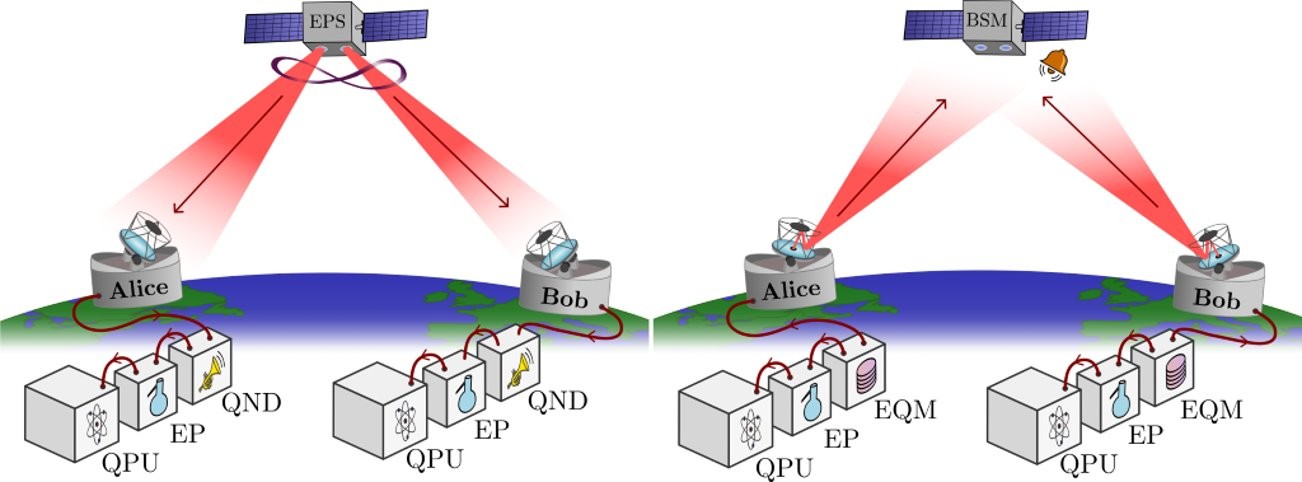
The project does not cover the development of actual hardware, but the conceptual design and analysis of possible architectures and use cases for distributed quantum computing. The focus lies on two ground stations connected via a single satellite link. In the particular use case of a blind Grover’s search, one of the ground stations (the client) can only perform measurements, whereas the other hosts a full-fledged quantum processing unit. For the satellite link, different orbits and entanglement distribution schemes are analysed.
A promising setup is a satellite constellation in medium earth orbit (MEO) with downlinks (satellite-to-ground) and inter-satellite links, since this architecture allows to reach arbitrary points on Earth via only two satellites, thus minimising losses. On ground, different quantum computing platforms are evaluated. These show different abilities and impose different requirements on the interfaces between matter qubits and photons, and also on the timescales, on which entanglement needs to be provided. Neutral atoms, trapped ions, photons, and NV centres were found to be suitable platforms for satellite-enabled DQC, whereas superconducting circuits operate on shorter time scales than satellite-based entanglement distribution and thus would need additional components.
Plan
The project starts with surveying and assessing the available literature on quantum computing platforms, algorithms and use cases for DQC and satellite-based entanglement distribution. Building on these, suitable performance measures of the most promising DQC algorithms and entanglement distribution schemes are identified, based on the necessary/achievable amount of entanglement. These are then used to simulate DQC applications enabled via satellites, and to evaluate their feasibility and expected performance. The final step is the summary of the results into a development plan, providing a specification of the parameters that need to improve for useful DQC.
Current Status
The project started in March 2025 and has been completed in August 2026.
As the first steps, an in-depth evaluation of the state of the art of hardware, algorithms and satellite-based entanglement distribution for DQC was performed.
Building on this, a small-scale demonstrator mission implementing a blind Grover’s search has been proposed, and its technical specification and expected performance have been evaluated, showing the principle technical viability of the necessary entanglement distribution for such a mission. The project concluded with a development plan that collects the necessary development steps towards this demonstrator mission and towards useful DQC in the future.
Related Links
Companies