


PAGE CONTENTS
Objectives
The primary objective of this activity is to deliver a 5G reference User Equipment (UE) which implements a 3GPP rel. 17 standard compliant protocol stack and, in particular, the NR NTN enhancements. This is intended to allow UE manufacturers to accelerate the timescales of their related developments by assessing and potentially incorporating the reference IP core into their overall 5G UE development and test programmes. The reference IP Core is designed to provide portability across different platforms (e.g., Processor, FPGA, ASIC).
An investigation of state-of-the-art architectures is performed, with a baseline reference UE being delivered utilising Viavi’s IP software which builds on actual proven market implementation.
To explore the portability of the protocol stack, time and performance-critical elements of the NTN stack in the Software IP Core are identified and ported to an FPGA implementation.
The reference UE is validated in a test environment that reflects a real 5G Terrestrial/Non-Terrestrial Network operation.
Benefits
The Benefits of this product include:
• A Reference UE available in a timely manner to suit UE manufacturers and their pace of development.
• A faithful non-customised 3GPP rel. 17 NTN implementation which UE manufacturers can build upon quickly.
• A Reference UE with sufficient configurability to support different UE types and scenarios/use cases.
• A solution that enables further porting of the protocol stack implementation to other platforms.
Features
A Reference IP core providing a full stack supporting both terrestrial and non-terrestrial networks and 3GPP release 17.
Reference UE delivering a prototype user equipment that can be used to test various TN/NTN scenarios.
Core features include:
• Modality: support both terrestrial and non-terrestrial connection
• Satellite orbits: support both GEO and LEO satellites
• Frequency bands: use FR1 frequencies with 20MHz bandwidth
• Throughput: targeting high throughputs up to 100Mbps
• Modularity: modular architecture, with clear interfaces and functionality split between the NTN stack integration with UE components
Challenges
3GPP Release 17 incorporates key approaches to managing timing and doppler compensation which places technical demands on UE protocol stack implementations. A compliant implementation is required.
3GPP NTN specifications evolve over time and UE implementations must be maintainable from both technical and commercial aspects.
Production of widely applicable technology to support UE manufacturers places demands on the level of portability, e.g., to different processing platforms for different UE purposes.
Achieving a processing solution that delivers broadband throughputs within the context of satellite channels is a technical challenge. Carrying out performance characterisation, leading to verification and validation of components is challenging, which can address precision of system elements and overall end-to-end use case conformance for the whole system.
System Architecture
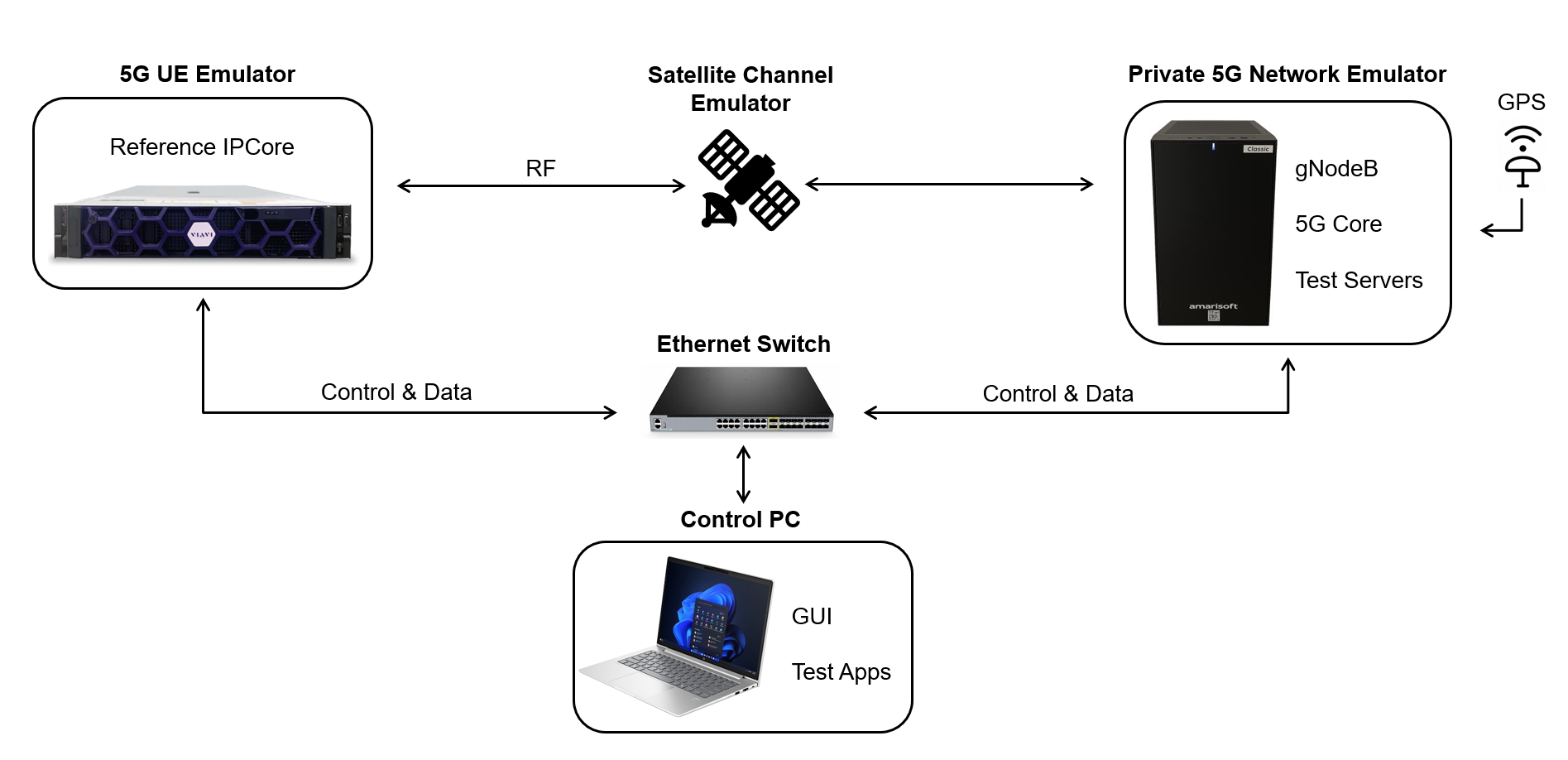
The Reference UE incorporates a Reference IP Core providing key 5G-NTN functionality, along with applications to allow test scenarios to be defined and carried out. The Reference UE is exercised with a Satellite Channel Emulator and Private 5G Network Emulator, allowing end-to-end scenarios to be demonstrated, and supporting evaluation of the technology performance.
The product allows scenarios to be established and run to represent a UE operating over both 5G terrestrial and non-terrestrial networks. This is achieved using the following system components:
- Reference UE represents user equipment, incorporating a Reference IPCore for layers 1-3 of the stack and test applications (Iperf3, VoNR, Instant Messaging, Ping)
- Satellite Channel Emulator represents the satellite channel
- Private 5G Network Emulator representing terrestrial and NTN gNB, 5G Core Network and test servers, including IMS, on the ground
Plan
The UniCore Project kicked off in January 2024 and has run for 30 months.
The project began with 3-month stages for requirements and specification towards Systems Requirements Review (SRR) in March 2024, architecture and interfaces towards Preliminary Design Review (PDR) in June 2024, and detailed design towards Critical Design Review (CDR) in October 2024. Part-way through the detailed design phase, an 11-month implementation phase was initiated, completing with a Qualification Results Review (QRR) in September 2025. Following QRR, an Acceptance Review (AR) was held in June 2026 following a 8-month verification and test phase, followed by the Final Review (FR) in August 2026.
Current Status
The project started in mid-December 2023, with a formal kick off by ESA on 19 January 2024. It has successfully completed all planned milestones: SRR, PDR, CDR, QRR, AR, and FR.
The UniCore project has successfully developed and demonstrated through Lab validation a 5G compliant Reference UE utilising terrestrial satellite-based networks. The digital signal processing Porting activity has successfully demonstrated porting of a PDSCH channel to a target hardware.
Key successes:
• All requirements achieved and use cases (Terrestrial, Non-Terrestrial LEO & GEO, terrestrial-NTN handovers) demonstrated
• Throughput > 100Mbps achieved
• Successful demonstration of portability using novel technology
Future opportunities:
• Reference UE available to UE developers
• Testbed reuse within ESA supported projects
• Extending porting activity to full 5G stack and beyond
Related Links
Companies


