September 17, 2026


Under the overall responsibility of the European Commission, the Infrastructure for Resilience, Interconnectivity and Security by Satellite (IRIS²) secure connectivity programme, will provide Europeans with a sovereign, secure and resilient satellite communications infrastructure, where and when it matters most.
ESA acts on behalf of the European Commission as the qualification and validation authority for the governmental infrastructure of the Union Secure Connectivity Programme. It manages development and validation contracts supporting the initial space and ground segments, verifies end-to-end system, service, and security performance against EU requirements, and coordinates these activities with ESA’s own programme.
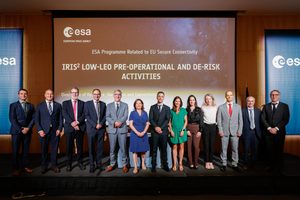
Through the ESA Programme Related to EU Secure Connectivity, ESA translates this strategic ambition into coordinated industrial activities, mission and system solutions, and the in-orbit validation of space-based services and capabilities up to a pre-operational level.
Europe’s future resilience will depend not only on secure space infrastructure, but also on the ability to evolve that infrastructure as new governmental, security and societal needs emerge. Within IRIS², the Low-LEO layer provides a flexible and sustained innovation mechanism to support this evolution, in a rapid manner, complementing the more stringent LEO and MEO layers of the system.
The IRIS² Low-LEO layer, also referred to as the IRIS² LEO-Low layer, is a broad part of the overall IRIS² architecture. It is intended to support the rapid development and maturation of emerging services, with shorter development cycles and a focus on bringing new capabilities towards operational use.
The Low-LEO layer is also a strategic industrial instrument to broaden participation across the European space ecosystem, including emerging companies, Small and Medium Enterprises (SMEs), Midcaps, and new entrants that are not yet part of the IRIS² supply chain.
By opening Low-LEO activities to a wider range of industrial actors, the European Commission and ESA are helping to strengthen the diversity and competitiveness of Europe’s space industrial base. The complementary EU and ESA Low-LEO components provide different routes for industry to contribute to the development, validation and future evolution of European secure connectivity capabilities.
The EU IRIS² Low-LEO layer is composed of two complementary components. The EU Low-LEO component comprises activities led by the European Commission under the Low-LEO pre-booked variation of the Concession Agreement. It focuses on implementing strategic governmental services within the operational EU IRIS² Low-LEO environment (<750 km).
The ESA Low-LEO component complements this effort through activities implemented under Element 3 of the ESA Programme Related to EU Secure Connectivity. It provides a rapid and recurrent mechanism for validating complementary governmental services in orbit up to a pre-operational environment, supporting their maturation and potential future integration into the operational EU IRIS² baseline.
Following ESA’s 2025 Ministerial Council, ESA’s contribution is structured around three complementary elements covering secure governmental connectivity and forward-looking activities supporting the future evolution of IRIS². ESA’s Low-LEO contribution is implemented under Element 3.
The operational IRIS² system will provide long-term continuity, but emerging needs may require shorter development cycles than those typically associated with major operational constellations. The Low-LEO layer addresses this need by creating a sustained mechanism for the rapid development, demonstration, validation and maturation of new services and capabilities.
Within the Low-LEO layer, the EU Low-LEO component focuses on implementing strategic governmental services in the operational environment, while the ESA Low-LEO component provides a pathway for in-orbit validation of complementary governmental services up to a pre-operational environment. The two components are therefore distinct but mutually reinforcing.
The ESA Low-LEO component is not a separate operational constellation. It forms part of the broader Low-LEO layer and acts as a service-oriented innovation engine, supporting the continuous evolution of EU IRIS² through the maturation and de-risking of complementary services and enabling technologies.
Across the Low-LEO layer, user needs and service priorities drive the definition, development and validation of associated missions, system concepts and enabling technologies. For the ESA Low-LEO component, this service-driven approach starts with governmental use cases and services preliminarily identified as relevant for development or enhancement within EU IRIS² and/or other relevant EU programmes, in coordination with the European Commission.
These needs inform the definition of missions, operational concepts, interfaces, enabling architectures and associated technologies. The ESA Low-LEO component uses recurrent development and validation cycles of approximately three years, aligned with ESA Ministerial Council cycles.
Each cycle provides an opportunity to identify relevant services, mature mission concepts, validate capabilities in orbit up to pre-operational level and reduce the risks associated with potential subsequent operational deployment. This complements the operational service development pursued through the EU Low-LEO component.
Together, the EU and ESA Low-LEO components aim at allowing capabilities to be introduced progressively rather than waiting for major constellation upgrades, making innovation and service evolution systematic features of the broader Low-LEO layer.
The ESA Low-LEO implementation model reflects this service-driven approach. ESA begins with a Consolidation Phase in which several parallel industrial contracts explore services compatible with a pre-established mechanism developed by the Agency alongside the European Commission, together with associated mission concepts, system configurations and enabling technologies.
During this phase and in coordination with the European Commission, ESA consolidates user and service requirements, assesses technical maturity and programmatic credibility, identifies complementarities or potential overlaps with other EU activities, and evaluates architectural synergies and interoperability with the EU IRIS² system.
Following consolidation, ESA initiates the implementation of a set of missions, each representing the minimum viable infrastructure needed to validate its targeted services in orbit up to a pre-operational level. For the 2025–2028 Ministerial Council cycle, the Implementation Phase is planned from 2027 to 2029.
The EU and ESA Low-LEO components are designed to operate within a coherent overall framework. Particular attention is given to architecture and interoperability, while also exploring synergies in areas such as shared infrastructure, common building blocks, launch and spectrum access.
To support systematic alignment, the European Commission and ESA have established coordination mechanisms to define services priorities, providing a common baseline for the Commission, the Agency and industry on the services to be addressed within each ESA Low-LEO cycle.
The Low-LEO layer provides a flexible pathway for the progressive incorporation of new services and capabilities into the wider IRIS² architecture. The EU Low-LEO component supports the implementation of strategic governmental services in the operational Low-LEO environment, while the ESA Low-LEO component complements this through an innovation mechanism addressing in-orbit validation and de-risking of complementary governmental services up to pre-operational level.
By combining operational service development, rapid innovation cycles, in-orbit validation, architectural coordination and broad industrial participation, the EU and ESA are establishing a complementary Low-LEO framework that can help keep European secure connectivity capabilities aligned with evolving needs and priorities.