PAGE CONTENTS
Objectives
Quantum Key Distribution (QKD) lets two distant parties generate a shared secret key that remains secure against quantum computers, and satellite links extend it to continental distances. Several European satellite QKD missions are in preparation, but their QKD units start from a low technology readiness level (TRL 3) and are tailored to one mission each.
The objective of MPQR is to bring a QKD receiver for optical ground stations from TRL 3 to TRL 5 and to make it reusable across missions. The project defines a complete and traceable set of technical and security requirements, derived from a baseline low Earth orbit downlink scenario, and carries out a security risk assessment hand in hand with the design. It covers the detailed design, manufacturing and validation of a prototype receiver (hardware and software), together with the supporting units needed to test it end to end in a relevant environment.
The design is modular and its external interfaces are defined with standardisation in mind, to maximise interoperability. The activity closes with a technology readiness assessment and a roadmap towards higher TRL, additional wavelength bands, encodings and protocols.
Benefits
Satellite QKD receivers available today are mostly laboratory set-ups built around one mission, one source and one protocol. MPQR offers a single receiver unit that different missions and optical ground stations can reuse.
The receiver is protocol-agnostic: it is compatible with prepare-and-measure decoy-state BB84 (three or four states) and with entanglement-based BBM92, so the same hardware serves different satellite payloads. Its optical input, synchronisation, detector and data output interfaces are clearly defined and prepared for standardisation, which simplifies integration with telescopes, detectors and post-processing systems from different suppliers.
Security is part of the design from the start: requirements, architecture and trade-offs are assessed against a catalogue of known QKD vulnerabilities through a structured security risk assessment, which eases later evaluation for operational and potentially classified use.
The unit is rack-mountable, built largely from commercial off-the-shelf components, including mature telecom C-band parts, and designed for a ground lifetime above ten years, keeping cost and lead times low.
Validation at TRL 5 against realistic downlink conditions reduces the development risk for missions that adopt it, and the consortium brings together European expertise in system integration, single-photon detection, security engineering and QKD post-processing.
Features
The receiver sits downstream of the ground station telescope and is connected to it by single-mode optical fibre. It operates in the telecom C-band (1530–1570 nm). Its main capabilities and components are:
- Spectral filtering in two stages, which rejects background light and separates the quantum signal from the synchronisation signal.
- Active polarisation synchronisation: a polarimeter measures the polarisation drift of the synchronisation signal and a closed control loop realigns the incoming light to the reference basis.
- A passive four-output polarisation state analyser feeding four superconducting nanowire single-photon detectors (SNSPDs), an arrangement that avoids halving the saturation rate and is robust against timing attacks.
- Time synchronisation with the satellite transmitter, recovering clock and absolute time from the optical synchronisation signal, and time tagging of every detection event with low jitter.
- A data output streaming decoded, time-tagged events to the post-processing system, and a telemetry and telecommand interface for automated operation, settings and monitoring.
- Design targets include a quantum state fidelity above 99 %, a saturation rate above 100 MHz per channel, a mass below 30 kg and mountable in standard 19-inch racks.
Challenges
The receiver shall not be tied to a single mission, and even though mission requirements have been flowing down, a generic baseline mission scenario is defined to justify and trace requirements and design choices. Reference standards for QKD receiver interfaces are not yet available, so interface requirements have been defined. The receiver has to keep a very low error rate while compensating in real time for the polarisation drift, Doppler shift, timing jitter, fading and background light of a satellite downlink. Demonstrating TRL 5 on ground requires reproducing these link effects faithfully in the laboratory.
System Architecture
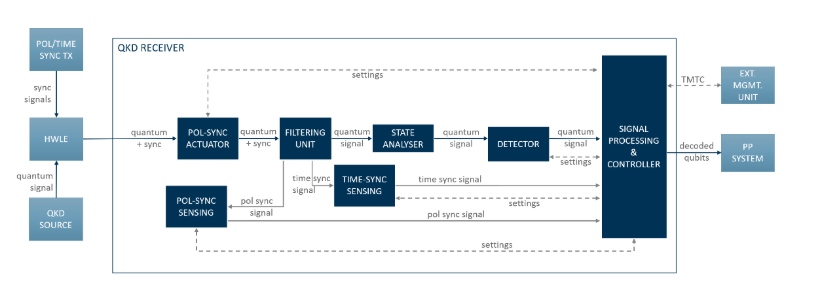
The receiver interacts with three external entities: the source and link (the satellite downlink collected by the telescope), a management unit exchanging telemetry and telecommands, and the post-processing system receiving the decoded data.
Internally it consists of two rack-mounted units and a detection unit based on cryogenically cooled superconducting nanowire single-photon detectors (SNSPDs). The opto-electronics unit hosts the optical input, the first filtering stage, the polarisation actuator, the second filtering stage, the polarisation and time synchronisation sensors and the quantum state analyser. The four analyser outputs are routed by fibre to the SNSPDs. The signal processing and control unit time-tags the detector signals, recovers the transmitter clock, runs the polarisation feedback loop, handles telemetry and telecommands and streams the data to the post-processing system.
A dedicated test bed completes the system: a C-band decoy-state polarisation QKD source, a time and polarisation synchronisation transmitter, a hardware link emulator reproducing attenuation, fading, Doppler shift, timing jitter, polarisation transformations and background light of a low Earth orbit downlink, and post-processing software performing sifting on the receiver output.
Plan
The project is organised in five phases, each closed by a review with ESA. Phase 1, requirements and concept consolidation: Kick-Off to System Requirements Review (SRR) in August 2026. Phase 2, detailed design and verification plan: Design Assessment (DA) planned for December 2026. Phase 3, procurement, manufacturing, assembly and integration: Test Readiness Review (TRR) planned for April 2027. Phase 4, end-to-end testing up to TRL 5: Test Review Board (TRB) planned for August 2027. Phase 5, technology assessment and development roadmap: Final Review (FR) planned for October 2027.
Current Status
The System Requirements Review has been passed successfully, closing the requirements and concept consolidation phase with consolidated technical and security requirements, the baseline mission scenario, the security risk assessment and the selected technical baseline. The project is now in the detailed design phase: the final design of the receiver is almost complete, and the team is approaching the Design Assessment (DA) milestone, planned for December 2026. Procurement of the test equipment has started already, together with assembly of the opto-electronics module; manufacturing, assembly of the back-end electronics will start in 2027 after the DA, followed by the final integration of the prototype.