PAGE CONTENTS
Objectives
Reliable deployable communications are increasingly required by first responders, civil authorities, utility providers and organisations operating in remote or disrupted environments. Severe weather, infrastructure failure and unexpected incidents can reduce the availability of terrestrial networks at the point they are most needed. In these situations, resilient connectivity is operationally critical for coordination, reporting and recovery.
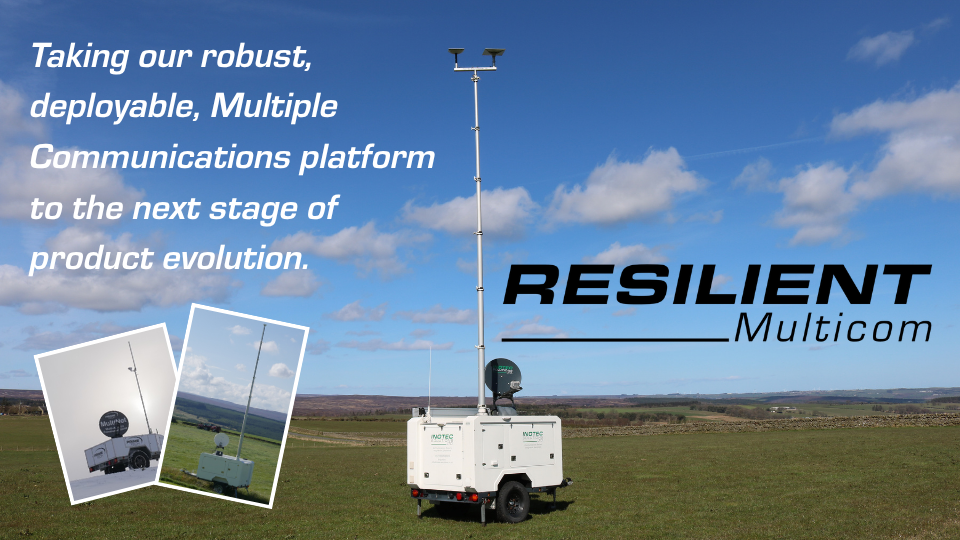
For the average person, there seems to be no clear way of filling the connectivity void caused by adverse conditions and the impact it can have on their lives. One potential answer exists in the form of Resilient Multicom, the Resilient Comms Platform from Inotec Solutions and AmbaSat Ltd.
The deployment of Resilient Multicom is not confined to times of adversity and emergency. It is designed to provide internet access, communications and private 5G or wi-fi distribution for the commercial and events sector such as agricultural fairs, trade shows, festivals, exhibitions, sports and community events. Any events that attract a large footfall that potentially will cause a disruption to traditional networks.
Benefits
There are several ways that Resilient Multicom can be deployed. In the event of a major disruption to utilities, the platform can be used as a central communications hub, turning a building of opportunity such as a village hall, sports hall or similar space into an incident room. First responders, utilities providers, local government departments and welfare providers can ‘plug in’ and manage their engineers on site.
Similarly, where a company has experienced an unexpected interruption in their services, Resilient Multicom can provide essential connectivity which enables business continuity, particularly important where cloud-based storage and online applications are used.
The Resilient Multicom platform can be deployed and remotely monitored and managed. Once set up, the trailer can be left unattended. The intelligent power management system ensures that the platform runs efficiently. Multiple communications systems can be employed or be prioritised dependent upon the bandwidth required for the number of users.
Features
The intelligent core of the Resilient Multicom platform can be configured to interface with any VSAT terminal. This allows the system to utilise all available space assets ensuring optimal coverage for the end user. By integrating satellite communications with other available bearers, the platform can support continuity of service, prioritisation of critical traffic and more robust operational performance than terrestrial-only alternatives.
Remote management and configuration are completed using a satellite constellation that has true global coverage. This combination of space and non-space assets enables a flexible and dependable communications solution for users who need connectivity in demanding or unpredictable conditions.
Challenges
One of the challenges of the project is finding the correct equipment pairing that achieves the level of communications resilience and robustness to withstand any unexpected future event of service or capability disruption whether it be naturally occurring or manmade regardless of location.
System Architecture
The system architecture of the Resilient Multicom platform includes the exploitation of both Geostationary and Low Earth Orbit assets and utilises innovative software written by our project partners AmbaSat Ltd. Private 5G services are also provided from the platform, which is powered by wind, solar, generator or by plugging in via shoreline to existing power outlet.
Maintenance of the platform is simple, using industry standard parts readily sourced from normal purchasing routes. Digital maintenance, configuration and management can be either on site or done remotely.
Plan
The Kick Off meeting signified the actual start of the project in March 2026. The Mid Term Review in June 2026 is a pivotal point that sees the consolidation of all the equipment suppliers, designers, software architects and product manufacturers before the actual build commences. Demonstration, testing and validation by prospective users form the content of the Final Report due for presentation March 2027.
Current Status
The project is at the end of its active development phase. Initial service objectives, use cases and high-level system architecture have all been established by the consortium. Gateway software development has progressed at pace during the past month, and all of the constituent parts and components have now been identified.
We are currently within our main purchasing period establishing supply chain relationships in time for the completion of construction and delivery of the new superstructure. The refining of the operational concept for emergency response, business continuity and temporary event scenarios is a continual process of improvement so that the platforms resilience is assured. All the technical and operational baselines for the Resilient Multicom Platform have been achieved.
Related Links
Companies