PAGE CONTENTS
Objectives
The TANNDEM project designed and tested a demodulator supported by an artificial neural network (ANN) for 5G NR physical-layer processing over Non-Terrestrial Network (NTN) satellite channels. The implementation focused on three core receiver tasks: channel estimation, symbol demapping/equalisation, and channel decoding.
Within the receiver chain, Forward Error Correction (FEC) – implemented as a 5G NR LDPC decoder – is the block accounting for the largest share of computational complexity. Reducing implementation complexity and power consumption of FEC and channel estimation algorithms has become essential to evolving future communication systems toward higher throughput and lower energy cost.
From the satellite communications perspective, reducing processing time and power consumption is vital due to its direct impact on payload design and cost. The TANNDEM project specifically targeted three performance objectives:
• Up to 77.8% reduction in computational complexity (FLOPs) for the hybrid RNN + LDPC decoder (1 LDPC iteration after RNN), with 44.5% for the recommended 3-iteration configuration.
• Up to 46% reduction in energy per decoded bit on the Jetson Orin embedded platform (19% on NVIDIA RTX A6000), compared to a conventional 6-iteration LDPC decoder.
• Up to +33% throughput improvement at low SNR (3 dB) for the CNN-based channel estimator (CNN-CE) in the base scenario (QPSK, TDL-A, 3 km/h).
Benefits
The TANNDEM project demonstrated that integrating ANN-based models into the 5G NR receiver processing chain provides measurable and practically significant improvements over classical baselines. The three implemented ML components deliver the following quantified benefits, all reported from TN5 results:
Hybrid RNN + LDPC Channel Decoder:
• Up to 77.8% FLOPs reduction vs. standard LDPC-BP with 6 iterations (RNN + 1 LDPC iteration). The recommended 3-iteration configuration achieves 44.5% FLOPs reduction while maintaining reliable decoding performance.
• Energy per decoded bit reduced by ~19% on NVIDIA RTX A6000 and ~46% on Jetson Orin (embedded platform) at 5 dB SNR, vs. conventional LDPC-BP with 6 iterations.
• Consistent BLER and throughput gains across UE speeds of 3, 100, and 300 km/h, modulations (QPSK, 16-QAM), and NTN channel profiles (TDL-A, TDL-D).
CNN-based Channel Estimator (CNN-CE):
• Up to +33% throughput improvement at low SNR (3 dB) vs. LS + 2D interpolation baseline in the base scenario (QPSK, TDL-A, 3 km/h).
• Maintained positive throughput gains at mid-SNR (~3–6%) across UE speeds up to 100 km/h and under frequency-selective channels (TDL-D, τrms = 100 ns: +8–9%).
• Computational cost approximately 2× the classical baseline, making it the most practical ML enhancement for partial integration.
DeepRx Lite (Joint End-to-End Receiver):
• The joint channel estimation, equalisation, and demapping architecture showed poor convergence and severe throughput degradation in most evaluated scenarios (−90% to −100% throughput at low-to-mid SNR).
• Even after retraining with a doubled dataset, no significant improvement was observed, indicating architectural rather than data-related limitations.
• Computational cost ~9.4× the baseline; not recommended for embedded deployment in its current form.
These results confirm that modular, hybrid ML–classical designs (CNN-CE, RNN + LDPC) provide the best performance-to-complexity trade-off, while fully end-to-end approaches (DeepRx Lite) require further architectural optimisation before operational use.
Features
The TANNDEM project implemented and evaluated three ANN-based receiver components integrated into a 5G NR PDSCH DM-RS transceiver processing chain for NTN scenarios.
CNN-based Channel Estimator (CNN-CE): A convolutional neural network is used to estimate the channel frequency response from pilot DM-RS signals. The CNN-CE is trained for QPSK and 16-QAM modulations using synthetic datasets generated with MATLAB’s 5G Toolbox. It was evaluated in terms of BER, BLER, and throughput against the classical LS + 2D interpolation baseline across a wide range of SNR values and UE speeds (3, 100, and 300 km/h).
DeepRx Lite (Joint Channel Estimation, Equalisation, and Symbol Demapping): An end-to-end neural receiver replacing the channel estimation, equalization, and symbol demapping blocks with a single convolutional neural network architecture. The model takes the received resource grid as input and directly outputs log-likelihood ratios (LLRs) for the LDPC decoder, enabling tightly integrated physical layer processing.
Hybrid RNN + LDPC Channel Decoder: A Recurrent Neural Network (RNN) generates soft initialisation values for the LDPC belief-propagation decoder, enabling it to converge with fewer iterations. The hybrid architecture achieves throughput gains of up to several percentage points in low-SNR conditions while maintaining convergence to the LDPC baseline at high SNR. The model was evaluated under TDL-A and TDL-D channel profiles, code rates 1/2 and 4/9, QPSK and 16-QAM modulations, and user speeds of 3, 100, and 300 km/h.
All models were implemented in Python (TensorFlow/PyTorch) and benchmarked on an NVIDIA RTX A6000 GPU, a Jetson Orin embedded platform, and the Xilinx Versal AI Core VCK190. Complexity metrics (FLOPs, MACs, inference time) and energy consumption per decoded bit were measured and compared against the classical processing baseline.
Challenges
Satellite communication has been playing a significant role in wireless communications due to its ability to offer omnipresent wireless coverage. In particular, low Earth orbit (LEO) satellites are able to enhance communication performance by reducing over-the-air delay and path loss due to the shorter link distance. Most commercial LEO Satcom systems are improving thanks to the third-generation digital satellite television broadcasts (DVB-S2/S2X). As 5G networks are developed, the interest in combining LEO satellites with 5G networks is growing. Nevertheless, to provide dual-mode communications using both satellites and terrestrial networks, DVB-S2X must incur high costs. Moreover, when compared to 5G, DVB-S2X lacks features like uplink synchronisation, HARQ, and a control channel. Furthermore, the orthogonal frequency division modulation (OFDM) method can offer the bandwidths required for future space communication. For instance, as reported in, the Ku-band Starlink downlink is most likely based on OFDM. We then choose the 5G NR standard for the software demodulator’s implementation due to its higher flexibility and promising higher performance.
Figure 1 illustrates a simplified conventional communication system for satellite communications. First, the desired bit stream is augmented by adding proper redundancy via channel coding. Then, the bits are mapped to symbols using quadrature amplitude modulation (QAM). This generates the waveform for the signal. This waveform is important because it is related to features such as power. Next, to address the interference related to the multipath nature of the propagation environment, the OFDM scheme is added. The signal is converted from the frequency domain to the time domain via the inverse fast Fourier transform (IFFT, and the cyclic prefix (CP) is added. Finally, the signal is transmitted. At the receiver side, shown in Figure 1, all the processes carried out on the transmitter side must be undone until we can recover the transmitted bit stream. During the training phase, pilot signals are sent to estimate the channel and then used in equalisation during the data phase.
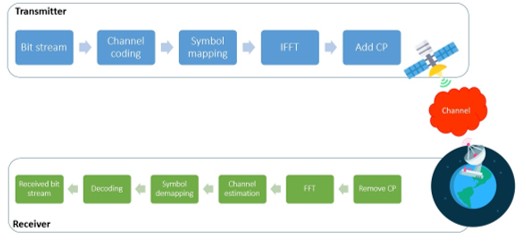
Among the tasks mentioned above, channel estimation and equalisation, decoding and demodulation are the physical layer tasks that consume the most of the resources in a conventional receiver, such as power consumption. In addition, they require a large computation time and many operations. Accurate channel state information (CSI) is critical for the performance of wireless communication systems since this information is the basis for subsequent tasks such as adaptive modulation, beamforming, and other link adaptive technologies in the current modern systems.
System Architecture
The TANNDEM system model is based on the 5G NR PDSCH DM-RS downlink transceiver processing chain. The baseline implementation uses MATLAB 5G Toolbox for the full physical-layer pipeline (DL-SCH encoding, symbol mapping, OFDM modulation with DM-RS insertion, NTN-TDL channel propagation, OFDM demodulation, LS channel estimation with 2D interpolation, LMMSE equalisation, soft demapping, and LDPC decoding). ML models were trained and evaluated using Python (TensorFlow/PyTorch).
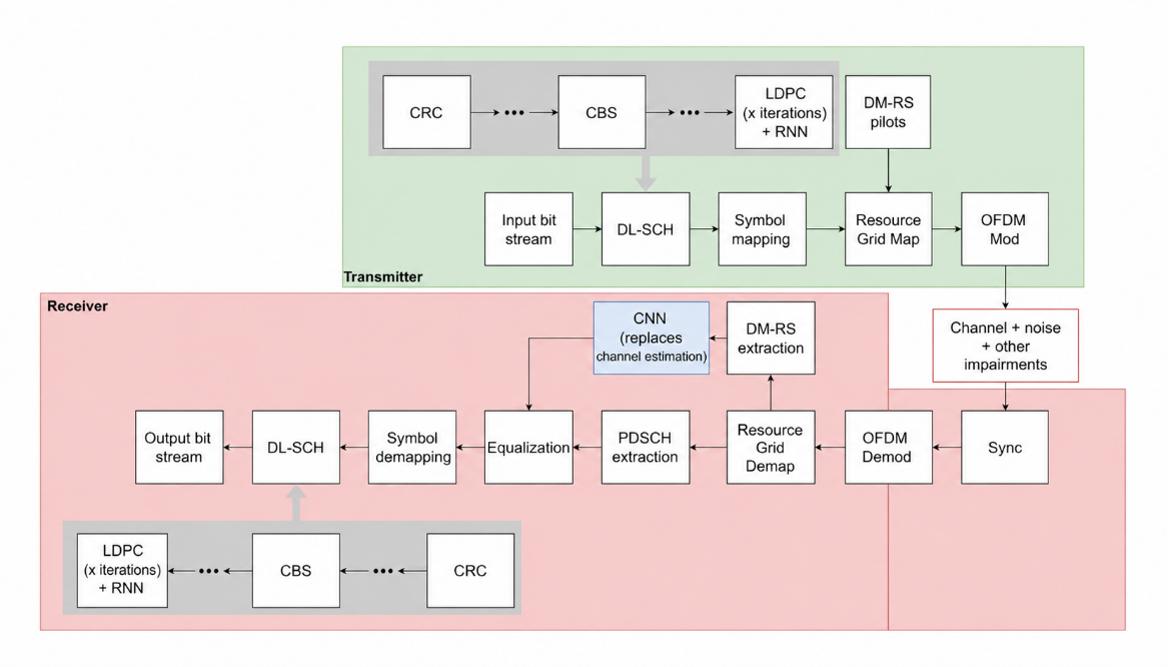
Three ML-based receiver components were implemented:
1. CNN-based Channel Estimator (CNN-CE): A convolutional neural network replaces the classical LS + 2D interpolation stage. Trained on synthetic datasets generated with MATLAB 5G Toolbox for QPSK and 16-QAM. Integrated into the existing pipeline alongside LMMSE equalisation and soft demapping.
2. DeepRx Lite: A joint neural receiver performing channel estimation, equalisation, and symbol demapping in a single end-to-end CNN, producing LLRs directly for the LDPC decoder. Trained in Python/TensorFlow.
3. Hybrid RNN + LDPC Decoder: A single-layer vanilla RNN (hidden size=2, sequence length=1528) generates soft-input initialisation for the LDPC belief-propagation decoder, enabling convergence with fewer iterations. Trained and evaluated in Python/TensorFlow.
Hardware evaluation was performed on:
• NVIDIA RTX A6000 GPU (48 GB VRAM, 10,752 CUDA cores) — primary inference and energy measurement platform.
• NVIDIA Jetson Orin — embedded edge platform; energy measured via tegrastats.
• Xilinx Versal AI Core VCK190 — DPU-based inference; a CNN surrogate was used as the RNN cannot be compiled directly on the DPUCVDX8G accelerator.
The baseline was simulated in MATLAB R2022a. ML training used Python 3.x with TensorFlow 2.x on SnT HPC GPU nodes.
Plan
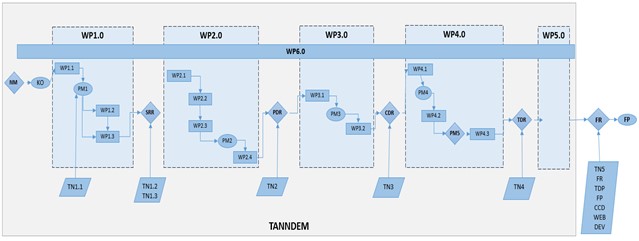
The work to be performed in each WP is summarised below:
WP 1.0: Literature Review and Application Scenario Definition
Objective: definition of the application into which the demodulator is integrated, SoTa review and establish the end-user requirements and quantify the advantages of using the new demodulator with respect to SoTA alternatives.
Output: TN 1 is composed of TN1.1 and TN 1.2.
WP 2.0: Technical Baseline and Design
Objective: identification of the technical baseline that offers the best potential for the development of a demodulator based on an artificial neural network (ANN). To do so, preliminary simulations based on technological options are foreseen to select the best ANN topology that it can satisfy the technical requirements.
Output: TN 2 is composed of TN2.1 and TN 2.2.
WP 3.0: Definition Plan of Demodulator
Objective: focused on all detailed plans necessary to successfully implement and test the deliverable items and verify their compliance with the technical specifications.
Output: TN 3.
WP 4.0: Development and Testing of Demodulator
Objective: development of the SW related to the demodulator, followed by the testing campaign and the reflection and analysis of the results. It is the longest WP in this activity as it also includes a final task where compliance with requirements and potential corrective actions are considered. Therefore, we foresee this task to take a significant portion of the total project time
Output: TN 4 is composed of TN4.1 and TN 4.2.
WP 5.0: Outline and Technology
Objective: a critical assessment of the potential of the developed items for commercial exploitation and establishes a development plan to further raise their TRL and thereby bring them to market readiness. Disseminate the findings and identify the technical, non-technical and standardisation gaps that exist for implementing and commercialise the demodulator developed and tested in WP 3 and 4. Propose how these gaps should be addressed and develop a roadmap of key workstreams, activities and outputs.
Output: TN 5.
WP 6.0: Project Management
Objective: It is dedicated throughout the project to the management, coordination of the different tasks, dissemination, documentation, and project meetings.
Output: FP, FR.
Current Status
As of May 2026, the TANNDEM project has been completed successfully. All five work packages (WP1–WP5) have been executed and the five Technical Notes (TN1–TN5) delivered to ESA under ESTEC Contract 4000141752/23/NL/CLP.
The project designed, implemented, and validated three ML-based receiver components for a 5G NR PDSCH DM-RS downlink over NTN (LEO) satellite channels. Evaluation was conducted on NVIDIA RTX A6000 and Jetson Orin, with additional tests on Xilinx VCK190. Key quantitative outcomes from TN5:
Hybrid RNN + LDPC Decoder: 44.5% FLOPs reduction (3-iter config); ~19% energy saving on RTX A6000 and ~46% on Jetson Orin at 5 dB SNR.
CNN-CE: Up to +33% throughput at 3 dB SNR (base scenario, QPSK, TDL-A, 3 km/h), at ~2× the baseline computational cost.
DeepRx Lite: Severe throughput degradation (−90% to −100%). No improvement after retraining with doubled dataset. ~9.4× baseline FLOPs. Not recommended for embedded deployment in current form.