PAGE CONTENTS
Objectives
The project aimed to assess the feasibility and demonstrate a low-profile optical head for retrofit integration into commercial aircraft, enabling free-space optical communications with satellites and reaching Technology Readiness Level (TRL) 4. The target system supported bi-directional data rates of up to 1 Gbps at 1550 nm.
A central objective was to achieve these capabilities within a highly constrained envelope, compatible with an aerodynamic radome of 40 cm height, while maintaining the optical performance and pointing accuracy required for reliable communications.
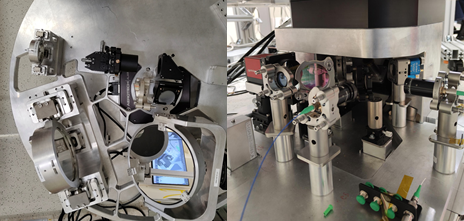
The activity covered system scenario and requirements definition, architecture trade-offs, optical and optomechanical design, aerodynamic assessment, prototype development and verification. A functional optical head prototype was developed using predominantly Commercial Off-the-Shelf (COTS) components and tested under laboratory conditions. Particular emphasis was placed on beam steering, telescope performance, acquisition and tracking, and integration with the aircraft radome.
The project also assessed the main certification constraints and applicable standards for installation on commercial aircraft, identifying the critical technologies and design aspects requiring further maturation towards an operational system.
Benefits
The proposed optical communication terminal offers a combination of high-capacity connectivity, compactness and aircraft integration capability that is not readily available in conventional airborne communication systems. Compared with traditional RF-based solutions, the optical approach enables significantly higher data rates while being inherently immune to electromagnetic interference and avoiding RF spectrum congestion and allocation constraints.
A key differentiator is the terminal’s innovative low-profile optical architecture, which achieves the required optical and pointing performance within a compact envelope suitable for integration on commercial aircraft. Its aerodynamic form factor minimise structural and aerodynamic penalties, while the retrofit-oriented design requires only limited modifications to the existing aircraft fuselage. This can reduce installation effort, certification complexity and overall integration cost compared with larger or more intrusive communication terminals.
The technology therefore addresses two major limitations of existing solutions: the capacity and spectrum constraints of RF systems and the integration penalties associated with conventional high-performance optical terminals. Although developed for commercial aviation, the resulting combination of high data-rate capability, low profile and RF independence also provides significant value for future defence and security airborne communication applications.
Features
The product features are:
• Bi-directional data rate up to 1 Gbps
• 150 mm optical beam at 1550 nm wavelength
• Compact, low-profile off-axis beam-steering architecture
• Wide field of regard enabled by a scanning mirror
• Fast-steering mirror for high-bandwidth line-of-sight correction
• Shared transmit/receive optical path using a fused-silica beam-combining prism
• Single image sensor for acquisition and tracking, with windowing capability
• Target tracking error below 1.2 µrad
• Integration within an approximately 40 cm-high aerodynamic radome
• Wide-angle and durable optical-window coatings for aircraft operation
Challenges
The project addressed the challenge of combining high optical and pointing performance within a highly constrained, low-profile architecture. Coupling the required wide field of regard with an aerodynamically efficient radome was particularly challenging, as it required a large optical aperture while minimising the radome height and aerodynamic impact. The design also had to accommodate aircraft-induced vibrations while maintaining the required pointing performance.
System Architecture
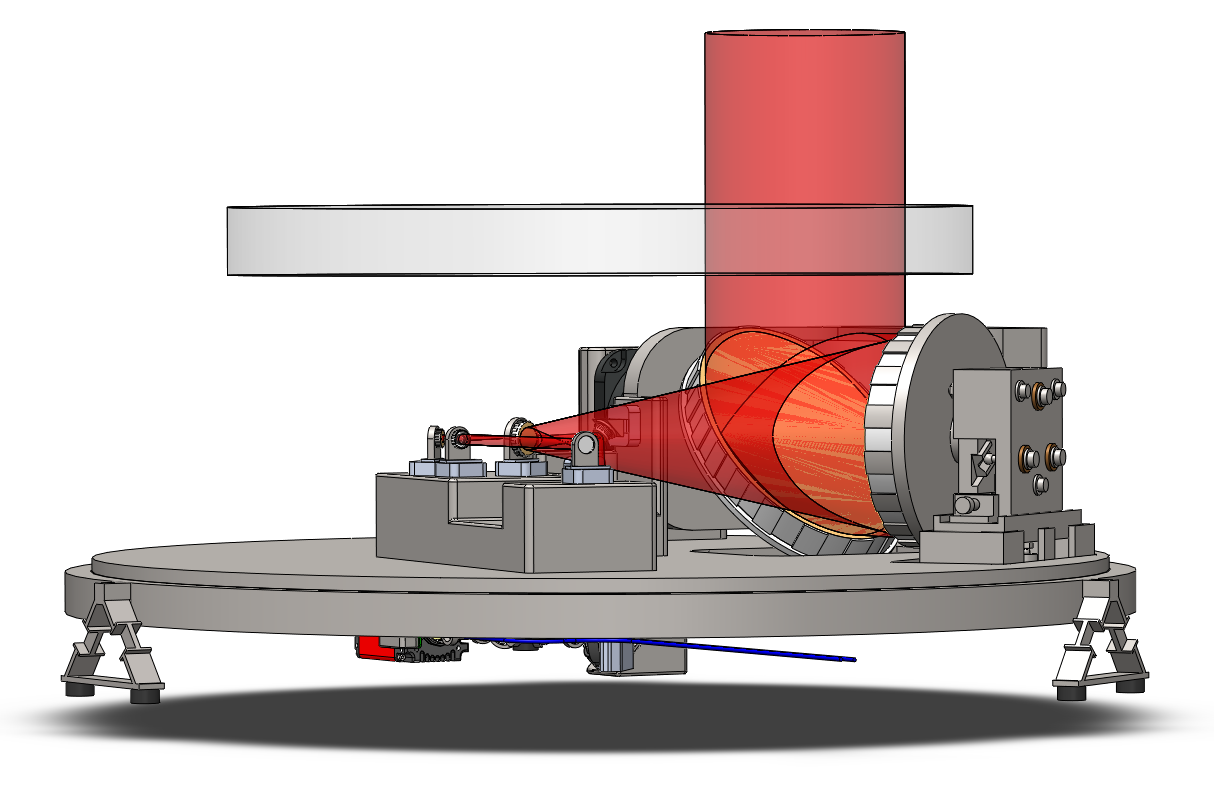
The system architecture comprises an aerodynamic radome with an integrated optical window and a compact optical head located beneath the radome. The low-profile optical head is arranged around an off-axis beam-steering concept, enabling the required wide field of regard while limiting the optical-window dimensions.
The optical path consists of a scanning mirror, a telescope and optical bench. The scanning mirror provides the main beam steering, while a fast-steering mirror located at the optical bench provides high-bandwidth line-of-sight correction for aircraft-induced disturbances.
The transmit and receive channels share the main optical path and are combined and separated using a fused-silica prism. A single area image sensor provides both acquisition and tracking functions, with windowing used to support the tracking operation.
The aerodynamic radome and optical window form integral elements of the terminal, with the window incorporating wide-angle anti-reflection and durable hard coatings to withstand the aircraft operating environment.
Plan
The project followed a structured development process, progressing from the definition of the system scenario and requirements through architecture trade-offs, preliminary and detailed design, prototype manufacturing, assembly and integration, and verification.
The main project milestone was the completion of the TRL4 development and verification campaign, demonstrating the integrated optical head prototype and assessing its performance under laboratory conditions.
The project concluded with an evaluation of the achieved performance, identification of design limitations, and consolidation of key lessons learned. These outcomes were used to define priorities for subsequent development phases and establish the roadmap towards higher TRLs and, ultimately, aircraft certification.
Current Status
In August 2026, the project was completed, achieving its objective of developing and demonstrating the low-profile optical head concept at TRL 4. The prototype demonstrated the proposed optical architecture and performance under representative laboratory conditions.