The European Space Agency (ESA) has signed 18 consolidation contracts, worth a total of €20 million, to support the future evolution of the European Union’s Infrastructure for Resilience, Interconnectivity and Security by Satellite (IRIS²), an upcoming multi-orbital constellation designed to provide reliable connectivity for governments, commercial businesses and European citizens across Europe.
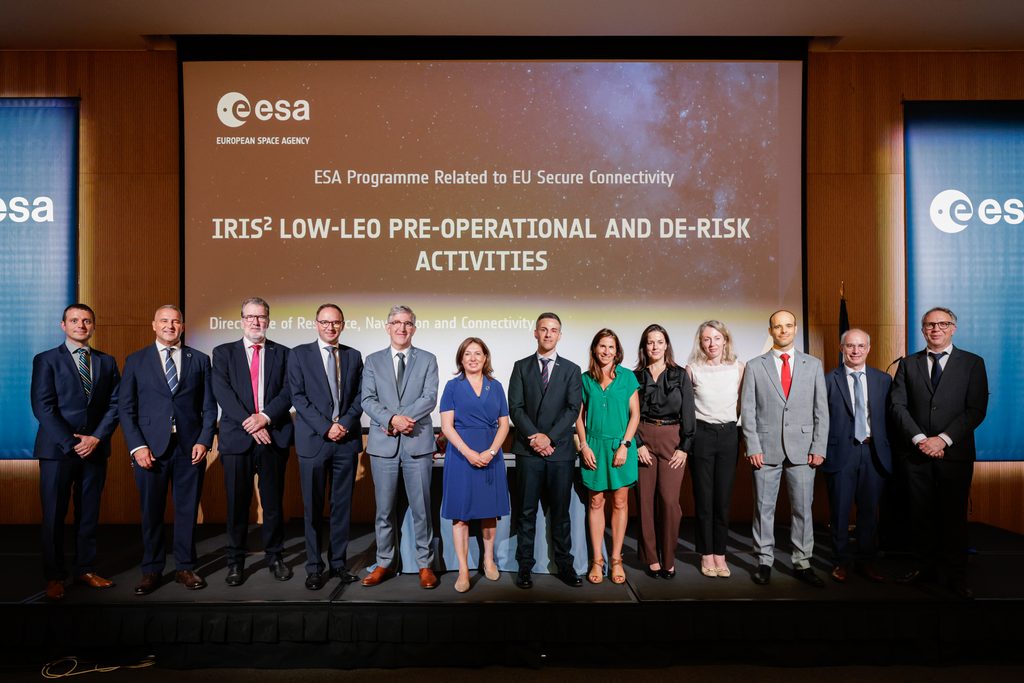
Director of ESA Resilience, Navigation and Connectivity, Laurent Jaffart (fourth from left) with the ESA Programme Related to EU Secure Connectivity team, and Giuditta Montesanti of the European Commission. Image credit: ESA
The signatures, which launch the consolidation phase of ESA’s Low-LEO component for new governmental services and associated mission concepts, range from secure broadband, maritime operations and safety, aviation and airspace to data relay and tasking, among others, and took place at ESA’s European Space Astronomy Centre (ESAC) in Madrid, Spain.
ESA Director of Resilience, Navigation and Connectivity, Laurent Jaffart, signed the agreements in the presence of representatives of the European Commission, and the selected industrial consortia. The contracts, which bring together nearly 80 European industrial partners, makes a move to strengthen the industrial base of ESA Member States, particularly Small- and Medium-Sized Enterprises (SMEs) and Midcaps.
Low-LEO serves as the low Earth orbit layer of IRIS², operating below approximately 750 km above Earth. The proximity will be able to support lower-latency connectivity and capabilities such as direct connections between satellites and user devices, as well as Internet of Things (IoT) services. It also offers Europe the opportunity to develop and test new capabilities in-orbit without waiting for major lengthy changes to the constellation’s system. It is envisaged that 338 satellites will be in LEO (High LEO and Low-LEO).
The Low-LEO layer has two complementary components. The EU Low-LEO component, led by the European Commission, focuses on strategic government services. ESA’s component – which is being supported through the Agency’s Programme Related to EU Secure Connectivity – provides a rapid and recurrent mechanism for validating complementary governmental services and associated mission concepts in orbit, supporting their maturation and later integration into the operational EU IRIS² baseline.
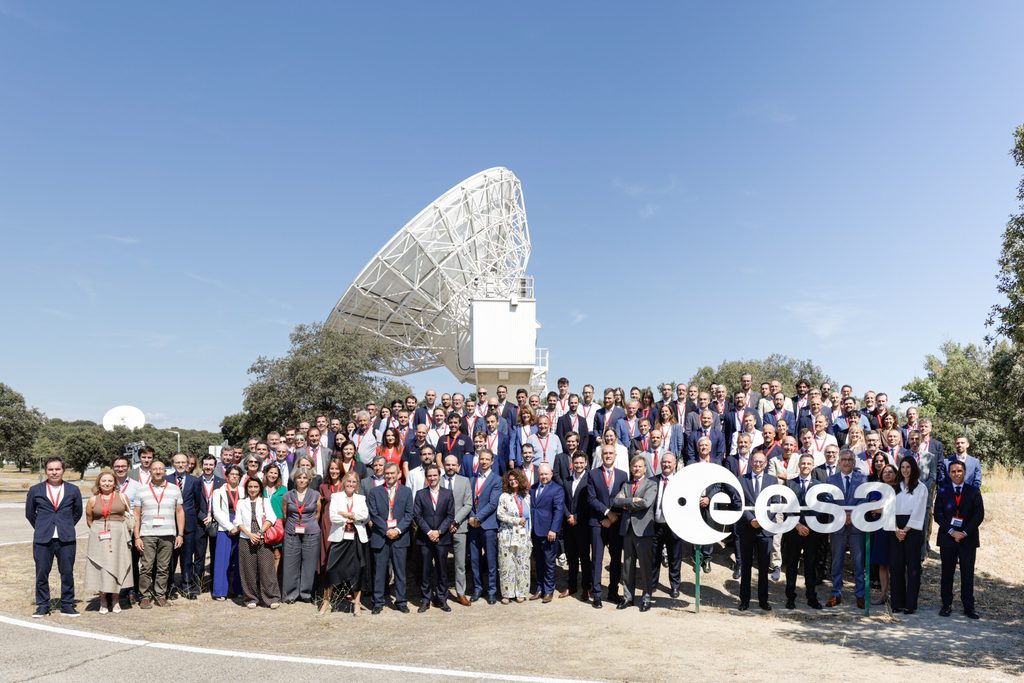
The European Space Agency (ESA) has signed 18 consolidation contracts, worth a total of €20 million, to support the future evolution of the European Union’s Infrastructure for Resilience, Interconnectivity and Security by Satellite (IRIS²). Image credit: ESA
As part of these activities, ESA, working with the European Commission, will assess the potential of key services and the suitability of associated mission concepts, including their added value, technical feasibility, and interoperability aspects with IRIS² and other European programmes.
Based on the outcomes of the consolidation phase, in terms of maturation and subject to future programme priorities, ESA will initiate several procurements for an implementation phase that will feature a concrete set of missions, planned for implementation between 2027–2029, to validate the targeted services in orbit up to a pre-operational level.
The future of secure connectivity will not be defined by a single technology or a single orbit. It will come from combining complementary capabilities and having the flexibility to adapt as Europe’s needs evolve. Through its Low-LEO activities, ESA looks forward to working hand-in-hand with the European Commission and European industry to explore what comes next for IRIS²; to shape the capabilities that will support Europe’s future connectivity needs,” said Laurent Jaffart, Director of ESA’s Resilience, Navigation and Connectivity.
Home
/ Webinar: How to build and train a private satellit...
Webinar: How to build and train a private satellite communication-specific Large Language Model (LLM)
Location
Online
Date: 25 September 2026 Time: 10:30–12:00 CEST Participation: Open to all ESA Member States. Registration is required by 25 September at 00:00 CEST. Registration now open.
INTRODUCTION
How can you optimise an open-source Large Language Model (LLM) for satellite communications applications and customise it using an organisation’s own technical information, while maintaining confidentiality?
This practical webinar will showcase the results of the SatComLLM activity and demonstrate the complete workflow used to develop SCEVA-RAG, the SatCom Expert Virtual Assistant combining: Fine-tuned SatCom Llama + Retrieval-Augmented Generation (RAG) = SCEVA-RAG.
Participants will see how a general-purpose Llama model can be adapted to the satellite communication domain using Low-Rank Adaptation (LoRA) fine-tuning, and how Retrieval-Augmented Generation (RAG) can connect the model to a searchable knowledge base built from technical documents.
The session will follow the complete development journey, from collecting and preparing satellite communication literature to generating training data, fine-tuning the model, creating a document knowledge base and integrating the components into an operational assistant.
WHAT WILL BE DEMONSTRATED?
The webinar will include practical demonstrations of:
Building a high-quality satellite communication corpus from technical literature
Converting documents into training data and searchable knowledge
Generating and quality-checking synthetic satellite communication question-and-answer examples
Configuring the two-stage LoRA fine-tuning workflow
Creating a knowledge base from technical PDF documents
Connecting a fine-tuned satellite communication model to a RAG pipeline
Comparing model responses with and without document retrieval
Deploying the solution locally, in the cloud or through a hybrid architecture
A complete production fine-tuning run of an 8-billion or 70-billion parameter model requires several hours and substantial computing resources. The webinar will therefore demonstrate the fine-tuning configuration, execution process, outputs and resulting model artefacts, using completed satellite communication model checkpoints for the live SCEVA-RAG demonstration.
AGENDA
1. INTRODUCTION AND SYSTEM OVERVIEW | 10 MINUTES
Overview of the final SatComLLM architecture
Main steps followed to develop the satellite communication-specialised models
Relationship between fine-tuning, the knowledge base and RAG
Introduction to the complete SCEVA-RAG workflow
2. CREATING THE SATELLITE COMMUNICATION CORPUS, TRAINING DATA AND EVALUATION DATASETS | 10 MINUTES
Collection and preparation of satellite communication literature
Document extraction, cleaning and chunking
Generation of synthetic question-and-answer data
LLM-based filtering and quality assurance
Introduction to the satellite communication-QA and satellite communication-MCQA evaluation datasets, with practical examples
3. FINE-TUNING WORKFLOW | 15 MINUTES
Practical walkthrough based on the delivered fine-tuning tutorial
Selection of the Llama base models
Two-stage LoRA fine-tuning methodology
Training configuration and execution
Review of training outputs and the resulting SatCom-8B and SatCom-70B models
Infrastructure requirements and indicative training runtimes
4. KNOWLEDGE-BASE CONSTRUCTION AND RAG INTEGRATION WITH PRIVATE DOCUMENTS | 15 MINUTES
Practical walkthrough based on the delivered RAG tutorial
Loading a collection of technical PDF documents
Document chunking and embedding generation
Creation of a searchable knowledge base
Explanation of document retrieval and contextual grounding
Comparison of responses with and without retrieval augmentation
5. DEPLOYMENT CONSIDERATIONS | 5 MINUTES
Local, cloud and hybrid deployment options
Privacy, data sovereignty and infrastructure trade-offs
Hardware considerations for the SatCom-8B and SatCom-70B models
Deployment considerations for proprietary or sensitive technical information
6. QUESTIONS AND DISCUSSION | 20 MINUTES
Participants will have the opportunity to discuss the technical approach, potential use cases and options for adapting the SatComLLM ecosystem to their own data and operational environments.
WHO SHOULD ATTEND?
The webinar is intended for:
Companies and institutions from all ESA Member States
Satellite communications engineers and system architects
Artificial intelligence and machine-learning practitioners
Technical and knowledge-management teams
SatCom operators, manufacturers and service providers
Research organisations and universities
Organisations considering secure, domain-specific AI assistants
Teams interested in fine-tuning open-source models or implementing RAG with proprietary technical documentation
WHAT WILL PARTICPANTS LEARN?
By the end of the session, participants will understand:
The difference between fine-tuning and RAG, and why the two approaches are complementary
How satellite communication documents can support both model training and a RAG knowledge base
How two-stage LoRA fine-tuning adapts a general-purpose Llama model to satellite communication
How RAG provides documentary grounding, traceability and access to updated or private information
How the fine-tuned model and retrieval pipeline are integrated into SCEVA-RAG
The practical infrastructure and deployment choices involved in implementing a similar solution
Join us for a practical demonstration of how open-source LLMs, domain-specific fine-tuning and document retrieval can be combined to create a trusted satellite communication AI assistant.
On 7 August, the European Commission and the SpaceRISE consortium concluded negotiations and signed an implementation agreement to roll out IRIS², the European Union’s new flagship satellite constellation. The agreement, among other items, adds 66 satellites into low Earth orbit to the programme, bringing the main constellation to 348 satellites, and moving it from planning to full-scale deployment with the support of the European Space Agency (ESA).
The logo for IRIS², the EU’s upcoming multi-orbital satellite constellation. Image credit: European Commission
ESA plays a key role in the IRIS² technical implementation, overseeing the constellation’s development, qualification and in-orbit validation, and translating the programme’s ambitions into industrial delivery. In cooperation with the European Commission and SpaceRISE, ESA will ensure the successful delivery of a secure and resilient connectivity system to further strengthen Europe’s strategic autonomy and competitiveness.
These negotiations, which began in January, confirm the programme’s key parameters and necessary adjustments, including the design, system capacity, deployment schedule, target price and private operators’ investment. Under the agreement, European manufacturers have committed to delivering the additional satellites, designed with enhanced resilience. Concrete next steps are now in place to achieve first launches by 2029.
From plans to deployment: concrete next steps towards 2029
Once operational, the constellation will provide sovereign, secure and highly reliable connectivity for European governments, defence and security forces, and emergency services across Europe.
The Commission, ESA and the EU Agency for the Space Programme, together with the SpaceRISE consortium and European industrial partners, have defined the next steps needed to deliver IRIS². These include finalising the detailed design of the satellite constellation, preparing the construction of satellites and secure ground infrastructure, securing launch services, and progressively deploying operational connectivity services from 2029 onwards.
The future constellation will comprise 348 satellites, consisting of 330 satellites in low Earth orbit and 18 satellites in medium Earth orbit, with additional optional elements to support specific missions.
A reinforced constellation for security and resilience
To respond to a changing security environment, the Commission is increasing the capacity of IRIS² beyond the original design. A dedicated layer of an additional 66 high-low Earth orbit satellites will strengthen capabilities for defence, security and emergency services further enhancing its architecture.
This reinforcement will increase secure governmental capacity by 60% within the EU and 54% globally, while significantly expanding Europe’s ability to support critical missions during crises.
Once operational, the constellation will provide sovereign, secure and highly reliable connectivity for European governments, defence and security forces, and emergency services across Europe. Image credit: Shutterstock
European industry commits to delivering IRIS²
IRIS² will be built through a strong Team Europe approach, combining the expertise of the European Commission, EU Member States, ESA, the European Union Agency for the Space Programme and European industry. Under the public-private partnership, the SpaceRISE consortium (consisting of SES, Eutelsat and Hispasat) and European manufacturers have committed to deliver the required space and ground infrastructure to meet the accelerated timeline.
The industrial team includes major European space companies such as Airbus Defence and Space, Thales Alenia Space, OHB and Aerospacelab, together with numerous companies across the European supply chain. By design, the programme will also generate opportunities for start-ups, small and medium-sized enterprises and mid-caps developing innovative space technologies.
Secure connectivity when it matters most
IRIS² will enable authorised governmental users across EU Member States and participating countries, currently Norway and Iceland, to communicate securely and continuously during critical operations. Whether responding to emergencies, protecting critical infrastructure or supporting security missions, IRIS² will provide Europe with an autonomous and resilient connectivity capability.
Ensuring value for money
The faster deployment and increased capacity required for defence and security needs mean an additional investment in the programme budget. This investment will support enhanced satellite technologies and the deployment of the expanded constellation, while ensuring efficient use of existing programme resources. Funding will come from a combination of EU budget resources for 2028–2034 and additional investments from EU Member States and other countries.
EU Member States are already strengthening IRIS² through national investments to address specific additional needs. Poland and Hungary have already committed €656 million and €500 million respectively, while Spain has announced investments between €1.6 and €2 billion. Further EU Member State contributions are under consideration, with the relevant agreements currently being finalised.
Next steps
With a clear roadmap setting out the next steps, the Commission sent an official letter to the European Parliament and EU Member States to inform them of the outcome of the negotiations and the implementation phase.
Under the leadership of the Commission and the technical expertise of ESA, the SpaceRISE consortium will now accelerate programme development. This includes satellite manufacturing, the procurement of launch services, and the development of secure ground infrastructure to ensure the timely deployment of the constellation.
Background
IRIS² satellite network will provide sovereign, secure and reliable connectivity across Europe and beyond. It helps protect Europe’s connectivity independence and ensures that governments, emergency services and citizens can stay connected, even in remote areas or during crises.
On 16 December 2024, the Commission signed the 12-year IRIS² concession contract with the SpaceRISE consortium (SES, Eutelsat and Hispasat), turning the EU’s planned secure satellite connectivity system into an officially funded and legally binding project. The agreement launched the public-private partnership to design, build, deploy and operate IRIS².
Since December 2024, the SpaceRISE consortium and the Commission have focused on detailing the system design, allocating industrial work packages, and preparing large-scale procurement for satellites, launch services and ground infrastructure. At the same time, they have continued refining the constellation architecture and security requirements.
The Commission and the SpaceRISE consortium began negotiations on the programme’s governance, technical set-up and financing, known as Rendezvous 1, in January 2026. The negotiations were concluded on 6 August 2026.
Andrius Kubilius, European Commissioner for Defence Industry and Space, said: “Today we are taking a decisive step forward for Europe’s security and digital sovereignty. By accelerating the delivery of early defence and security services and reinforcing the IRIS² architecture, we will not only bring the network into operation ahead of schedule but also boost secure governmental capacity by more than 60% within the Union. This reinforced, faster-to-market constellation will give our Member States, emergency services and citizens the resilient, autonomous connectivity they need now and in the crises of the future.”
Josef Aschbacher, ESA Director General, said: “IRIS² is a clear answer to Europe’s needs for sovereign and secure connectivity. Achieving the critical Rendezvous 1 programme milestone demonstrates Europe’s ability to deliver a secure and resilient capability that enables independent action and safeguards its essential interests. ESA is working alongside the European Commission to further translate this progress into operational capacity.”
Home
/ Secure communications satellite SpainSat NG I comp...
Secure communications satellite SpainSat NG I completes milestone year with exceptional performance across all systems
The SpainSat Next Generation I (SNG1) satellite has successfully completed its first year of in-orbit operations, delivering exceptional performance across all critical systems. A comprehensive first-year telemetry review conducted by Hisdesat and ESA has confirmed that the European secure communications satellite is operating reliably and as expected from geostationary orbit (GEO).
An artist’s impression of SpainSat Next Generation I in orbit. Image credit: Airbus Defence and Space
Built on Airbus’ Eurostar Neo platform and weighing 6.1-tonnes, the satellite features advanced reconfigurable X-band active antennas with beam-hopping and geolocation capabilities as well as KaGov-band steerable antennas, both of which are developed through ESA’s Pacis 3 Partnership Project.
SpainSat NG I brings together Europe’s leading space industry players – led by Airbus Defence and Space – to advance secure satellite communications capabilities. The payload, which represents over 45% of the satellite’s value, incorporates Spain’s advanced technological expertise through partnerships with companies including Thales Alenia Space Spain, Sener, Indra, Arquimea, Tecnobit, GMV, and Airbus Crisa.
The satellite’s electrical infrastructure – including the ACE transmit and receive modules, power supply unit (PSU), and geolocation payload (GEOSCAU) – has maintained performance since the satellite’s initial operational testing. Meanwhile, the thermal management systems controlling the main transmit and receive antennas (DRA-TX, DRA-RX) alongside all deployed electronic units are also operating as expected, with individual modules running at conservatively low values compared to pre-flight predictions.
The satellite’s radio frequency (RF) performance is reported to be outstanding in both transmission and reception, with themain antennas and active beam-forming systems delivering the high-quality signal characteristics that are essential for secure government and defence communications across Europe, the Americas, Africa, the Middle East, and extending to Southeast Asia.
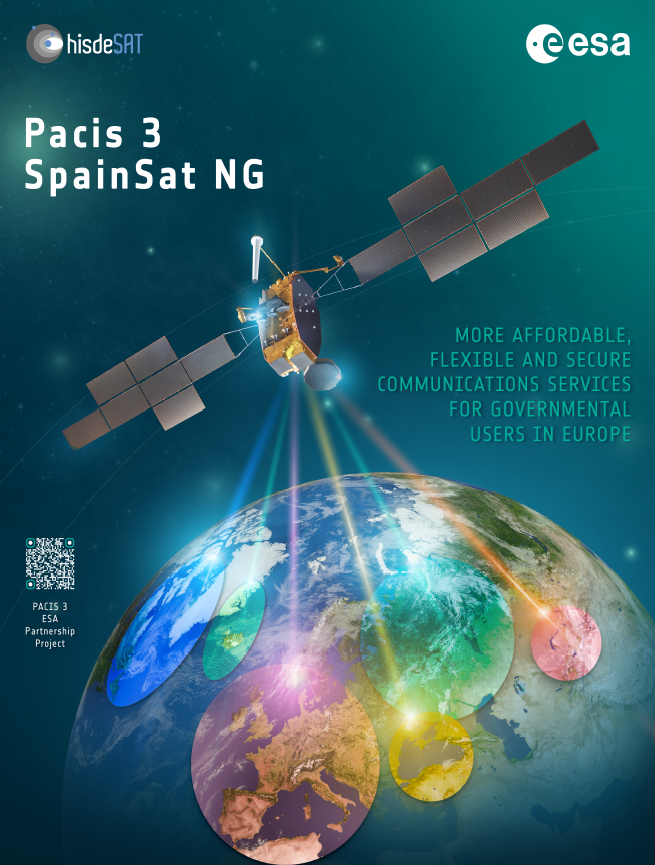
A poster for SpainSat NG. Image credit: ESA/Hisdesat
The geolocation performance has also surpassed design specifications. The precision and accuracy of the satellite’s geolocation capability, which is a critical feature for signal origin determination and threat assessment, has benefited from the exceptional stability demonstrated by all payload components and electronic modules throughout the first operational year.
With all critical systems operating at or beyond specifications, SNG 1 has established a strong foundation for reliable secure communications, which will carry through to 2040 when the mission is planned to conclude. The conservative operating margins and excellent performance across thermal, electrical, RF, and geolocation systems provide confidence in the satellite’s ability to serve Spanish government, allied nations, and NATO partners over the coming years.
“This collaboration underscores the strength of European cooperation in advancing space technology. Pacis 3 will not only enhance secure communication capabilities for governments, but also contribute to the long-term competitiveness and expertise of Europe,” said Oscar Del Rio Herrero, ESA’s former Pacis 3 Project Manager.
“The excellent stability of both our transmit and receive systems has enabled geolocation performance that exceeds our original expectations,” said Basilio Garrido, Hisdesat Project Manager for Spainsat NG.
Home
/ User Terminal Workshop hosted by ESA and the Europ...
User Terminal Workshop hosted by ESA and the European Commission convenes to shape the future of satellite connectivity solutions
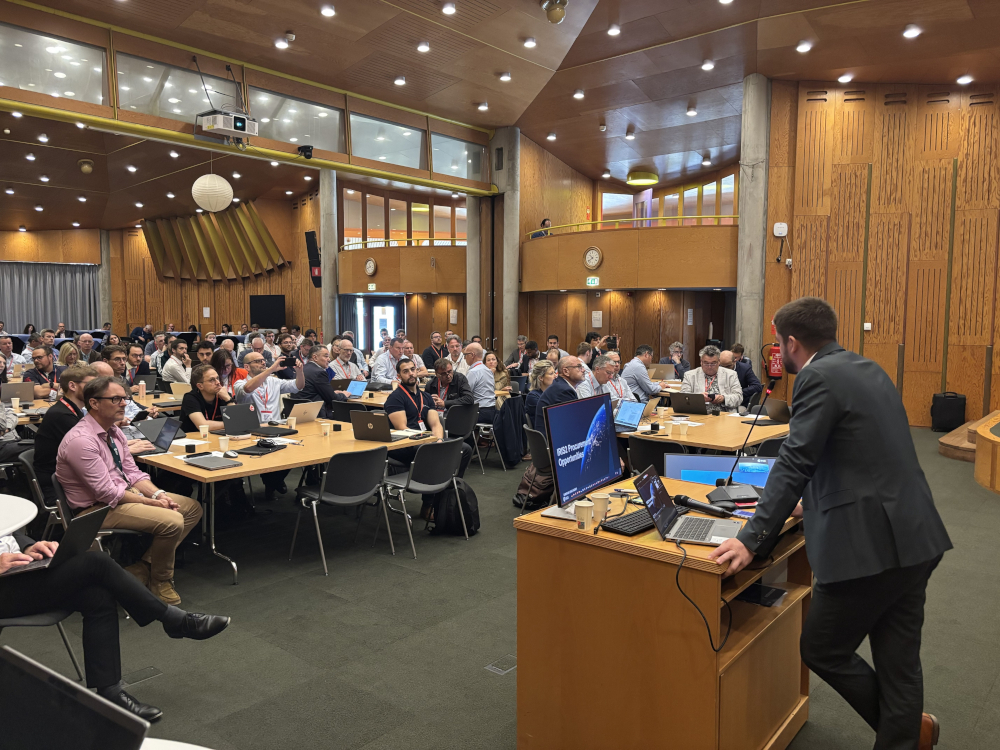
The European Space Agency (ESA), in collaboration with the European Commission held a workshop dedicated to User Terminal technology and products, on 6 July 2026 in the Agency’s European Space Research and Technology Centre (ESTEC), in the Netherlands.
ESA User Terminal Workshop. Image credit: European Space Agency
The event convened over one hundred technology and business experts from representatives of ESA Member States’ industry and institutions, with a hundred more joining online. The workshop featured presentations on ESA’s Advanced Research in Telecommunications Systems (ARTES) Flat Panel User Terminal Roadmap, and upcoming User Terminal Procurement Opportunities under the Infrastructure for Resilience, Interconnectivity and Security by Satellite (IRIS²) programme.
IRIS² is the next flagship programme of the European Union, and a strategic asset for the EU, in support of its strategic autonomy, resilience and competitiveness. Through the ESA Programme Related to EU Secure Connectivity, ESA plays a pivotal role by serving as the technical backbone, industrial orchestrator and oversight authority that bridges the EU’s policy ambition with industrial delivery.
ESA’s ARTES programme enables European and Canadian industry to develop innovative, market-leading satellite communications products, strengthening their global competitiveness while creating new business opportunities, jobs, and economic growth across multiple sectors of the space economy.
Over the day-long workshop, industry and delegates from ESA Member States were invited to discuss pathways to the development of competitive user terminal solutions and their deployment – a crucial component that will support future European satellite constellations.
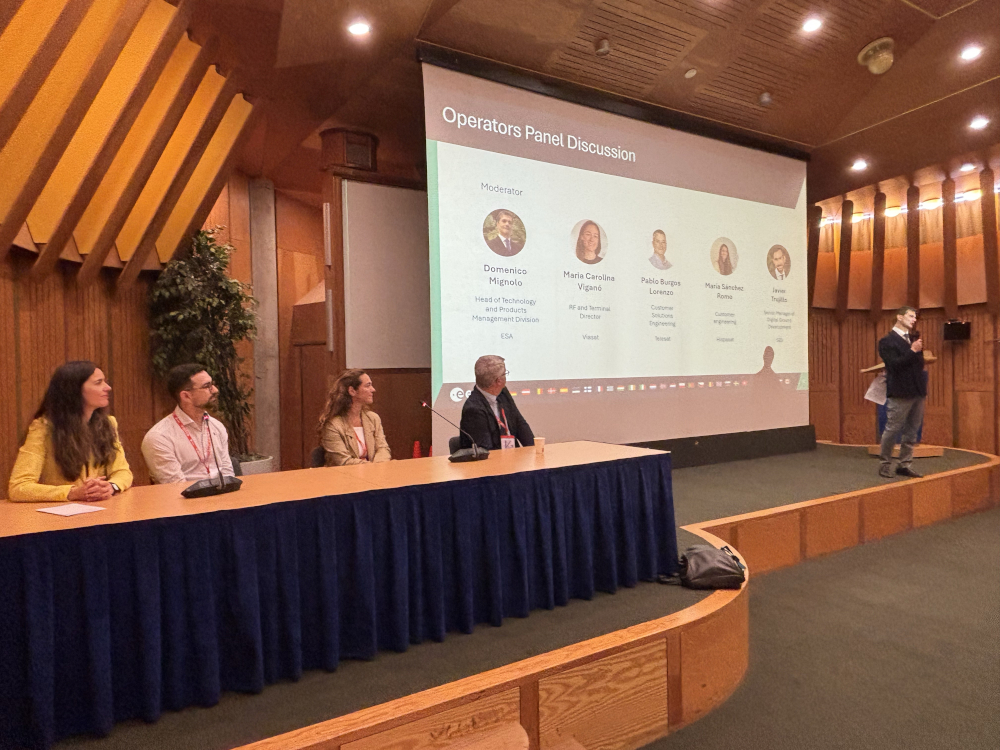
Panel session at ESA User Terminal Workshop. Image credit: European Space Agency
ESA and the European Commission showcased IRIS² and ARTES, two key programmes accelerating the development and industrialisation of Europe’s resilient and secure communications infrastructure. The outlook was complemented with a panel discussion featuring panellists from Viasat, TELESAT, Hispasat and SES, and moderated by Domenico Mignolo, Head of Technology and Products Management Division at ESA’s Resilience, Navigation and Connectivity directorate.
The centrepiece of the workshop were three round table sessions, enabling industry participants to exchange experiences, network openly, and discuss challenges and opportunities across the entire user terminal value chain.
“The European satellite ecosystem is entering a new phase. As future constellation takes shape, and resilient infrastructures are being built for European citizens. Competitive user terminal solutions have become a critical enabler of the satellite connectivity,” said Laurent Jaffart, Director of Resilience, Navigation and Communication at ESA, in the workshop’s inaugural address. “At ESA, we are working in close cooperation with the Commission and our industrial partner, SpaceRISE, to ensure that we will have cost-competitive, cutting-edge terminals covering diverse operational scenarios such as fixed, mobile, and maritime use.”
The workshop event helped to bring European strategic priorities into focus and kickstart discussions among institutional and industry stakeholders. Both the panel and round table sessions provided valuable insights into the global satellite communication user terminal market and its competitive dynamics.
ESTEC, Keplerlaan 1, 2201 AZ Noordwijk, Netherlands
The European Space Agency (ESA) and the European Commission invite European and ESA Member states industry to a User Terminal workshop including a presentation of the ARTES and IRIS² User Terminal Roadmap, industry panels, and round tables.
The European satellite ecosystem is advancing its capabilities to support the deployment of future satellite constellations and resilient infrastructures for European citizens. This workshop will focus on the development and deployment of competitive European user terminal solutions as a key enabler of satellite connectivity. It will address the complete user terminals technology and value chain, from key components (flat panel antennas, interfaces, chipsets) through terminal integration, regulatory certification, and scalable production.
The objective is to align stakeholders on targeted priorities and capabilities, initiate discussions on upcoming procurement opportunities within the ARTES and IRIS² Programmes, and enable structured networking (B2B sessions) between ESA, the European Commission (EC), and industry participants.
PROGRAMME
09:30-10:00
Registration / Welcome Coffee
10:00-10:30
Opening (ESA/EC)
10:30-11:15
ARTES and IRIS2 Roadmap and procurement opportunities (ESA/EC)
…EUROPE AND CANADA LOST SATELLITE COMMUNICATIONS FOR SEVEN DAYS?
In late 2025, ESA commissioned a study from London Economics to illustrate the critical role of satellite communications (satcom)
The study examined the positive economic and social impact of satcom across five key sectors
Maritime
Aviation
Consumer
Energy
Payment
To capture the scale of Europe and Canada’s reliance on satellite communications and their positive contributions, London Economics’ study estimates the cost of satcom’s absence. The study applies a hypothetical scenario wherein satellite communications are disrupted over seven days during an average week of the year. In this scenario, satellite communications are inhibited across all orbits – with no identified cause – leading to an immediate and global loss of satcom while other space-based services remain operational. The total monetised impacts from this hypothetical loss of satellite communications were estimated at up to €20 billion over the seven-day period.
The London Economics study maps the use of satellite communications across the maritime, aviation, consumer, energy and payment sectors, as well as their related use cases, taking into consideration their dependence on satcom versus terrestrial alternatives. To do so, London Economics undertook 48 stakeholder consultations with customers and end-users of satellite communications, as well as satellite operators and connectivity providers, national regulators, expert stakeholders, financial institutions and academics. The estimate yielded by this study focuses on the economic and social costs of a disruption, quantifying the number of households and businesses affected through:
LOSS OF REVENUE
OPERATIONAL DELAYS
CONSUMER WELFARE LOSS
ENVIRONMENTAL COST
This study illustrates the importance of sustaining resilient satellite communications that support the economic growth and maintenance of social norms across Europe and Canada.
KEY FINDINGS
The result of this study estimates the total monetised impacts from loss of satellite communications in a bracket ranging from €10.2 billion up to as high as €20 billion, as suggested by a sensitivity analysis. In particular, the maritime sector accounts for more than 90% of losses – as high as €19 billion. These findings represent a snapshot of losses based on the current usage of satellite communications in Europe and Canada – a figure that is expected to grow in the medium term as new technologies make their way to market, driving adoption of space-based communications. The socio-economic benefits principally affected by this loss are considered to be (click on the tabs below to cycle through entries):
DIGITAL INCLUSION
Households with no terrestrial infrastructure become cut-off
CARBON SAVINGS
Maritime and aviation routes can no longer be optimised and shortened
SHIPPING
Disrupted vessel and port operations, as well as knock-on effects result in major losses across supply chains
THE RESULTS – MARITIME
CONSERVATIVE
€9.6 billion
SENSITIVE
€19 billion
GMDSS
Inoperative
The total estimated impacts for the maritime sector range from €9.6 billion to €19 billion. The loss of economic activity in transport, warehousing and port support services, as well as the wider knock-on effects across supply chains affect ESA Member States and Canadian domestic industries due to their dependence on maritime imports for key inputs. What’s more, disrupted vessel operations – including for the Global Maritime Distress and Safety System (GMDSS) – go on to affect the safety of transiting cargo and of roughly 178,000 cruise passengers.
THE RESULTS – AVIATION
CONSERVATIVE
€307.6 million
SENSITIVE
€558.7 million
CANCELLED FLIGHTS
4,000 flights
The estimated impact for aviation ranges from a €307.6 million to €558.7 million, with loss of satellite communications impacting ESA Member States and Canadian airlines and Air Traffic Management and operations control centres. Within the seven-day timeframe of the study’s scenario, no less than 4,000 transatlantic flights are delayed or cancelled. The delays cost airlines €69.2 million, with 1,800 aircraft hours of cascading delays at major hubs valued at €63.8 million. European and Canadian passengers lose a collective 2.2 million hours at a cost of €58.4 million. In addition, the delays incur an environmental impact – with 200,000 tonnes of CO2 emitted at a cost of €44.1 million.
THE RESULTS – CONSUMER
CONSERVATIVE
€262.8 million
SENSITIVE
€352.7 million
FORCED OFFLINE
2.2 million
The estimated cost to consumer activities ranges from €262.8 million to €352.7 million, with 2.2 million citizens in ESA Member States and Canada losing their connectivity. The disruption of satellite communications has broad social consequences: users in remote and mountainous regions lacking coverage suffer the greatest impact, becoming completely cut-off. Digital isolation and reduced access to online education, remote work and healthcare delays are also compounded by the absence of satellite communications. Satellite-enabled emergency messaging in particular is estimated to reach a cost of €4.5 million in societal impact due to disrupted emergency responses.
THE RESULTS – ENERGY
CONSERVATIVE
€73.9 million
SENSITIVE
€89.8 million
FORCED OFFLINE
1,860
Estimated loss for the energy sector ranges from €73.9 million to €89.8 million. Offshore rigs in particular are impacted – pausing operations to the cost of €70.7 million, with standby costs incurred by stack warming reaching €3.1 million. Furthermore, the lack of terrestrial coverage and of alternative infrastructure affect the connectivity for 1,860 offshore crew, with consequences on welfare and mental health.
THE RESULTS – PAYMENTS
Although no monetisable impact was found for the payment infrastructure in ESA Member States and Canada, the consequences of a satellite communications disruptions are nevertheless tangible. ATM and Point of Sale (POS) machines in isolated communities with no terrestrial connectivity lose functionality. Additionally, Canada’s community aggregator model is found fully dependant on satellite operations. In contrast to other sectors however, strong contingency plans exist for payment infrastructure to mitigate loss of communication, enabling operations within seven days even if POS and ATMs become fully reliant on satellite communications in the future.
LIMITATIONS AND NEXT STEPS
The overall monetised impacts estimated by the study are expected to be higher than the brackets illustrated above. Indeed, multiple known users of satellite communications were excluded from the scope of this study – including media, government and defence. Moreover, monetised impacts do not account for financial transfers within Member States and can result in monetised impacts appearing lower than expected in this report.
Future research should explore the role of satellite communications as a back-up to terrestrial communication infrastructure, additional and emerging use cases, as well as evolving dependencies. This information will be invaluable to better inform resilience planning, investment decisions, and policy development.
CONSULT THE FULL REPORT
The full report is accessible for free on the London Economics website.
The European Space Agency (ESA) has announced that it has joined the O-RAN ALLIANCE to help develop ties between mobile operators and satellite network operators. ESA’s participation will boost space segment engagement with mobile network operators and facilitate the integration of satellite communications technologies and non-terrestrial networks (NTN) into future O-RAN standards.
Artist’s illustration of satellite and terrestrial networks. Image credit: Shutterstock
This move is coherent with the emphasis placed by ESA’s Member States on the development of 5G and 6G technologies and integrated terrestrial/non-terrestrial networks (TN/NTN). Indeed, the Space for 5G/6G and Sustainable Connectivity programme line of the Advanced Research in Telecommunications Systems (ARTES) programme was fully funded at the Council meeting at Ministerial level 2025 (CM25), reflecting the continued trust placed by ESA’s Member States in its mission to deliver the benefits of space communications technologies for its citizens.
ESA’s membership to the O-RAN ALLIANCE adds to a worldwide community of mobile network operators, vendors, and research, academic and government institutions, pooling deep practical know-how and technical insight. The ALLIANCE aims to transform the design and deployment of radio access networks (RAN), on which mobile telephony and connectivity rely. By promoting innovation throughout the telecommunications ecosystem, the ALLIANCE aims to enable standardised, open and interoperable interfaces and intelligent RAN functions across vendors, reducing dependency on proprietary solutions.
ESA is uniquely positioned to bridge the ALLIANCE’s existing community with Space Network Operators (SNO) and facilitate knowledge exchange and collaboration. Through ESA’s membership, SNOs will be able to work with the Agency to take an active contributor role to defining the operational requirements of the space segment and solving the technical challenges of merging the two network ecosystems.
In the view of accelerating this process and strengthening cooperation between the space and terrestrial ecosystems, ESA will join the O-RAN ALLIANCE’s work on NTN and will help to engage key stakeholders by leading a group of NTN companies working to interact with O-RAN. ESA and other NTN companies have already engaged with O-RAN in a workshop that took place at the O-RAN ALLIANCE Face-to-Face meetings in Rome in February 2026.
“Joining the O-RAN ALLIANCE is a major step towards fleshing out the integration of TN/NTN,” said Antonio Franchi, Head of ESA’s Space for 5G/6G & Sustainable Connectivity programme. “We will work together to define the standards that will steer the worldwide deployment of these next-gen networks for the benefit of our Member States’ citizens. At the same time, we are helping our satellite network operators become recognised as global leaders in the matter and fostering a strong ecosystem that will support their commercial success.”
“ESA’s participation in the O-RAN ALLIANCE reflects the strategic importance of embedding Non-Terrestrial Networks within open RAN architectures,” said Angelos Goulianos, 5G/6G Systems Engineer at the European Space Agency. “As 5G evolves towards 6G, space–terrestrial integration must be addressed at system level to ensure interoperable and resilient global connectivity. Through focused programme activities, coordinated industrial engagement, and access to ESA testing facilities and validation environments, ESA supports technology evolution and product readiness, strengthening European competitiveness towards the integration of terrestrial and non-terrestrial networks”
Home
/ ESA and GSMA Foundry open new round of Innovation ...
ESA and GSMA Foundry open new round of Innovation Challenges for 5G/6G connectivity via satellite at Mobile World Congress Barcelona 2026
The European Space Agency (ESA), in partnership with the GSMA Foundry has announced a new round of Innovation Challenges to fast-track technology and product developments that will advance networks blending terrestrial telecom infrastructure with satellite communications at Mobile World Congress (MWC) Barcelona 2026.
Laurent Jaffart, Director of Resilience, Navigation and Connectivity at MWC Barcelona 2026. Image credit: European Space Agency
For the past three years, the Innovation Challenges have been jointly defined by ESA and GSMA Foundry. Their goal is to help European industry scale innovations that will accelerate the delivery of ubiquitous global connectivity through the seamless integration of satellite and terrestrial assets. This year, new Challenge categories were unveiled across four strategic pillars, designed to advance technological developments pivotal to the commercialisation of such hybrid networks:
AI x NTN: Integrating Artificial Intelligence with the emerging trend of Non-Terrestrial Networks will allow next-generation mobile connectivity to benefit from nearly ubiquitous and continuous coverage by orchestrating traffic and dynamic spectrum through satellite networks on multiple orbits.
Direct-to-Device (D2D): On the ground, consumer and commercial users will rely on standardised and globally accessible satellite connectivity directly to consumer smartphones and Internet-of-Things (IoT) devices.
5G and 6G Hubs: The convergence of standards-based mobile connectivity and satellite communications will be advanced through targeted exchanges and collaborative testbeds to help operators and developers to create the next generation of hybrid network infrastructure.
6G innovation: Focusing on early-stage 6G technologies, such as edge intelligence and advanced IoT by emphasising areas where satellite-terrestrial convergence will play a crucial role.
The 2026 edition of the Innovation Challenges announced at MWC Barcelona 2026 is the third round in an ongoing partnership between ESA and the GSMA Foundry inaugurated in 2024. Successful applications selected by ESA and its National Delegations are invited by the GSMA Foundry to showcase their achievements at the MWC Barcelona conference. These live project demonstration contribute to increasing their visibility, as well as their opportunities for collaboration with leading organisations in the telecommunications and space sectors. Furthermore, successful applicants are directed to relevant ESA funding mechanisms and programmatic support to fast-track the development and commercialisation of their project.
ESA and GSMA Foundry at MWC Barcelona 2026. Image credit: European Space Agency
“Our Member States’ unwavering support in our programmes, particularly during the ESA Council at Ministerial Level (CM25), has made this collaboration with GSMA Foundry possible,” said Laurent Jaffart, Director of Resilience, Navigation and Connectivity at ESA. “At Mobile World Congress, we’re collectively marking a pivotal moment for the convergence of Europe’s space and telecommunication sectors. By offering funding access for AI, NTN, and D2D, we are not just developing technology; we are preparing for the seamless, global 6G infrastructure of tomorrow.”
“By combining the reach of the mobile industry with ESA’s space expertise, we are unlocking a new era of connectivity. This funding and our showcase demonstrate that hybrid networks are no longer a concept, they are a commercial reality,” Alex Sinclair, Chief Technology Officer at GSMA, said “The collaborative breakthroughs you see today signal a step-change for digital transformation, making seamless and universal connectivity possible even in the most remote regions. Together, we are driving forward innovation that will empower businesses, revolutionise industries, and bring transformative benefits to society as a whole.”
The New Frontiers stage at MWC Barcelona 2026. Image credit: European Space Agency
The up to €100 million investment put forward by ESA’s Members States at CM25 is part of their subscription to the Agency’s Space for 5G/6G and Sustainable Connectivity. Under this programme line, ESA’s aim is to support industry in integrating satellite communications with the connectivity currently enabled by terrestrial networks. The potential benefits of this convergence are far-reaching: mobile and Internet-of-Things connectivity could become consistently available by seamlessly switching from terrestrial to non-terrestrial networks. This ubiquitous connectivity will help bridge the digital divide by improving commercial and consumer applications, for example with access to emergency services and telemedicine, even in remote locations.
Applicants for the 2026 ESA and GSMA Foundry Challenges are now able to submit their projects to be considered for funding and support, as well as the opportunity to showcase their innovation at MWC Barcelona 2027.
Home
/ ESA, Airbus, TESAT and TNO set new record for fast...
ESA, Airbus, TESAT and TNO set new record for fast and secure optical communications from geostationary orbit
The European Space Agency (ESA), alongside Europe’s Airbus Defence and Space, the Netherlands Organisation for Applied Scientific Research (TNO), and TESAT, have successful demonstrated laser communications between an aircraft and a geostationary satellite over 36,000 kilometres away.
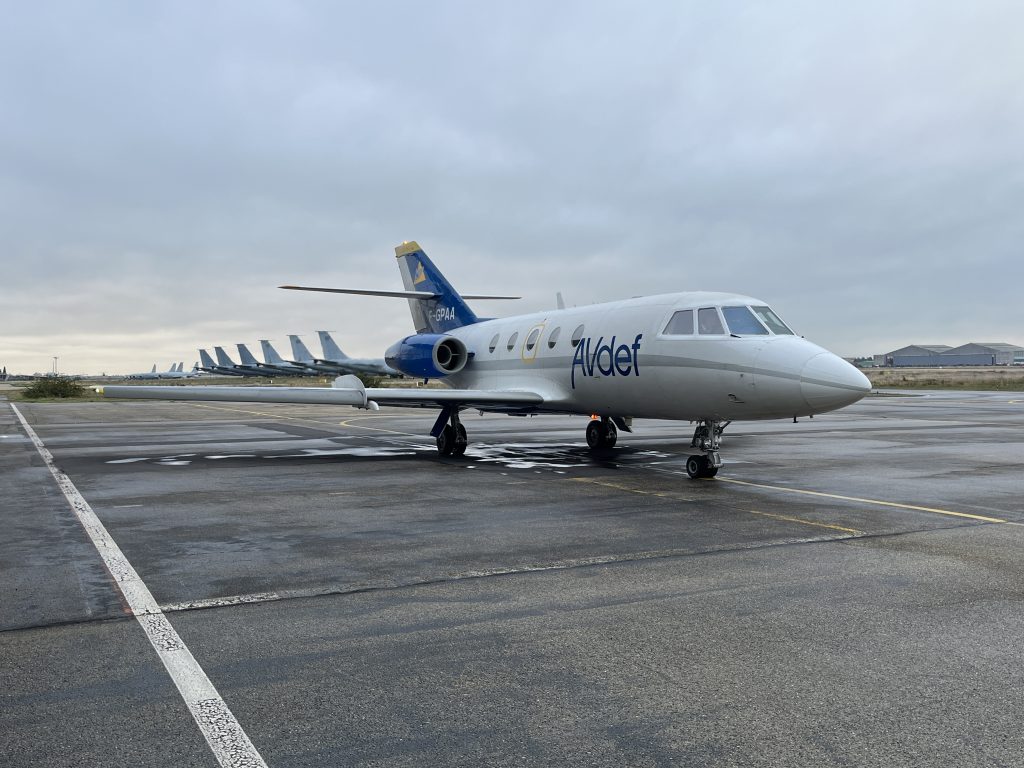
Test aircraft fitted with UltraAir terminal on the runway. Image credit: Airbus Defence and Space
In a series of flight tests from the Nîmes Airport in France, the jet aircraft equipped with Airbus’ UltraAir laser communication terminal established and maintained a secure laser link with its counterpart in geostationary orbit. On the aircraft, the UltraAir terminal’s mechanical and optical control technology – needed to achieve a stable laser link – was developed by TNO, while its free-space optical link was provided by Airbus subsidiary, TESAT.
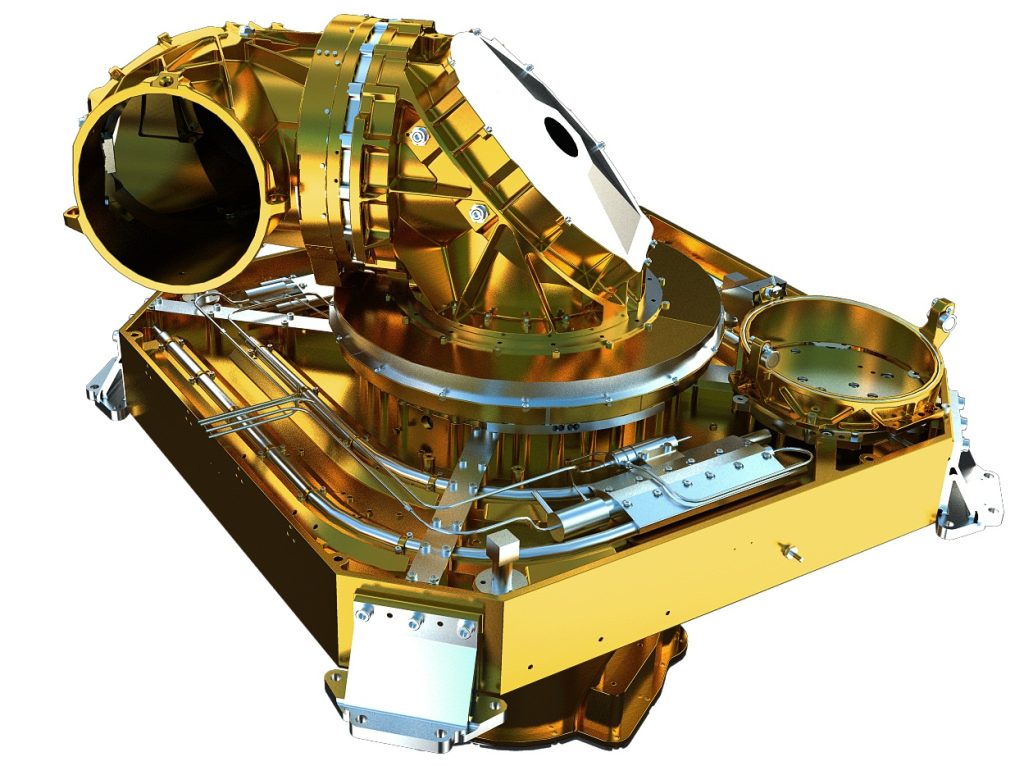
Together, these advancements allowed UltraAir to connect with a TDP–1, a testbed for the implementation of optical data links equipped onboard the Alphasat satellite. The TDP-1 Laser Communication Terminal is owned by the German Aerospace Center (DLR) and is operated by TESAT, in collaboration with ESA.
The Alphasat telecom satellite. Image credit: European Space Agency. Image credit: ESA-S. Corvaja
Optical data links have the potential to enable satellites to rapidly and securely transmit complete data sets in a single burst, a significant improvement over legacy Radio frequency (RF) systems. The UltraAir demonstration flights tested acquisition and tracking abilities for optical links from a moving platform – rather than a static ground station – and established a seamless performance: a bit error free, coherent data rate of 2.6 gigabit per second that remained uninterrupted for several minutes.
This advancement has both civilian and defence applications, providing a secure alternative to RF satellite communications. RF has historically been the backbone of satellite communications, but it can be intercepted, jammed and disrupted by user proliferation and adverse weather – decreasing the integrity and security of data transmissions. In defence, laser communications could help overcome the challenge posed by clouds in multidomain operations and make it harder to intercept communications. In civilian applications, it could enable high–speed data connections with mobile platforms such as passenger airliners, cars and ships to keep passengers connected.
Alphasat TDP1 Optical Communication Terminal. Image credit: TESAT, DLR
“This achievement demonstrates how optical communications can transform secure connectivity for our Member States. Particularly by working to resolve the technical challenges that come with establishing fast laser communications, capable of evading interference and detection in demanding conditions,” said Laurent Jaffart, Director of Resilience, Navigation and Connectivity at ESA. “Collaboration drives innovation, and this milestone will strategically deliver benefits to future missions, where speed and security of data transmission is paramount. For Europe and beyond.”
“Establishing laser links between moving targets at this distance is technically very challenging. Continuous movements, platform vibrations and atmospheric disturbances require extreme precision,” said François Lombard, Head of Connected Intelligence at Airbus Defence and Space. “This milestone is a further development of our long successful laser communication history; it opens the door to a new era of laser satellite communications to meet defence and commercial needs in the next decades.”
“This breakthrough proves that our industry strengthens Europe’s security and its autonomy by leading strategic technology in the field of secure laser communications,” said Kees Buijsrogge, Director of Space at TNO.
“Optical communications between airborne users and satellite networks, like ESA’s High-thRoughput Optical Network (HydRON), are high on ESA’s agenda,” said Harald Hauschildt, Head of ESA’s Optical and Quantum Communication Office. “High-data rate, low-latency links that connect High-Altitude Pseudo Satellites (HAPS) and aircraft are equally demanded for commercial and resilience driven applications.”
The project was co-funded by Airbus and TNO, with support from the Netherlands Space Office (NSO) and the German Aerospace Center (DLR) as part of ESA’s Optical and Quantum Communications – ScyLight programme.
Manage Consent
To provide the best experiences, we use technologies like cookies to store and/or access device information. Consenting to these technologies will allow us to process data such as browsing behaviour or unique IDs on this site. Not consenting or withdrawing consent, may adversely affect certain features and functions.
Functional
Always active
The technical storage or access is strictly necessary for the legitimate purpose of enabling the use of a specific service explicitly requested by the subscriber or user, or for the sole purpose of carrying out the transmission of a communication over an electronic communications network.
Preferences
The technical storage or access is necessary for the legitimate purpose of storing preferences that are not requested by the subscriber or user.
Statistics
The technical storage or access that is used exclusively for statistical purposes.The technical storage or access that is used exclusively for anonymous statistical purposes. Without a subpoena, voluntary compliance on the part of your Internet Service Provider, or additional records from a third party, information stored or retrieved for this purpose alone cannot usually be used to identify you.
Marketing
The technical storage or access is required to create user profiles to send advertising, or to track the user on a website or across several websites for similar marketing purposes.