ESA signs 18 new contracts to advance Low-LEO activities for the future evolution of IRIS²

Publication date

17 Sep 2026

The European Space Agency (ESA) has signed 18 consolidation contracts, worth a total of €20 million, to support the future evolution of the European Union’s Infrastructure for Resilience, Interconnectivity and Security by Satellite (IRIS²), an upcoming multi-orbital constellation designed to provide reliable connectivity for governments, commercial businesses and European citizens across Europe.
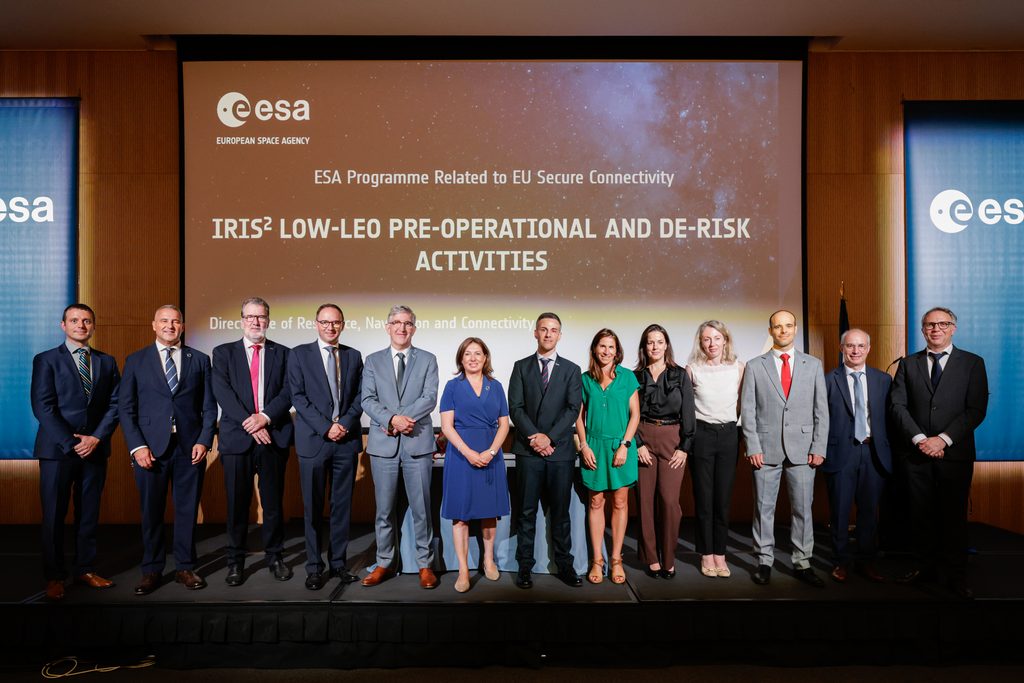
Director of ESA Resilience, Navigation and Connectivity, Laurent Jaffart (fourth from left) with the ESA Programme Related to EU Secure Connectivity team, and Giuditta Montesanti of the European Commission. Image credit: ESA

The signatures, which launch the consolidation phase of ESA’s Low-LEO component for new governmental services and associated mission concepts, range from secure broadband, maritime operations and safety, aviation and airspace to data relay and tasking, among others, and took place at ESA’s European Space Astronomy Centre (ESAC) in Madrid, Spain.

ESA Director of Resilience, Navigation and Connectivity, Laurent Jaffart, signed the agreements in the presence of representatives of the European Commission, and the selected industrial consortia. The contracts, which bring together nearly 80 European industrial partners, makes a move to strengthen the industrial base of ESA Member States, particularly Small- and Medium-Sized Enterprises (SMEs) and Midcaps. 

Low-LEO serves as the low Earth orbit layer of IRIS², operating below approximately 750 km above Earth. The proximity will be able to support lower-latency connectivity and capabilities such as direct connections between satellites and user devices, as well as Internet of Things (IoT) services. It also offers Europe the opportunity to develop and test new capabilities in-orbit without waiting for major lengthy changes to the constellation’s system. It is envisaged that 338 satellites will be in LEO (High LEO and Low-LEO).

The Low-LEO layer has two complementary components. The EU Low-LEO component, led by the European Commission, focuses on strategic government services. ESA’s component – which is being supported through the Agency’s Programme Related to EU Secure Connectivity – provides a rapid and recurrent mechanism for validating complementary governmental services and associated mission concepts in orbit, supporting their maturation and later integration into the operational EU IRIS² baseline.
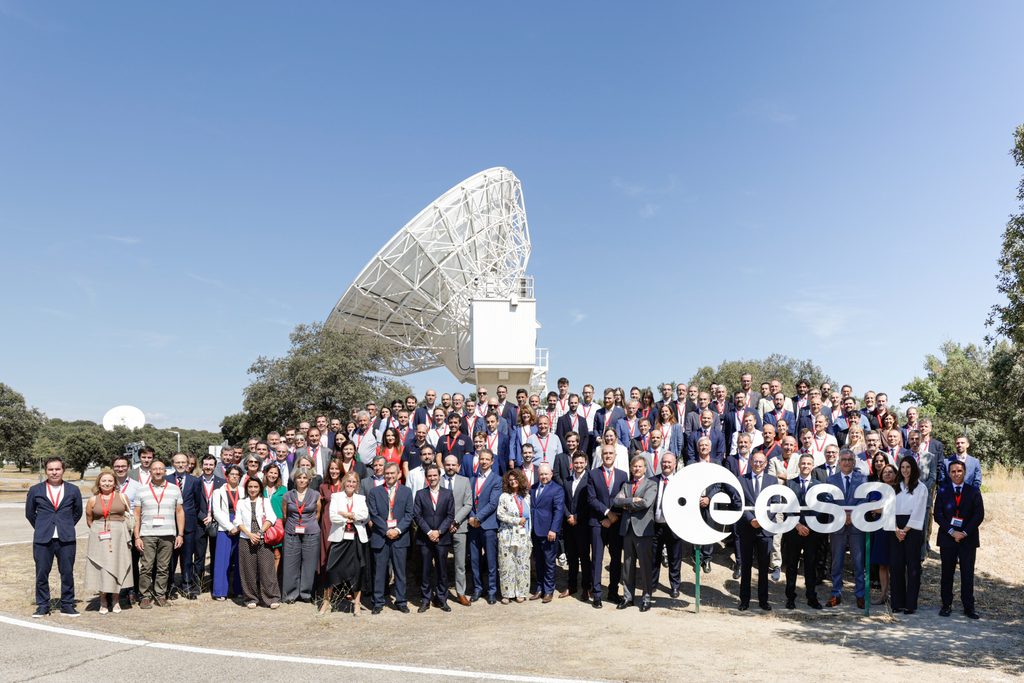
The European Space Agency (ESA) has signed 18 consolidation contracts, worth a total of €20 million, to support the future evolution of the European Union’s Infrastructure for Resilience, Interconnectivity and Security by Satellite (IRIS²). Image credit: ESA

As part of these activities, ESA, working with the European Commission, will assess the potential of key services and the suitability of associated mission concepts, including their added value, technical feasibility, and interoperability aspects with IRIS² and other European programmes.

Based on the outcomes of the consolidation phase, in terms of maturation and subject to future programme priorities, ESA will initiate several procurements for an implementation phase that will feature a concrete set of missions, planned for implementation between 2027–2029, to validate the targeted services in orbit up to a pre-operational level.

The future of secure connectivity will not be defined by a single technology or a single orbit. It will come from combining complementary capabilities and having the flexibility to adapt as Europe’s needs evolve. Through its Low-LEO activities, ESA looks forward to working hand-in-hand with the European Commission and European industry to explore what comes next for IRIS²; to shape the capabilities that will support Europe’s future connectivity needs,” said Laurent Jaffart, Director of ESA’s Resilience, Navigation and Connectivity.
Quantum source for ESA’s QKDSat mission achieves key qualification milestone for next-generation secure communications

Publication date

01 Sep 2026

A critical technology that will contribute to the future of Europe’s quantum-secure communications has reached a major development milestone.

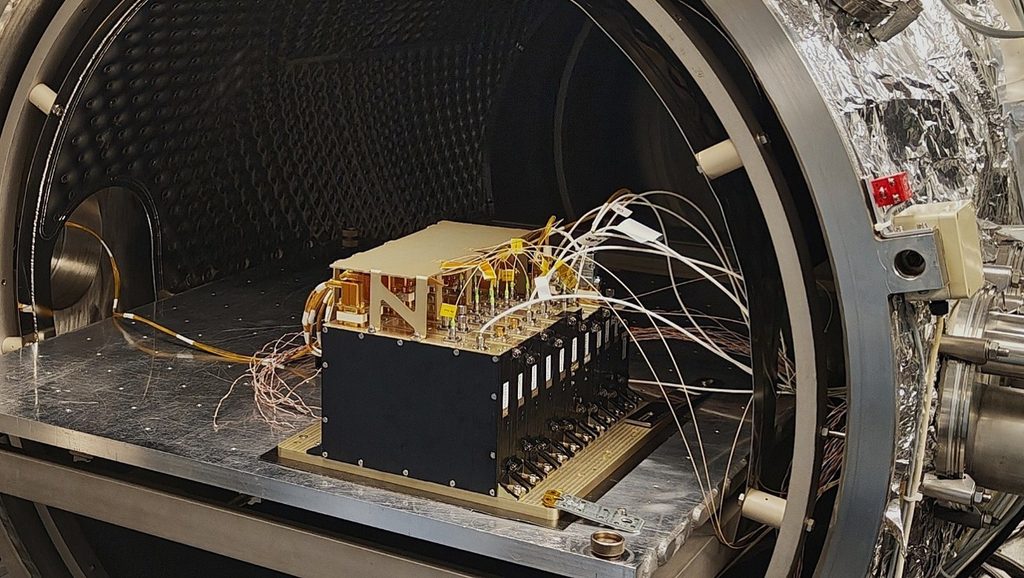
The Quantum Faint Pulse Source, which was developed by Spanish company DAS Photonics and will be placed on ESA’s Quantum Key Distribution Satellite (QKDSat) spacecraft, has successfully completed its qualification campaign. The testing, which took place with a prototype – an Engineering Qualification Model – marks significant progress towards Europe’s plans to deliver operational and commercial quantum-secure cryptographic key services.

The Faint Pulse Source Engineering Qualification Model in the TVAC testing at ESA-VSC Testing facility in Valencia, Spain. Image credit: DAS Photonics

QKDSat, an ESA Partnership Project with Honeywell Aerospace in collaboration with satellite prime contractor, Redwire Europe, aims to demonstrate a pre-operational satellite-based Quantum Key Distribution service, which will enable the secure exchange of cryptographic keys based on the principles of quantum physics.

By extending secure communications beyond the limitations of terrestrial fibre networks, QKDSat will help pave the way for resilient, sovereign and quantum-secure connectivity for governments, critical infrastructure operators and commercial users across Europe.

The Quantum Faint Pulse Source is one of QKDSat’s most crucial payload elements. Developed using advanced photonic technologies, it generates the precisely controlled optical pulses required for Quantum Key Distribution while incorporating embedded security mechanisms that support the mission’s end-to-end security. The Quantum Faint Pulse Source’s Engineering Qualification Model, which was designed, developed and qualified by the EM&E Group-owned DAS Photonics, has been delivered to Redwire Europe for end-to-end testing with QKDSat’s quantum payload.

To date, the successful functional and environmental qualification campaign confirmed that the Engineering Qualification Model, and therefore the Quantum Faint Pulse Source, meets the demanding performance and environmental requirements for operation in space. Conducted in accordance with applicable European Cooperation for Space Standardisation (ECSS) requirements, the campaign validates the maturity of the design and manufacturing approach ahead of flight-model production.

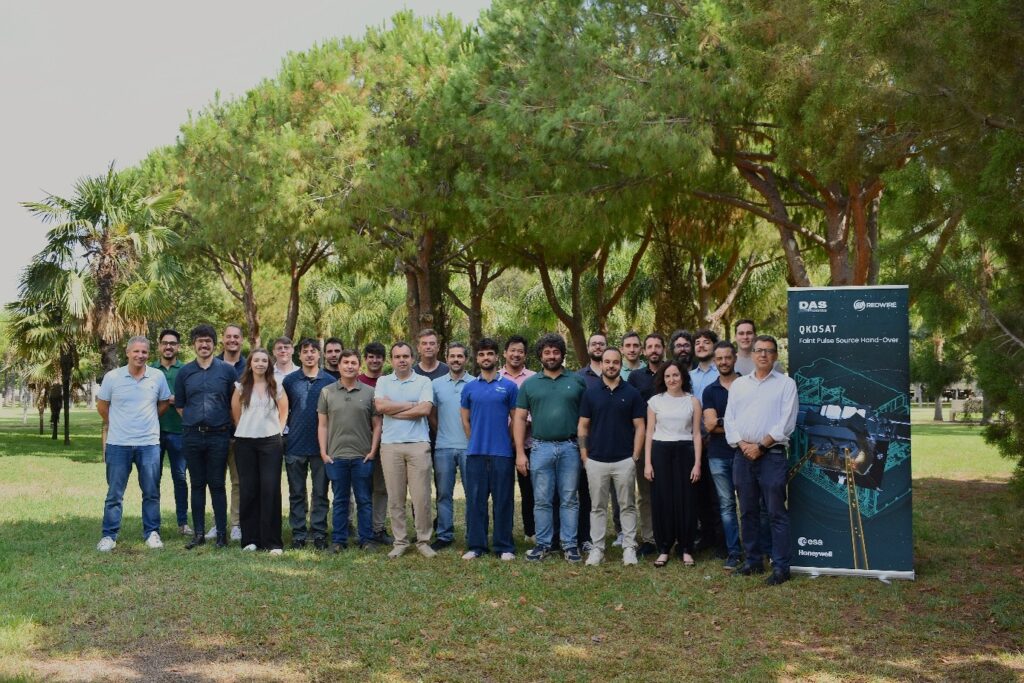
The DAS Photonics Team behind the Faint Pulse Source. Image credit: DAS Photonics

The qualification activities were supported not only through the QKDSat Partnership Project, but also through an Industrial Competitiveness co-funded contract between ESA and DAS Photonics. The Partnership Project and Industrial Competitiveness programmes are based within the Agency’s Advanced Research in Telecommunications Systems (ARTES) programme.

As well as bringing together leading European partners to develop the technologies and services that will form the basis of future operational quantum communications, QKDSat also includes two industrial partners, British Telecom Group and Colt Technology Services, to ensure that the technologies being developed today can evolve into future operational services.

“Europe’s future depends on trusted, secure communications, and space has a central role to play in delivering them. This important milestone for QKDSat demonstrates how ESA is working with European industry to transform cutting-edge research into operational capabilities that will strengthen the resilience, technological leadership and global competitiveness of our Member States. I congratulate DAS Photonics and the entire consortium on this achievement, which will contribute to future-proofing Europe’s critical infrastructure,” said Laurent Jaffart, Director of ESA’s Directorate of Resilience, Navigation and Connectivity.
“The successful qualification of the Faint Pulse Source is a key milestone for DAS Photonics and for the advancement of European quantum-secure communications,” said Marta Beltrán, Space Director at DAS Photonics. “It demonstrates our ability to transform advanced photonic technologies into robust, space-qualified subsystems. We are proud to contribute to a programme that is laying the foundations for the next generation of secure communications infrastructure.”

ESA and Spain sign agreement to advance Europe’s secure connectivity future

Publication date

20 May 2026

ESA and the Agencia Espacial Española (AEE) have signed a Memorandum of Intent (MoI) to strengthen cooperation on Europe’s future secure connectivity infrastructure. The agreement reinforces Spain’s leading role and the Agency’s contribution to the EU’s IRIS2 multi-orbital constellation, particularly through Low-LEO pre-operational activities within the ESA Programme Related to EU Secure Connectivity.

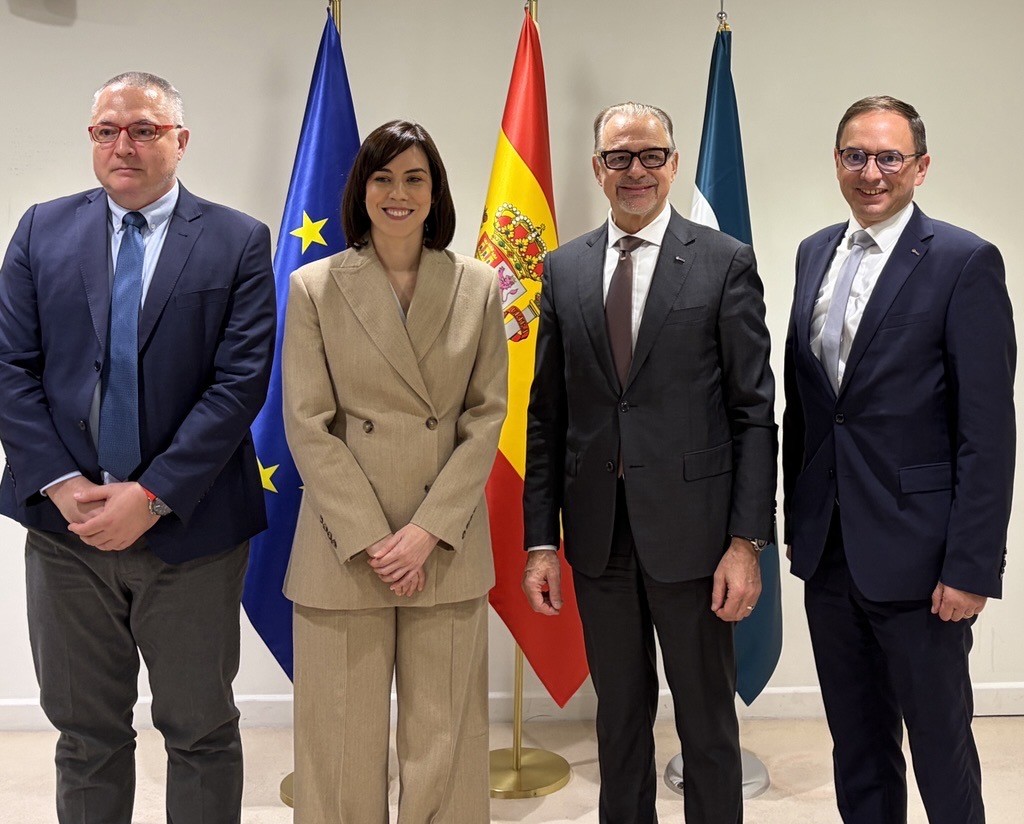
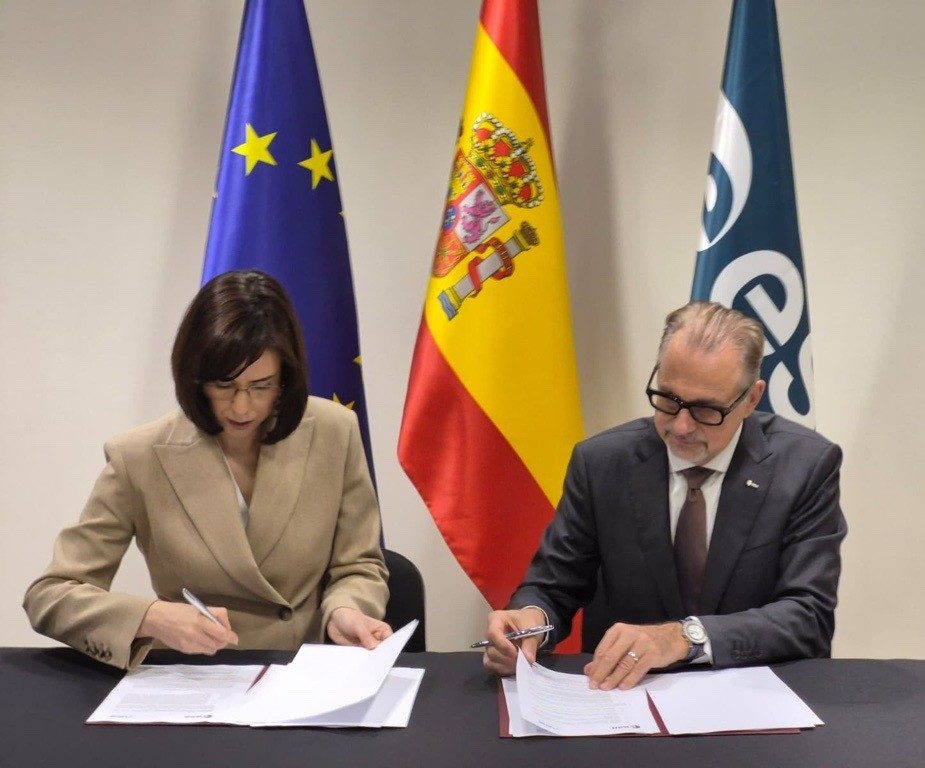
The Memorandum of Intent (MoI) was signed by ESA Director General, Josef Aschbacher, and the Minister of Science, Innovation and Universities of Spain, Diana Morant. Image credit: ESA/AEE

Taking place during the Congreso del Espacio 2026 in Madrid on 20 May, the Memorandum was signed by ESA Director General, Josef Aschbacher, and the Minister of Science, Innovation and Universities of Spain, Diana Morant. Present during the ceremony was Laurent Jaffart, Director of ESA’s Resilience, Navigation and Connectivity, and Director of Agencia Espacial Española (AEE), Juan Carlos Cortés.

In particular, the collaboration will address the ESA Programme Related to EU Secure Connectivity’s ‘Element 3’, where Spain is currently the Agency’s largest contributor. Working to maintain the IRIS² system at a state-of-the-art standard, the Element introduces forward-looking activities with the aim to prepare new services, strengthen resilience, accelerate user adoption and expand the multi-orbital constellation’s capabilities. It will allow for a secure, resilient and future-proof European connectivity infrastructure that’s capable of adapting to emerging operational needs.

The agreement will additionally establish a framework for exploring increased programme activities in Spain and foster closer technical cooperation between ESA and AEE, including the creation of a dedicated IRIS² integrated project team in Spain, with a particular focus on ESA’s Low-LEO layer efforts.

Beyond IRIS², which serves as the next flagship programme of the European Union after Copernicus for Earth observation and Galileo for navigation, the agreement reflects a broader ambition to deepen cooperation in resilience from space, satellite navigation and secure connectivity domains, in support of Europe’s long-term strategic autonomy and operational resilience.

The agreement reinforces Spain’s leading role and the Agency’s contribution to the EU’s IRIS2 multi-orbital constellation, particularly through Low-LEO pre-operational activities within the ESA Programme Related to EU Secure Connectivity. Laurent Jaffart, Director of ESA’s Resilience, Navigation and Connectivity (far right) and Director of AEE, Juan Carlos Cortés (far left) were also present during the ceremony. Image credit: ESA/AEE

Josef Aschbacher, ESA Director General, said: “With IRIS², Europe is building the next generation of secure connectivity from space. Through this agreement with Spain, ESA is advancing the technologies and partnerships needed to ensure these systems are resilient, trusted, and under European control.”

Diana Morant, the Minister of Science, Innovation and Universities of Spain, said: “Spain has stopped looking at the future with resignation and has started building it with technological and industrial ambition”, and expressed her conviction that “space must serve to improve the lives of those of us living on Earth.”

Juan Carlos Cortés, Director of the Agencia Espacial Española, said: “With this Memorandum, Spain reaffirms its commitment to IRIS² and becomes an architect of secure European connectivity, leading the programme’s Low-LEO component.”

In cooperation with the European Commission, IRIS² will be a strategic asset for Europe. Comprising of a multi-orbital constellation of less than 300 satellites spanning across LEO and MEO, it will support independence, resilience and competitiveness in an increasingly digital world. ESA plays a pivotal role in the programme by serving as the qualification and validation authority, while the SpaceRISE consortium is responsible for developing, deploying and operating the constellation.