

LATEST NEWS
October 8, 2026 • 16:16
October 7, 2026 • 09:02
September 24, 2026 • 15:12
September 17, 2026 • 15:26
23 Sep 2026
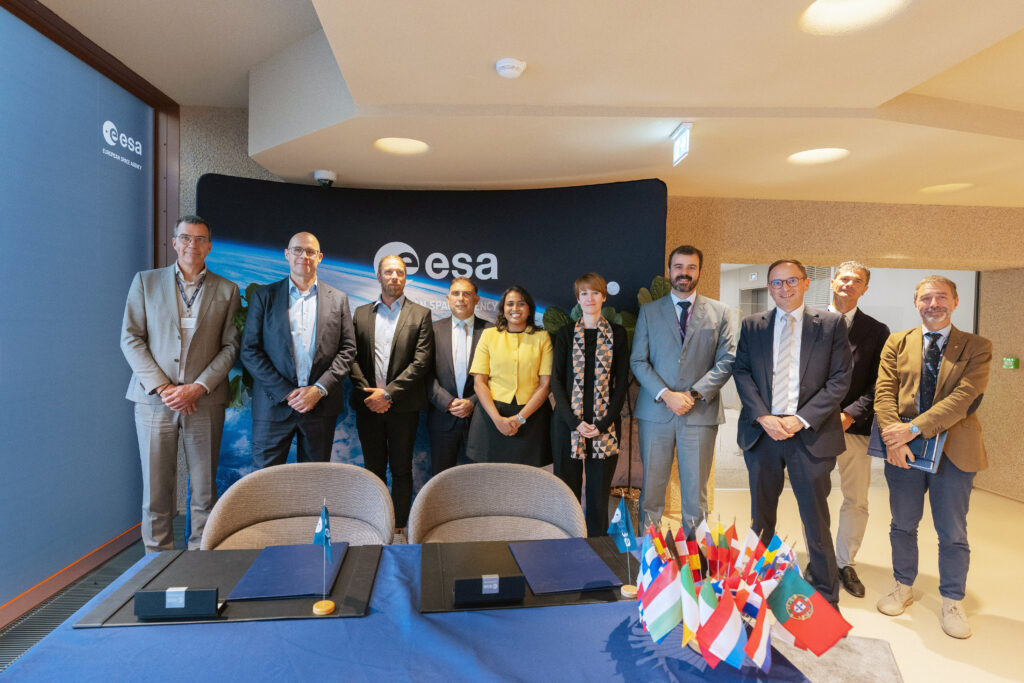
The European Space Agency (ESA) has signed a contract with ClearSpace Luxembourg for the Agency’s Phoenix Partnership Project to advance the development of a European in-orbit servicing spacecraft and its related commercial service for satellites in geostationary orbit. The signature took place under the auspices of the inaugural communications programme board meeting of ESA’s Resilience, Navigation and Connectivity directorate.

The new contract, signed at ESA Headquarters in Paris, France, kick-starts the next phase of Phoenix with a partnership between ESA and an industrial consortium led by Prime ClearSpace in Luxembourg, with planned contributions from Critical Software in Portugal and Spherical Systems in the Netherlands. With the overall goal of establishing the groundwork for a fully-fledged, recurring commercial service, ESA and the consortium will take key technologies to Technology Readiness Level (TRL) 5 and mature the system, platform, payload, software and ground segment through applicable Preliminary Design Reviews (PDRs).
Geostationary satellites are critical space infrastructure providing communications, broadcasting and weather monitoring services. These satellites’ operational life is often limited by the depletion of their embarked propellant, even if their mission-critical components are still operational. Consequently, in-orbit servicing capabilities enabling continued station-keeping and attitude-control manoeuvres have emerged as a crucial element to reinforce Europe’s resilience in space. Such services could also reduce the need for expensive replacement satellites, helping to preserve industrial and launch capacity.
To fulfil this strategic capability, the Phoenix Partnership Project consolidates several existing collaborations and offers continuity under the banner of a single European service. The consortium will build on system definition and requirements outlined in the project’s previous phase to realise its baseline concept: an innovative, non-intrusive docking interface, compatible with satellites not initially conceived for life-extension.
The project brings together several existing investments, advancements and strong relationships, including the Luxembourg Space Agency’s (LSA) LuxIMPULSE programme, funded by LSA and implemented by ESA under Article 9.2 of the Agency’s Convention. The project leverages the initial mission and docking-system baselines defined by LuxIMPULSE, as well as ClearSpace and Critical Software’s experience working on ongoing European servicing missions including ClearSpace-1, CLEAR and PRELUDE.
The Phoenix Partnership Project is implemented by the ESA Resilience, Navigation and Connectivity directorate’s Space Resilience Office and co-funded by the Agency’s Advanced Research in Telecommunications Systems (ARTES) Industrial Competitiveness programme line, with ClearSpace providing the remaining industry contribution. The ARTES investment and its support framework will help to de-risk the maturation and development of the technologies at the heart of the servicer’s mission.
The Phoenix end-to-end architecture combines a spacecraft platform with a servicing payload developed by ClearSpace, featuring the mission-critical docking system and guidance, navigation and control (GNC) subsystem. The programme also foresees contributions from Critical Software and Spherical Systems for payload flight software and robotic control electronics respectively. In addition, the partnership project includes development of ground segment for mission operations and navigation functions.
The structure of the partnership project will enable the consortium to mature the assembly, integration and verification procedures (AIV) strategy, procurement baseline and overall industrial capabilities required for subsequent implementation and ultimately for the establishment of a recurring commercial servicing capability in geostationary orbit.
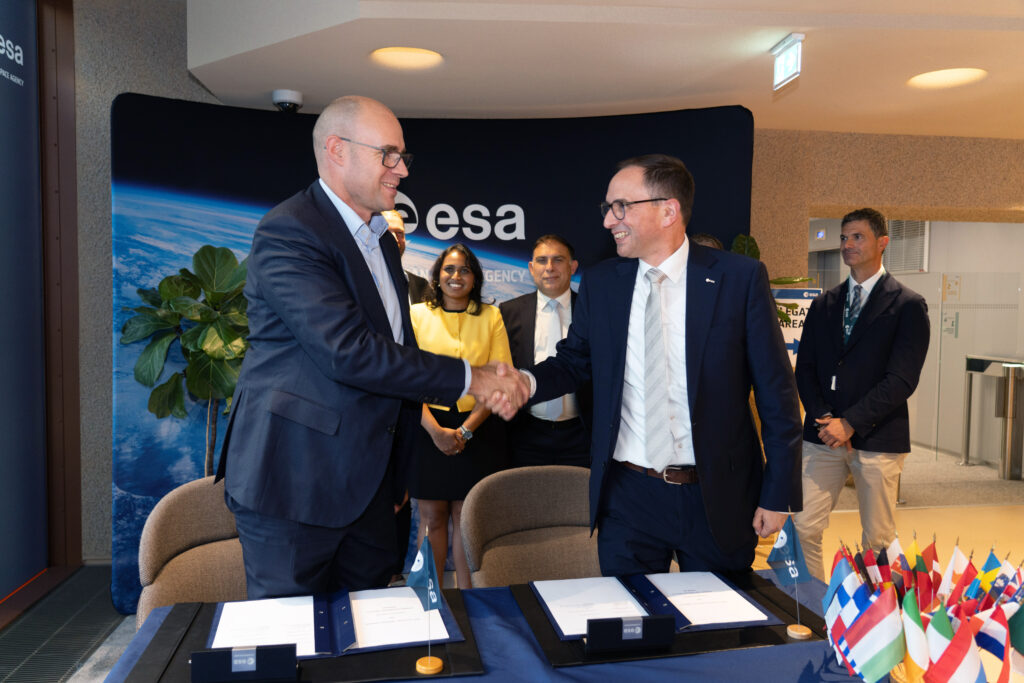
Laurent Jaffart, Director of Resilience, Navigation and Connectivity at ESA said: “ESA is dedicated to helping Europe build the capabilities needed for the next generation of in-orbit services. In cooperation with our Member States and European industry, we’re taking Phoenix to the next level by working to mature the dual-use technologies that will deliver clear benefits for sustainability, resilience, and the competitiveness of Europe’s space sector. Together, we will strengthen our position in this emerging market.”
Luc Piguet, CEO and co-founder of ClearSpace, said: “Phoenix is the result of a shared ambition to make in-orbit servicing a practical and valuable capability for satellite operators. We are deeply grateful to ESA, to Luxembourg and the Luxembourg Space Agency, and to the Member States whose continued commitment to European space capabilities has made this progress possible. Their support has allowed ambitious ideas to be transformed into technologies, missions and increasingly tangible services. We are fully committed to the mission: working with ESA, its Member States, our industrial partners and our customers to build a safe, competitive and commercially sustainable European in-orbit servicing capability.”
The technology, flight heritage and operational experience established through the Phoenix commercial service are intended to pave the way to further in-orbit logistics applications. In particular, the core rendezvous and docking capabilities could be extended to relocation, inclination correction, end-of-life disposal, inspection and bring-into-use services and, in the longer term, refuelling and other servicing capabilities.