

LATEST NEWS
August 28, 2026 • 11:53
August 7, 2026 • 16:13
August 6, 2026 • 17:18
EVENTS
January 25, 2022
01 Sep 2026
A critical technology that will contribute to the future of Europe’s quantum-secure communications has reached a major development milestone.
The Quantum Faint Pulse Source, which was developed by Spanish company DAS Photonics and will be placed on ESA’s Quantum Key Distribution Satellite (QKDSat) spacecraft, has successfully completed its qualification campaign. The testing, which took place with a prototype – an Engineering Qualification Model – marks significant progress towards Europe’s plans to deliver operational and commercial quantum-secure cryptographic key services.
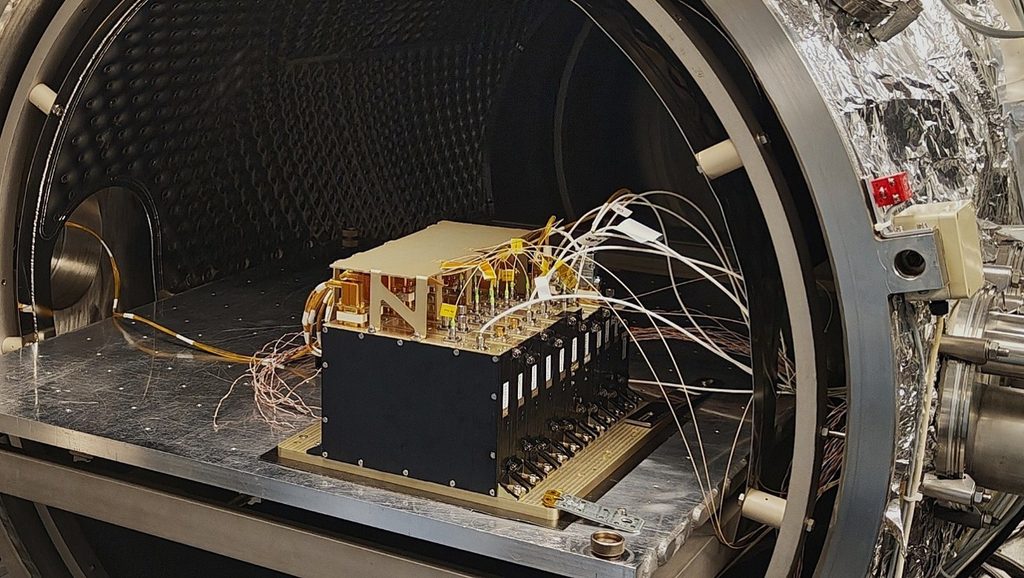
QKDSat, an ESA Partnership Project with Honeywell Aerospace in collaboration with satellite prime contractor, Redwire Europe, aims to demonstrate a pre-operational satellite-based Quantum Key Distribution service, which will enable the secure exchange of cryptographic keys based on the principles of quantum physics.
By extending secure communications beyond the limitations of terrestrial fibre networks, QKDSat will help pave the way for resilient, sovereign and quantum-secure connectivity for governments, critical infrastructure operators and commercial users across Europe.
The Quantum Faint Pulse Source is one of QKDSat’s most crucial payload elements. Developed using advanced photonic technologies, it generates the precisely controlled optical pulses required for Quantum Key Distribution while incorporating embedded security mechanisms that support the mission’s end-to-end security. The Quantum Faint Pulse Source’s Engineering Qualification Model, which was designed, developed and qualified by the EM&E Group-owned DAS Photonics, has been delivered to Redwire Europe for end-to-end testing with QKDSat’s quantum payload.
To date, the successful functional and environmental qualification campaign confirmed that the Engineering Qualification Model, and therefore the Quantum Faint Pulse Source, meets the demanding performance and environmental requirements for operation in space. Conducted in accordance with applicable European Cooperation for Space Standardisation (ECSS) requirements, the campaign validates the maturity of the design and manufacturing approach ahead of flight-model production.
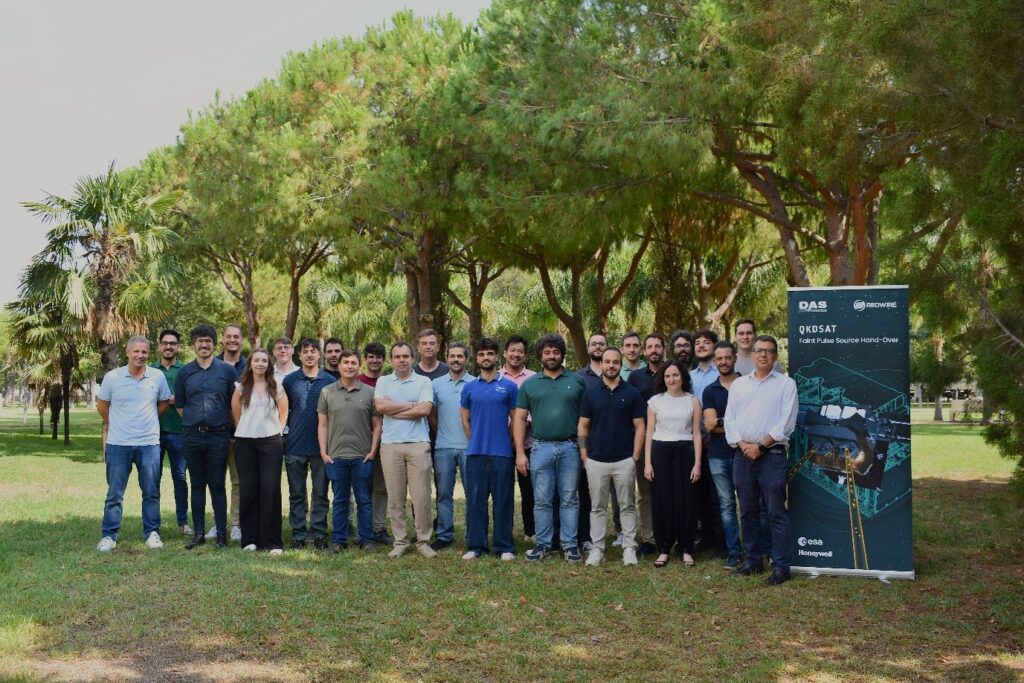
The qualification activities were supported not only through the QKDSat Partnership Project, but also through an Industrial Competitiveness co-funded contract between ESA and DAS Photonics. The Partnership Project and Industrial Competitiveness programmes are based within the Agency’s Advanced Research in Telecommunications Systems (ARTES) programme.
As well as bringing together leading European partners to develop the technologies and services that will form the basis of future operational quantum communications, QKDSat also includes two industrial partners, British Telecom Group and Colt Technology Services, to ensure that the technologies being developed today can evolve into future operational services.
“Europe’s future depends on trusted, secure communications, and space has a central role to play in delivering them. This important milestone for QKDSat demonstrates how ESA is working with European industry to transform cutting-edge research into operational capabilities that will strengthen the resilience, technological leadership and global competitiveness of our Member States. I congratulate DAS Photonics and the entire consortium on this achievement, which will contribute to future-proofing Europe’s critical infrastructure,” said Laurent Jaffart, Director of ESA’s Directorate of Resilience, Navigation and Connectivity.
“The successful qualification of the Faint Pulse Source is a key milestone for DAS Photonics and for the advancement of European quantum-secure communications,” said Marta Beltrán, Space Director at DAS Photonics. “It demonstrates our ability to transform advanced photonic technologies into robust, space-qualified subsystems. We are proud to contribute to a programme that is laying the foundations for the next generation of secure communications infrastructure.”