

LATEST NEWS
October 7, 2026 • 09:02
September 24, 2026 • 15:12
September 23, 2026 • 09:02
September 17, 2026 • 15:26
08 Oct 2026
The European Space Agency (ESA), UK company Autodiscovery and the Oxford Robotics Institute (ORI) at the University of Oxford have launched a new initiative to develop collaborative autonomous robots and drones from ESA’s AI Hub in Harwell.
The project will develop an AI and communications architecture which will enable multiple robotic systems to work together as a coordinated team. It will combine edge AI, advanced navigation and mapping with terrestrial 5G/6G and satellite communications, allowing autonomous systems to share information and coordinate their activities, even where terrestrial connectivity is limited or unavailable.
By bringing together expertise from UK industry, academia and ESA, the project will address the growing demand for autonomous systems that can operate safely and reliably in complex environments. Dedicated work packages will focus on the safety, security and cybersecurity of autonomous systems, with the navigation, AI, mapping and autonomy software developed in the UK using an open-source framework designed to support auditability and future updates.
With significant end-user demand for reliable security robot systems already identified, the project is being developed very much with potential end users in mind. Commercial partners including CORPS Security and Johnson Controls have already expressed interest in the project’s outcomes, with potential applications including the autonomous monitoring of critical infrastructure such as airports, power plants and data centres, as well as deployment in challenging disaster-response environments, in the pipeline.
This collaborative approach is intended to improve situational awareness, while reducing the amount of manual intervention required from operators. The project estimates that autonomous systems could reduce operator workload by 60–85% and enable areas to be covered three to five times faster than traditional manual patrols.
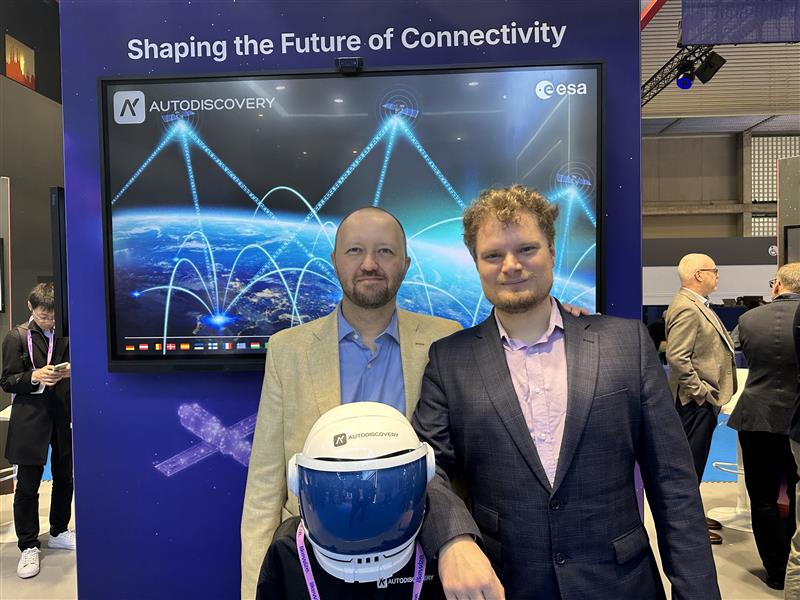
Aron Kisdi, Managing Director of Autodiscovery, said “Mobile robotics is at a turning point, where we are moving beyond lab demonstrations and pushing to industrial scale deployment. Connectivity is a critically important part of this transition. We are seeing growing customer demand for robots helping with security and safety of industrial sites and this project enables us to bring the highest quality products to our customers and to prepare for the future with scalable connectivity and robots working in close collaboration with people and each other.”
The project will comprise four robotic dogs and one scouting drone. Rather than relying on a single lead system, the distributed intelligence architecture will allow the robots to coordinate autonomously and adapt if an individual robot becomes unavailable. The robotic team will combine data from a range of sensors, including LiDAR, RGB-D cameras, thermal imaging, voice and air-quality sensors. Edge AI will allow data to be processed locally, with the individual systems sharing information to build detailed, real-time 3D maps of their surroundings.
Professor Ioannis Havoutis from Oxford Robotics Institute said “Robot teams that can scout, map and share information in real time have huge potential, not just for security applications, but for space exploration, disaster response and industrial inspection too. This project lets us push cooperative robotics out of the lab and into genuinely demanding field conditions, working with a partner who understands how to turn that research into deployable hardware. We’re excited to see what a four-robot team with next-generation connectivity can achieve.”
Reliable communications will be central to the project, which will investigate the use of hybrid terrestrial and non-terrestrial networks (TN/NTN), combining 5G/6G connectivity with direct satellite links. This approach could allow robotic systems to maintain connectivity and exchange information in remote or challenging environments where terrestrial networks are unavailable. It will also provide a testbed for exploring how next-generation communications can support the coordination of multiple autonomous agents in real time.
ESA’s European Centre for Space Applications and Telecommunications (ECSAT), located at the Harwell Science and Innovation Campus in Oxfordshire, will play a key role in the project. A new AI Hub will open shortly at ECSAT to support industry and academically led research, testing and demonstrations of AI for NTN and multi-agent robotic systems. This facility will complement ECSAT’s existing 5G/6G Hub and provide an environment in which the technologies developed through this project can be tested together, helping to explore interoperability between autonomous systems and next-generation communication networks.
“This exciting new project will demonstrate how autonomous systems can work collaboratively across different environments and communication networks. The new AI Hub will have an important role to play in the evolution of the new technologies, which have the potential to transform the autonomous systems market,” said Antonio Franchi, Head of ESA’s Space for 5G/6G and Sustainable Connectivity programme.