First ESA-supported Greek In-Orbit Demonstration (IOD) CubeSat ready for launch

Publication date

17 Jun 2025

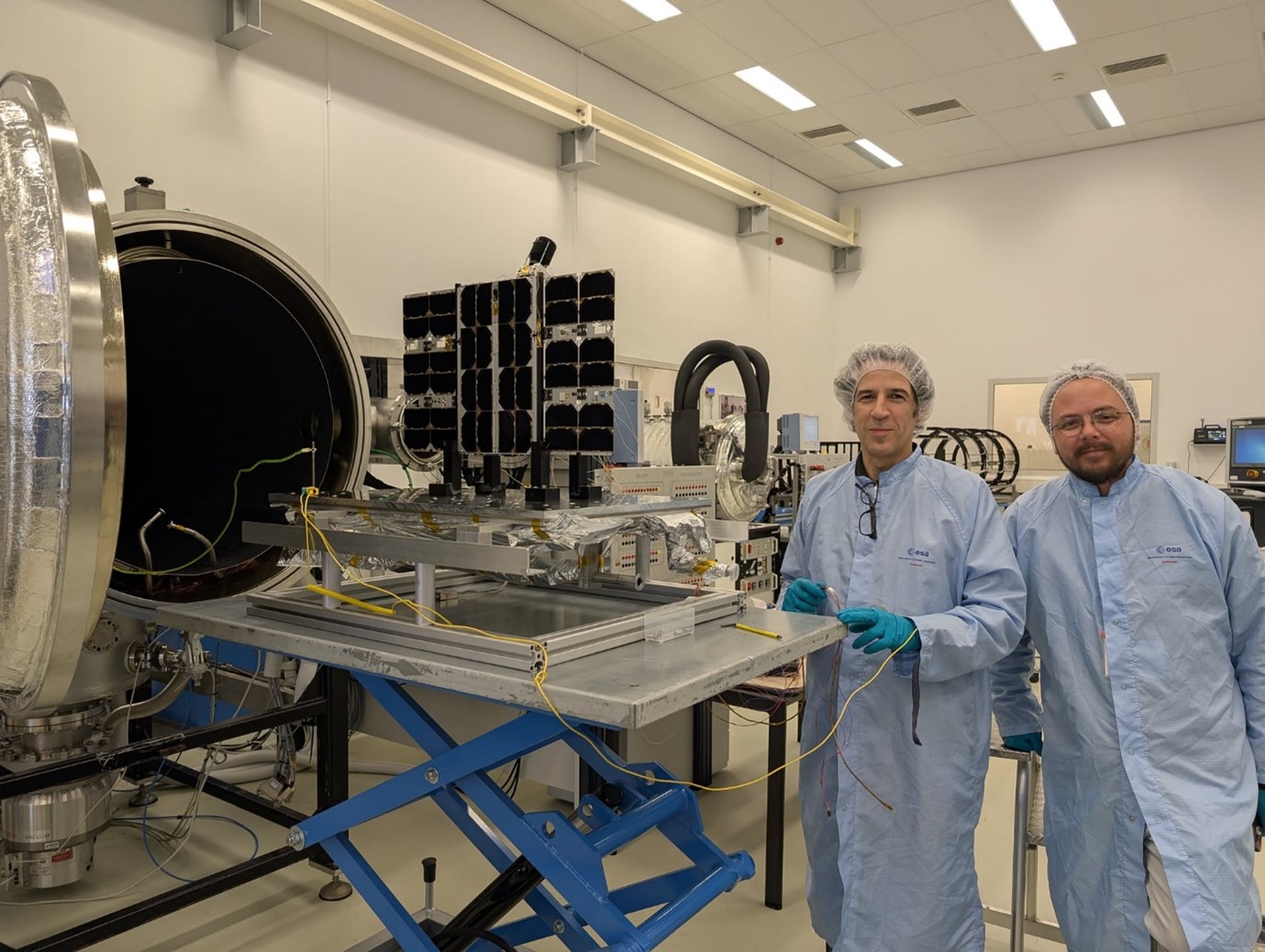
DUTHSat-2 Flight Model during preparations for the Thermal Vacuum testing campaign. Image credit: ESA

The first of the Greek In-Orbit Demonstration (IOD) CubeSat missions, DUTHSat-2, which is led by the Democritus University of Thrace, has been delivered to the launch provider ExoLaunch, and is ready for launch on the SpaceX Transporter-14 rideshare mission, scheduled for June 2025. Having successfully completed functional and environmental testing in February 2025, the 6U CubeSat mission will capture images in the visible and near infrared spectrum, over both sea and land.

DUTHSat-2 is part of the Greek National Small Satellite Programme (Measure ID 16855), and more specifically under the Greek Cubesats in-orbit Validation Projects that include a total of seven IOV CubeSat missions, managed by the European Space Agency’s (ESA) Greek Connectivity Recovery and Resilience (RRF) Project Team, as part of ESA’s Connectivity and Secure Communications directorate. The programme is executed under  the auspices of the Hellenic Ministry of Digital Governance with the support of the General Secretariat of Telecommunications and Posts and is closely supervised by the Hellenic Space Center. The programme is part of the National Recovery and Resilience Plan ‘Greece 2.0’, which is funded by the Recovery and Resilience Facility (RRF), core programme of the European Union’s NextGenerationEU.

The imagery and measurements will be used to provide yield information on soil moisture, as well as marine contamination. Additionally, the imagery frequency bands and the imager resolution have been selected to be able to detect both oil spills and ship bilge water pollution.

DUTHSat-2 will also perform in-orbit demonstration of an essential telemetry and housekeeping unit. The Essential TeleMetry and housekeeping (ETM) is the spacecraft version of a “black box”, allowing operators to have visibility over the spacecraft’s health in case of failures of the main subsystems. 
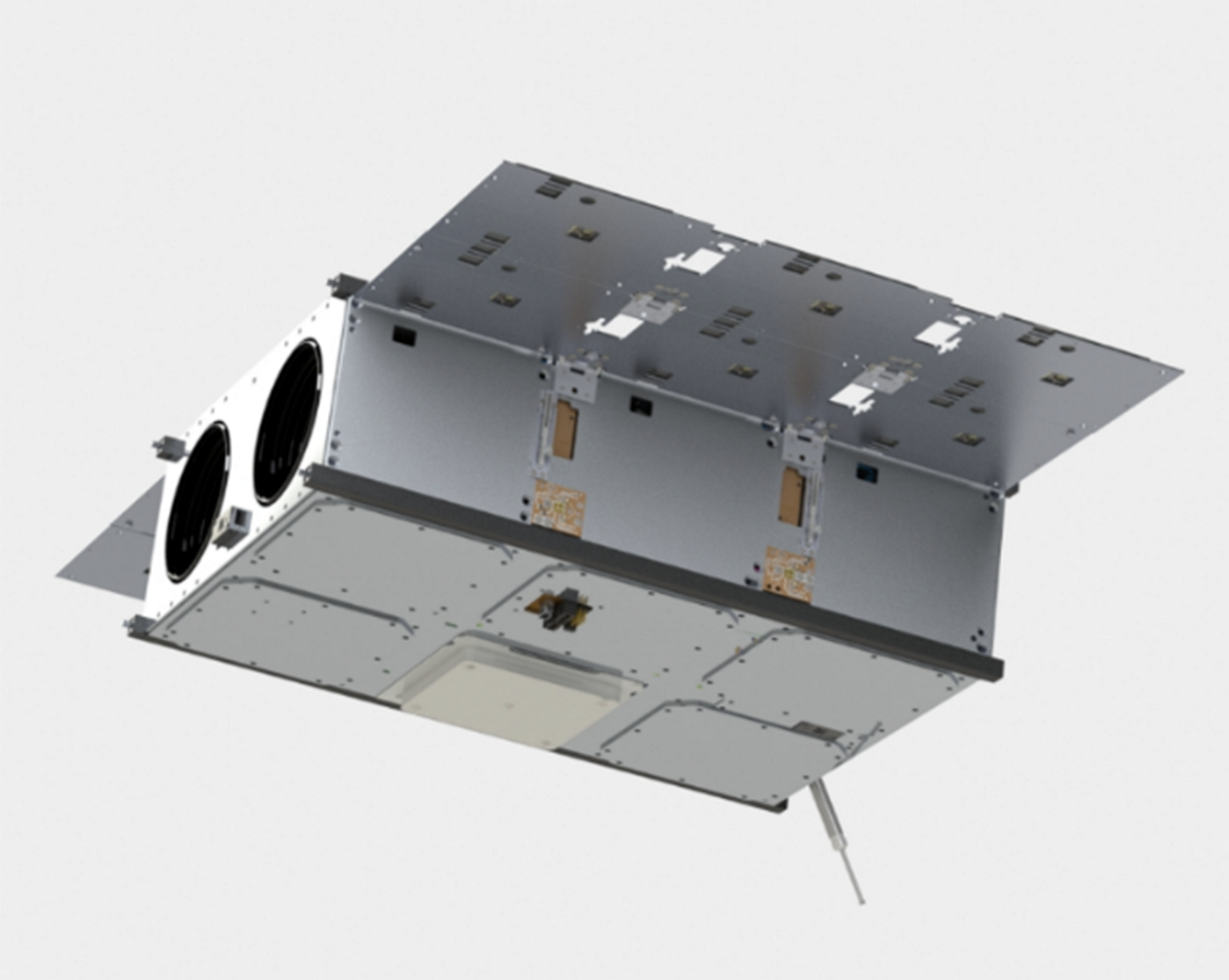
DUTHSat-2 rendered in the flight configuration. Image credit: Democritus University of Thrace

The DUTHSat-2 mission brings together Greek academia and industry, being led by the Democritus University of Thrace, and supported by the Athena Research Center and Greek companies Space Asics and Prisma Electronics SA. The spacecraft was assembled on site at the Democritus University of Thrace, with the design, assembly and test process guided and monitored by ESA’s Connectivity and Secure Communications.

“We are proud of this achievement, which was possible by working as one team and by sharing the same motto: Let us make this happen! We are now looking forward to the launch followed by the start of the operations,” said Frédéric Rouesnel, ESA’s Greek Connectivity RRF Project Manager.

“DUTHSat-2 is now at Vandenberg Space Launch Complex 4 with an expected launch date in a couple of weeks onboard a Falcon 9 rocket. We are excited to witness the first satellite of the Greek National Small Satellite programme delivered to the launch provider. Congratulations to both ESA and the Democritus University of Thrace and the respective teams, for managing a technicaly complex project with programmatic challenges. Greece is climbing the steep learning curve of accessing space in order to glean the benefits of the new space economy. We are all proud to be part of the endeavour and wish the best for this as well all upcoming missions,” said Prof. Konstantinos Karatzalos, Secretary General of Telecommunications and Posts.
ESA, GeoVille and Eutelsat OneWeb to deliver connectivity to distribute Earth observation data across Africa

Publication date

26 May 2025

A new collaboration between GeoVille and Eutelsat OneWeb, facilitated through the European Space Agency’s (ESA) Sunrise Partnership Project, is set to transform how Earth observation data reaches the world’s most remote regions. The “OneWeb Copernicus Data Hubs” project, which was recently signed under ESA’s partnership with Eutelsat group and with support from the Austrian Space Agency, will focus on delivering Earth observation data to end users in Africa.

The OneWeb Copernicus Data Hubs specifically target the access to data in connectivity-challenged regions. By integrating Eutelsat OneWeb’s satellite internet constellation with the Copernicus ecosystem, the service ensures high-bandwidth internet access and reliable dissemination of environmental and situational data to previously underserved areas, leveraging OneWeb’s global coverage.

At the heart of this service are the Copernicus OneWeb Data-Bridges – compact hubs equipped with Eutelsat OneWeb User Terminals and specialised processing units that manage data streams and storage in remote locations. These systems are equipped with user-friendly software for configuring and selecting specific data for local archive across all geographic areas, regardless of terrestrial infrastructure limitations.

The partnership leverages GeoVille’s EarthStreamer technology, an innovative high-efficiency streaming and compression solution that enables large volumes of satellite and climate data to be transmitted even in low-bandwidth environments. This technological breakthrough ensures uninterrupted access to critical Earth observation insights around the globe.

Additionally, the service incorporates the European Copernicus Emergency Management Service, directly streaming emergency management data to remote regions and significantly enhancing resilient response capabilities during natural disasters and other critical situations. The project will deliver actionable information for emergency response decision makers and first responders, Copernicus scientists & researchers working in remote areas, governmental organisations working in remote regions and the European Commission’s Directorate-General for International Partnerships.

The Copernicus-Connect feature of this service enables third-party European Copernicus downstream service providers to extend their reach to previously inaccessible locations.

The technical workflow involves compression and conversion of daily Copernicus data into efficient data streams, which are then transmitted via the Eutelsat OneWeb Broadband Service. This expansion creates new market opportunities for Europe’s Earth observation industry while delivering valuable environmental insights to communities worldwide.

This project showcases the growing partnership between ESA’s Connectivity and Secure Communications directorate and GeoVille. In 2024, GeoVille were selected to lead an industrial consortium on a project called Smart-Connect, as part of CSC’s Civil Security from Space programme.

Carsten Tobehn, Sunrise Project Manager in ESA’s Connectivity and Secure Communications, said, “Through our Sunrise Partnership Project, ESA creates a framework where industry leaders like GeoVille and Eutelsat OneWeb can combine their expertise and foster growth in joint Telecommunications and Earth Observation space applications. By de-risking these innovative developments, we enable European companies to deliver solutions that address global challenges while strengthening Europe’s industrial capabilities. This project perfectly demonstrates how our partnership approach enables European space technologies and services to deliver tangible benefits across the globe.”

Guillaume Scottez, Senior Director, Innovation for Eutelsat said, “Eutelsat Group is pleased to work with GeoVille and ESA within the Sunrise Partnership Project to enable the seamless transmission of Copernicus vital environmental data, directly supporting enhanced environmental monitoring and emergency response in remote and rural regions. Through this partnership, we are leveraging the global broadband connectivity provided by our OneWeb constellation to benefit both environmental stewardship and the expansion of Europe’s Earth Observation industry to remote areas.”

Wolfgang Kapferer, Head of Space and Security, GeoVille, states, “We are proud to contribute to the pioneering Sunrise Partnership Project in collaboration with ESA and Eutelsat Group. At the heart of this initiative is the dual-use potential – serving scientific communities, civil security operations and governmental administration. Our Copernicus Data Hubs service is helping to build a new ecosystem for delivering vital insights via satellite communications, ensuring timely and reliable data access. Leveraging our advanced EarthStreamer technology, we enable efficient compression and streaming of high-quality satellite data from the Copernicus programme and the private sector, even over Satcom and in low-bandwidth environments. This transformative capability is making a real difference in how critical information reaches those who need it most, especially in remote and underserved regions.”

JoeySat Celebrates its Second Anniversary

Publication date

21 May 2025

The European Space Agency (ESA) and Eutelsat OneWeb teams celebrated a significant milestone in advancing global connectivity solutions as its innovative JoeySat demonstrator satellite marked its second year in orbit. Developed under the ESA Sunrise Partnership Project in collaboration with Eutelsat OneWeb and with support from the UK Space Agency and industry from five other ESA Member States, JoeySat has successfully completed its comprehensive two-year test campaign at 3 low Earth orbit altitudes.

Launched into low Earth orbit on 20 May 2023 aboard a SpaceX Falcon 9 rocket, JoeySat is named after the hopping baby kangaroo, mirroring its beam-hopping capabilities. Unlike traditional satellite systems which struggle to efficiently allocate their limited spectral resources to meet various business requirements, JoeySat’s innovative approach directly addresses this challenge through its fully digital payload, which enables rapid switching between different locations.

By enabling dynamic allocation of communication resources, JoeySat enhances global connectivity, supporting emergency response efforts, and contributes to bridging the digital divide. Its successful demonstration paves the way for more resilient and adaptable satellite communication systems, benefiting businesses and citizens across the globe.

Its capabilities have been tested with an innovative ground segment, including a Multi-beam Phased Array Gateway Antenna and various user terminals (portable, aeronautical, and maritime). The 5G Pilot Tests have successfully demonstrated applications ranging from video streaming to Internet of Things (IoT) and Augmented/Virtual Reality (AR/VR) solutions, all critical technologies for tomorrow’s business environment. JoeySat’s development using off-the-shelf components and a lean management approach, allowed for rapid development and deployment within just two years of contract signing.

By supporting the development and demonstration of advanced beam-hopping technology, ESA is helping European industry maintain its competitive edge in the rapidly evolving satellite communications market.

“We are proud to be celebrating the second anniversary of JoeySat, the successes it has delivered, and the future innovation we can look forward to. JoeySat showcases how ESA, its Member States and industry can work together to develop and launch in a very short timeframe a satellite enabling organisations and people to access reliable connectivity wherever and whenever they need it”, said Khalil Kably, ESA Telecom Satellite Project Manager.

Guillaume Scottez, Senior Director for Innovation at Eutelsat Group said “JoeySat was a key step in proving new technologies like digital beam hopping and beam-steering-capabilities that underpin our next-generation satellites. We’re grateful to ESA and the UK Space Agency for their support in making this milestone possible.”

“As we mark JoeySat’s second anniversary, we’re proud of how this mission has pushed the boundaries of what’s possible in satellite communications,” said Henny Sands, Head of Telecommunications at the UK Space Agency. “It’s a shining example of UK innovation delivering real-world impact and driving forward connectivity solutions.”

ESA further supports seven Greek CubeSat missions as part of Operations Workshop

Publication date

04 May 2025

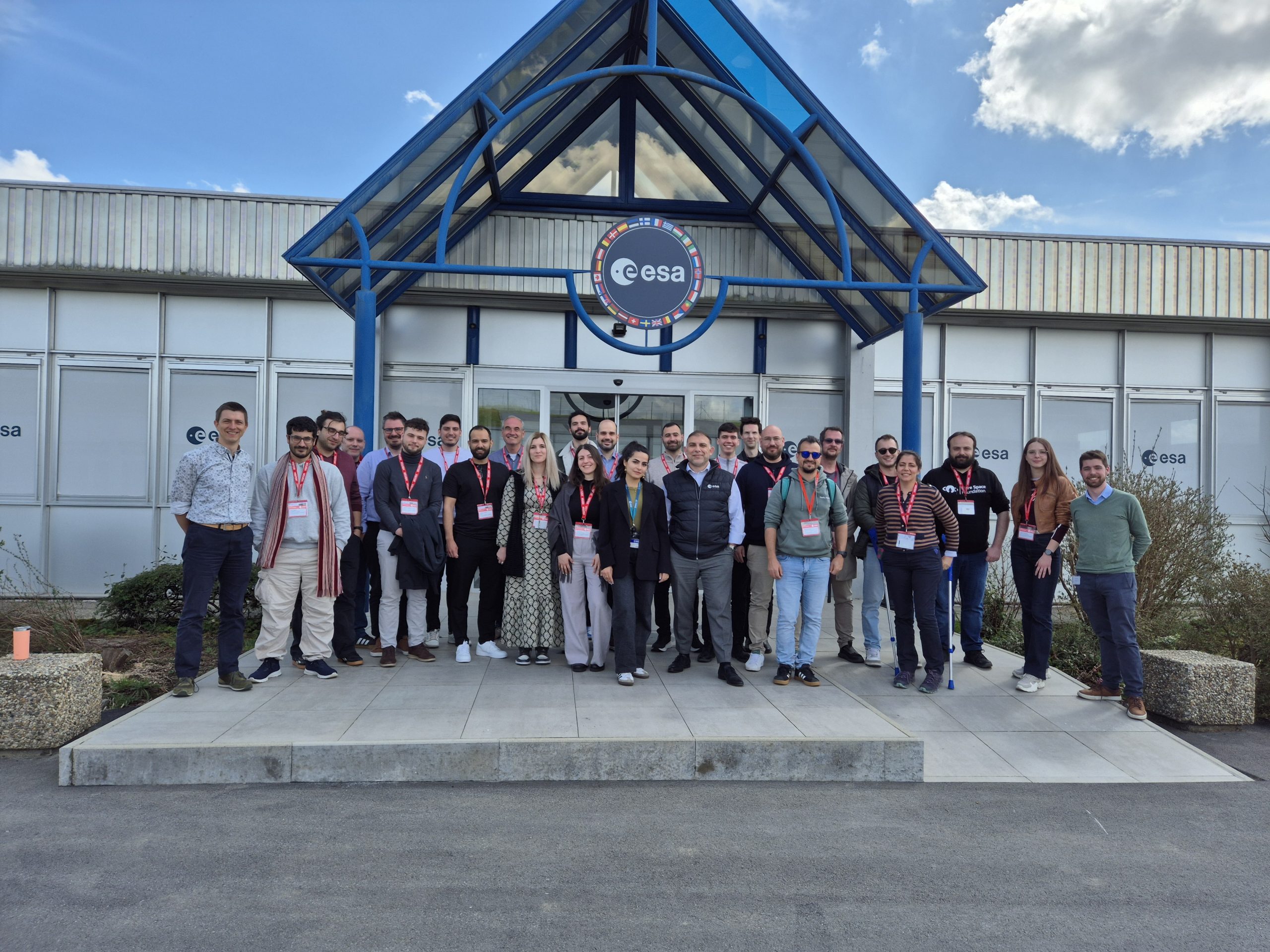
Group of people outside a building. The sky is blue.
Participants of the Operations Workshop stand outside ESA’s European Space Security and Education Centre (ESEC) in Redu, Belgium. Image credit: ESA

Seven Greek In-Orbit Demonstration (IOD) CubeSat teams came together with experts from the European Space Agency (ESA) in an Operations Workshop at the Agency’s European Space Security and Education Centre (ESEC) in Redu, Belgium. Taking place between 14-16 April, the workshop provided a deep dive into key aspects of CubeSat operations, with emphasis on Launch and Early Orbit Phase (LEOP), as well as IOD. It was organised as part of the continued support for the Greek space sector provided by ESA’s Connectivity and Secure Communications.

The comprehensive three-day workshop included practical training on spacecraft operations, mission management during critical phases, and the application of secure optical communications in space missions fostering knowledge transfer and identifying effective approaches for ensuring successful IOD mission operations.

The workshop enabled practical skills development across the space operations ecosystem, with first-hand experience from ESA’s PROBA operations team and detailed lessons on managing the critical LEOP of missions.

Concluding with a visit to the PROBA Mission Control Centre and ground stations, the workshop has established a strong foundation for the seven IOD missions scheduled for launch this year and early 2026.

With the Greek Connectivity Operations Workshop now completed, the Greek IOD CubeSat teams are one step closer to successfully commencing their missions in orbit in the coming year. These seven IOD missions will demonstrate a variety of advanced space applications:

  • Hellenic Space Dawn (EMTech SPACE): A mission featuring two 8U CubeSats, Helios and Selene, carrying payloads for in-space data processing, Earth observation, inter-satellite links, and secure optical communications.
  • PHASMA (Libre Space Foundation): A dual 3U CubeSat mission designed for radio frequency signal detection and monitoring, with two identical satellites flying in proximity.
  • OptiSat (Planetek Hellas): A 6U CubeSat dedicated to secure optical communication and space-based data processing, including automated cloud coverage assessment.
  • ERMIS (National and Kapodistrian University of Athens): A constellation of three CubeSats – two 6U satellites focusing on Internet of Things (IoT) applications and utilising S-band inter-satellite link, and an 8U satellite equipped with a hyperspectral camera for precision agriculture and optical communications.
  • MICE-1 (Prisma Electronics SA): A 3U CubeSat enhancing maritime tracking in the Mediterranean Sea through Automatic Identification System (AIS) signal reception and Internet of Things (IoT) communication.
  • PeakSat (Aristotle University of Thessaloniki): A 3U CubeSat aiming to demonstrate space-to-ground laser-optical links with optical ground stations in Greece.
  • DUTHSat-2 (Democritus University of Thrace): A 6U CubeSat designed to capture visible and near-infrared images for oil spill detection and soil moisture monitoring, while also demonstrating secure communication.

The Greek National Satellite Project is managed by the ESA Greek Connectivity RRF Project Team on behalf of the Hellenic Ministry of Digital Governance. It is part of the National Recovery and Resilience Plan ‘Greece 2.0’, and funded by the Recovery and Resilience Facility (RRF), a core programme of the European Union’s NextGenerationEU.

“My amazing Greek Connectivity team and myself are pleased to be able to support these Greek projects with access to leading European CubeSat operations expertise, through this dedicated and tailored workshop,” said Frédéric Rouesnel, Greek Connectivity RRF Project Manager at ESA’s Connectivity and Secure Communications. “ESA’s Connectivity and Secure Communications and its Satellite Programmes Department are proud to see these missions progressing towards launch and operations in the near future, allowing them to benefit Greece from orbit and to shine beyond the Greek borders.”

René Wittmann, PROBA Spacecraft Operations Manager at ESA’s Operations, said: “We are happy to support the CubeSat teams with our experience in operating techno-demo missions. While the five PROBA satellites [that we’re working on] are slightly larger, a lot of knowledge is transferrable to CubeSats.”

“We would like to thank ESA for organising this Operational Workshop, which gave significant insights into spacecraft operations and mission management, preparing them adequately for the upcoming In-Orbit Demonstration phase,” said Prof. K. Karantzalos, Secretary General of Telecommunications & Post, at the Hellenic Space Center.