ESA signs contract to co-fund VDES constellation for maritime safety communications with UK Space Agency and AAC Clyde Space

Publication date

25 Jun 2026

Illustration of satellite connection with Earth
Image: illustration of satellite connection. Credit: Shutterstock

The European Space Agency (ESA) has signed a contract with UK company, AAC Clyde Space, to fund the development and building of the in-orbit demonstration phase for the Very High Frequency Data Exchange System (VDES) network of its industry-led INFLECION initiative, a space-based maritime communication and surveillance network, with co-funding from the UK Space Agency. Testing and demonstration of the VDES services are expected to be completed by 2029, with a total of 12 satellites planned for the constellation.

Maritime traffic is crucial to Europe and Canada’s economies. With nearly 90 percent of all goods in international trade conveyed by sea, growing security concerns have increased the need to make supply chains more resilient – as well as to pursue stricter environmental and safety requirements.  ESA is working closely with industry to boost the resilience of its Member States and Canada’s international supply chains with space-based maritime communication and monitoring solutions that can help to address these safety requirements. Such capabilities will enhance routing, safety and security for ships, and improve environmental monitoring, thereby reinforcing compliance with international regulations.

AAC Clyde Space’s INFLECION initiative is designed to provide European maritime institutional users and shipping companies with dedicated communications between ships, shore and satellites for critical services. In addition, it will build towards future capabilities for maritime monitoring and situational awareness for vessel movement and anomalous behaviour detection. This solution leverages the company’s previous experience with maritime services and VDES, which enables automated ship identification as wells as ship-to-ship, ship-to-shore and shore-to-ship communications.

INFLECION is structured around a first definition phase, successfully completed, to be followed by the development and demonstration phases of a VDES satellite communications network – the object of AAC Clyde Space’s new contract with ESA. The contract for the VDES constellation is co-funded equally by a consortium led by AAC Clyde Space, and by the UK Space Agency through ESA’s Advanced Research in Telecommunications Systems (ARTES) Space Systems for Safety and Security (4S) strategic programme line.

This approach allows the consortium to de-risk technology development, whilst starting to deploy its proven VDES technologies, and demonstrating capabilities that build towards a scalable service.

“INFLECION is an important element in our global effort to advance Europe’s capabilities in satellite-enabled maritime services,” says Christophe Allemand, Head of Safety & Security from Space Programme Office, European Space Agency. “By providing dedicated connectivity for critical maritime operational services and more timely and reliable information from space, the programme will support safer, more resilient and more sustainable maritime operations. ESA is pleased to support initiatives like INFLECION, that strengthen Europe’s position and autonomy in a strategically important domain.”

“We are proud to lead a consortium of highly qualified partners to advance this next generation service in maritime intelligence from space,” says Luis Gomes, CEO of AAC Clyde Space. “The programme allows us to develop a service that is in high demand, and it is a key step towards delivering operational services that support safer, more efficient and more sustainable maritime operations.”

“The INFLECION programme is an important step for the UK in developing new space-enabled maritime capabilities,” says Henny Sands, Head of Satellite Communications, UK Space Agency. “The programme brings together leading industrial and academic partners to develop capabilities that will improve maritime safety and awareness, and support more resilient and efficient global shipping.”
ESA’s Iris satcom technology takes to US skies to showcase next-gen sustainability applications on Boeing 2025 ecoDemonstrator

Publication date

16 Dec 2025

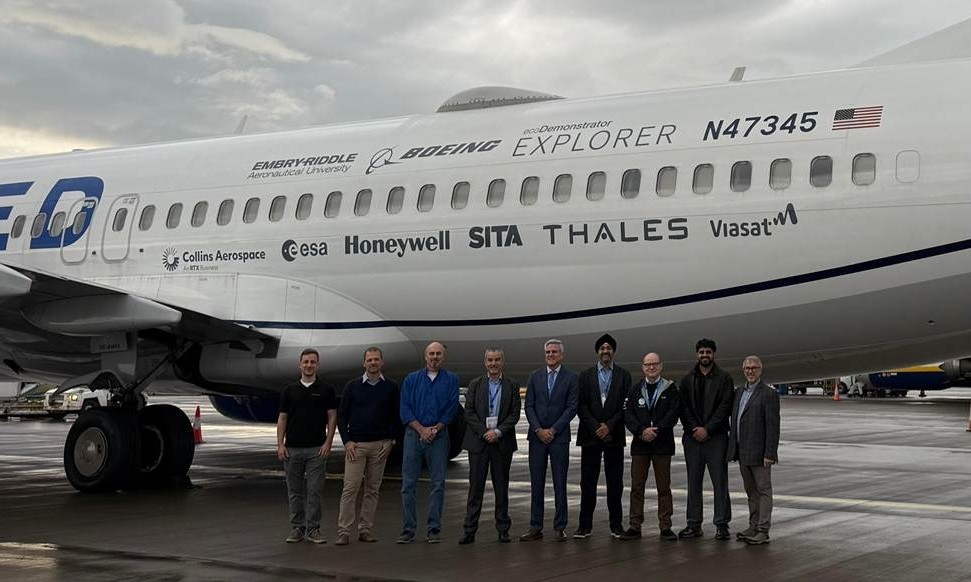
ESA Iris Implementation Manager, Davide Tomassini (fourth from left), with the Viasat, Boeing and Honeywell teams in front the ecoDemonstrator. Image credit: ESA/Boeing

The European Space Agency (ESA) has partnered with Viasat, ESSP and its consortium of industry partners to bring Iris secure satellite communications to the forefront of the US aviation sector, as part of a long-standing ESA effort to push space-based digital communications solutions for air traffic management. A Boeing 737-8 aircraft, the ecoDemonstrator Explorer, operated by United Airlines, has flight tested ESA’s Iris; a suite of internet-based communications technologies. These technologies complement current analogue communications standards between pilots and Air Traffic Control (ATC). In addition, they enable more sources of flight-relevant information to be made available for ATC.

This announcement highlights a trend in integration of satellite technologies to improve air travel sustainability, safety and efficiency. The partnership is co-funded through the Iris programme, developed by the Space Systems for Safety and Security (4S) team within ESA’s Advanced Research in Telecommunications Systems (ARTES) 4.0. Iris is implemented by ESA in close cooperation with a large European and Canadian industrial consortium led by Viasat.  This announcement paves the way for the global deployment of Iris after its rollout for aircraft operating in European airspace started in 2024.

The ecoDemonstrator Explorer. Image credit: Boeing

The Viasat-enabled Iris terminal is the latest technology to be integrated into Boeing’s ecoDemonstrator programme since its inception in 2012. The ecoDemonstrator showcased Iris’ next-generation capability to enhance operational data exchange for domestic flights in the US. Leveraging Iris’ satellite datalink and internet protocols will enable modern data-intensive applications for airlines, ATC and pilots, with benefits for route planning, fuel consumption, delay reduction and safety. Boeing and Viasat’s partnership is the culmination of extensive trans-Atlantic collaboration of aerospace industry leaders including ESA, the Federal Aviation Administration (FAA), NASA’s Air Traffic Management – eXploration project, Collins Aerospace, Honeywell, Thales, Société Internationale de Télécommunications Aéronautiques (SITA) and academic partners like Embry Riddle Aeronautical University.

Boeing’s ecoDemonstrator programme is a proven testing ground for accelerating the deployment of new technologies. The Explorer aircraft fitted with Iris was introduced to the ecoDemonstrator lineage in 2023 as a focused testbed for new solutions. It showcased ESA’s Iris technology and demonstrated its ATN-B1 and ATS-B2-enabled ability to communicate seamlessly and reliably across different airspace jurisdictions. This crucial feature ensures continuity of service across global communication standards allowing the efficiency, sustainability and safety of that will enable Iris to be adopted by the entire industry.

The ecoDemonstrator Explorer taking off. Image credit: Boeing

Flight tests started in late October 2025 with domestic flights from Houston, Texas, and concluded in November with an overseas test flight to Edinburgh, Scotland. These trials mark a milestone for the advancement of digital aviation in global standards, and for the 4S programme’s mission to improve global safety and resilience through space technology applications.

“This partnership marks a crucial milestone towards a unified global solution for Air Traffic Management. Through this testing of interconnected digital communications, we are not only advancing operational efficiency but also moving towards safer and more efficient airspace. Ultimately, this will deliver significant economic benefits and help reduce emissions, supporting the aviation industry in achieving its sustainability goals,” said Laurent Jaffart, ESA Director for Connectivity and Secure Communications

“Boeing is proud to lead the way in advancing digital communications that enhance safety and operational efficiency in aviation,” said Todd Citron, Chief Technology Officer of Boeing. Our partnership with United Airlines and esteemed collaborators marks a significant step towards a more sustainable future for air travel. By leveraging innovative technologies, we are not only improving the flying experience but also enhancing safety, paving the way for a more secure aviation industry.”

“At United, our commitment to innovation and decarbonization is at the core of what we do,” said Lauren Riley, Chief Sustainability Officer of United Airlines, “Collaborating with Boeing and other partners on the ecoDemonstrator Explorer allows us to advance new digital technologies that make flying safer, more efficient, and lower in emissions. By deploying these next-generation solutions, we’re not only enhancing the experience for our customers and crews but also supporting our goal to decarbonise aviation.”

“As aviation evolves, so too does the need for communication systems that can support emerging requirements, such as trajectory-based operations, which demand technologies beyond current standards,” said Yann Cabaret, CEO, SITA for Aircraft. “By partnering with Boeing on their ecoDemonstrator IPS Testing program we at SITA are actively testing these innovative solutions in real-world, multi-link environments, advancing our shared vision for safer, more efficient, and better-connected skies.”

“Viasat is excited to be partnering with Boeing on the ecoDemonstrator program to show how satcom datalink supports current and future Trajectory Based Operations,” said Joel Klooster, SVP Airline Operations and Safety of Viasat. “Building off the European Space Agency’s Iris programme, now operational in Europe, this activity will demonstrate the ability of Viasat’s SB-S service to support the transition to ATN/IPS, the next generation of IP-based datalink critical to supporting increased air traffic volumes in a sustainable and efficient manner.”

ITA Airways adopts satellite technology developed by ESA and Viasat to upgrade safety and fuel efficiency

Publication date

16 Dec 2025

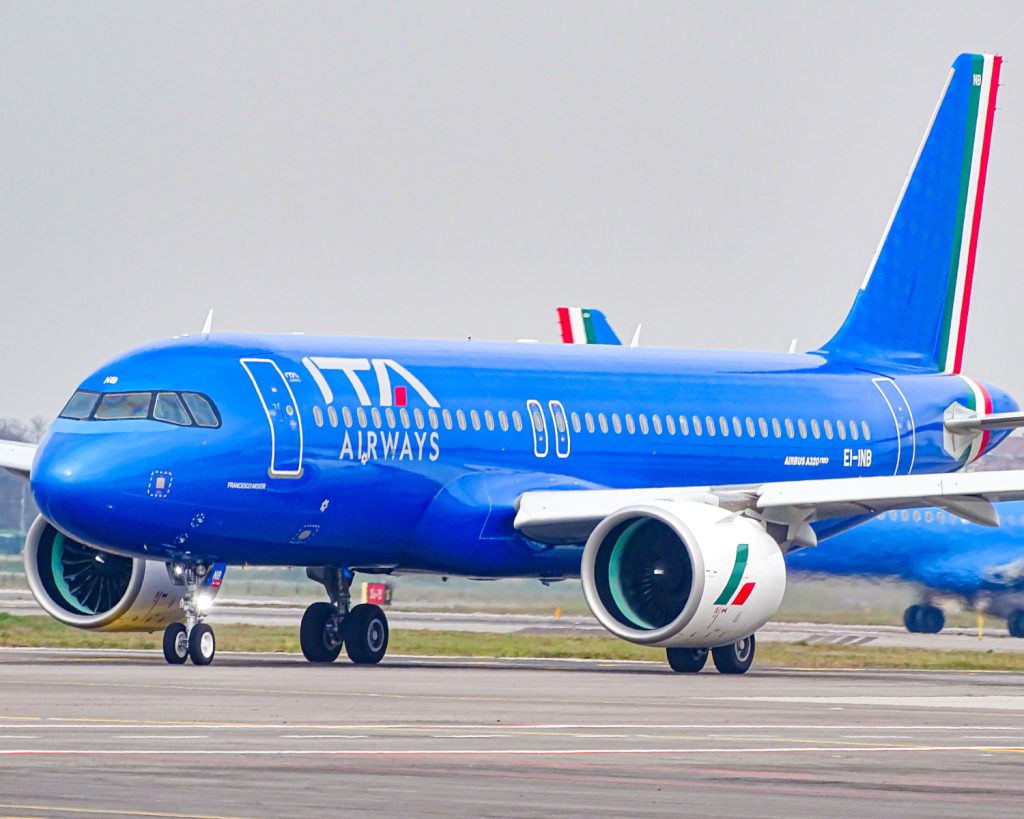
 An ITA Airways A320neo, the type that will feature the Iris terminal. Image credit: ITA Airways 

ITA Airways, Italy’s reference airline, has announced its adoption of the Iris system for Air Traffic Service (ATS), jointly developed by Viasat and the European Space Agency (ESA) Directorate for Connectivity and Secure Communications.

Iris will enable ITA to optimise aircraft routes and fuel consumption, increasing flight safety whilst curtailing CO2 emissions and delays. These applications are empowered by a satellite data link service complementing traditional ground-based infrastructure.

The introduction of Iris removes a bottleneck created by the explosion of data generated by modern aircraft. By distributing the data across ground and satellite networks, Iris creates a multi-link capability that will enable airlines and Air Traffic Management (ATM) to handle a larger volume of data in real time.

Since 2015, Viasat, a global leader in satellite communications, has partnered with ESA as an Iris Service Provider and key project partner (ESSP) to power the Iris service with their SwiftBroadband – Safety (SB-S) connectivity platform.

The Iris program is funded and promoted by ESA Connectivity and Secure Communications under the Space Systems for Safety and Security (4S) strategic programme Line of its Advanced Research in Telecommunications Systems (ARTES) programme, and in line with the Single European Sky ATM Research (SESAR) launched by the European Commission.

Iris is the only validated technology capable of pioneering these modern Airline Operational Communication and ATS standards. It showcases ESA Connectivity and Secure Communications’ commitment to delivering practical space-based applications through partnerships with Europe’s space industry and commercializing viable solutions to concrete challenges.

“With the addition of ITA Airways to the Iris service, another milestone has been achieved in supporting the European Commission’s Single European Sky vision for an efficient and environmentally friendly European airspace. The adoption of Iris is a key milestone for space-based solutions, supporting European Air Traffic Management, which will – in turn – pave the way for global use. By supporting Iris through an ESA public-private partnership, we are delighted to combine our expertise with those of leading aviation actors across the continent and beyond it,” said Laurent Jaffart, Director of ESA’s Connectivity and Secure Communications.

“We’re thrilled to see Iris taking to the skies on ITA Airways’ flights across Europe,” said Joel Klooster, SVP Flight Safety and Advanced Air Mobility at Viasat. “ITA has been committed to the goals of the Single European Skies initiative for a long time, and it’s been fantastic to work so closely with them, as well as our partners ESA and ESSP, to bring the benefits of Iris’ next-generation technology to more flights and passengers across Europe. We look forward to seeing success with these flights, and to rolling out the program across more routes and airlines soon.”

Iris will follow an initial deployment on four Airbus A320neo across the ITA fleet. One aircraft has already been fully operational since August 2025, introducing Iris in Europe with a view to export its gains in safety and security around the world.