PAGE CONTENTS
Objectives
The project aims at developing and demonstrating international use cases for Quantum Key Distribution (QKD) in pre-operational environments. The project objectives are:
• To develop and demonstrate an system-interoperable QKD network encompassing space links and optical fibre links;
• To demonstrate the use of QKD for the service of the financial sector;
• To deliver ultimately a cost-efficient solution able to support multiple use cases;
• To validate the approach of an agnostic service platform able to operate across multiple QKD system solutions operating on a global scale.
The project leverages on available space and terrestrial QKD infrastructures, in combination with Post-Quantum Cryptographic (PQC) elements to ensure optimal reach and operational resilience.
The initial phase supported by POST Luxembourg, the University of Luxembourg’s SnT, HITEC Luxembourg, evolutionQ (Canada) and SpeQtral (Singapore), deploys a standalone hybrid terrestrial and space Quantum Communication Infrastructure across Luxembourg, Belgium and Singapore and demonstrates a key delivery service between Europe and Asia.
The follow-up phase, supported by the Belgium partners Nexova, AMOS, Imec, and the Royal Military Academy, focuses on security management (SIEM), interoperability and efficient resource management to provide a robust and platform agnostic key delivery service across several interconnected Quantum Communication Infrastructures across European and non-European countries.
The system architecture design and project management tasks are conducted by Starion Luxembourg and Starion Technologies (Belgium).
The ultimate aim is to align the capabilities and service offering of INT-UQKD with the requirements of various national QCI programmes, and notably with the EuroQCI and EAGLE-1 programme.
Benefits
The INT-UQKD project focuses on business-oriented use cases to pave the road for commercial quantum safe, secure communications globally, and notably to serve the European Union (EU) aspirations for digital sovereignty and strategic autonomy.
Within the project, QKD and PQC technologies are tested and demonstrated in real-life pre-operational scenarios built across interconnected independently operated terrestrial and space Quantum Communication Infrastructures (QCI).
The project tasks include the assessment and benchmarking of future technology choices, the compilation of post-quantum security requirements and helps decision makers on framing European policies for Quantum Communications and Quantum Information Networking. INT-UQKD also contributes to the establishment of secure connectivity standards and harmonised certification processes.
The INT-UQKD project also compiles recommendations for commercial actors seeking a fast-to-market deployment and long-term sustainability of quantum safe technologies, products and services addressing the needs of Financial Institutions, International Companies and Private Entities.
Features
The INT-UQKD project combines quantum key distribution (QKD) and post quantum cryptography (PQC) to reliably secure end-to-end user applications across independently operated Quantum Communication Infrastructures (QCI).
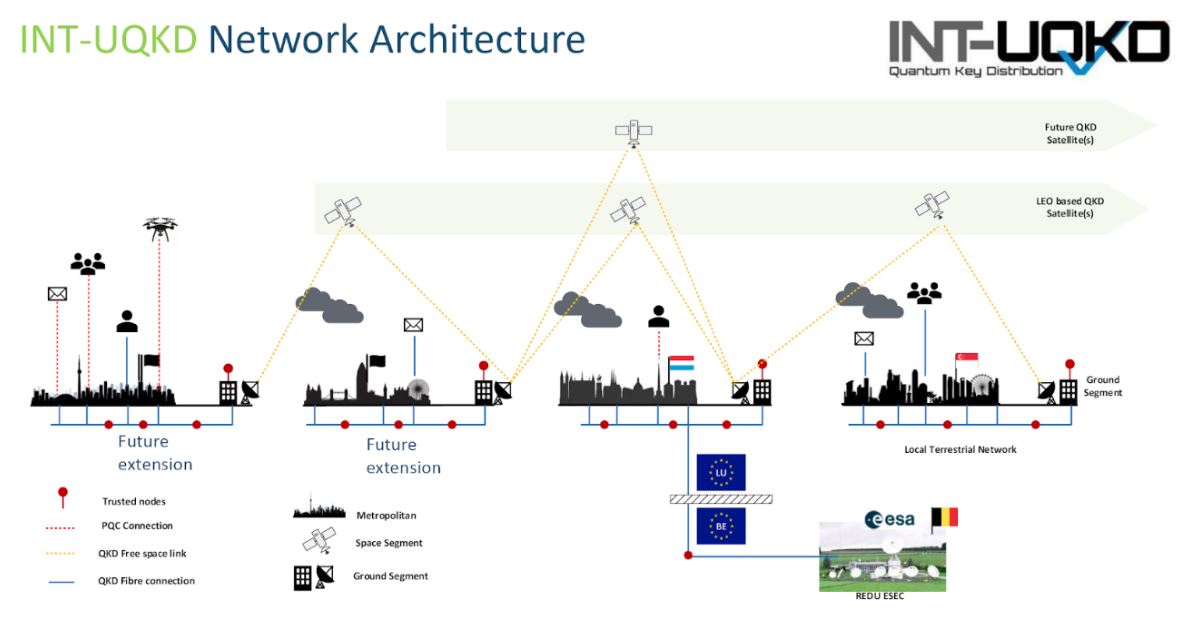
A fundamental goal of INT-UQKD is to define a network architecture allowing for a seamless exchange of secret keys over both optical fibre links and satellites in low-earth orbit.
For the satellite based QKD links, two Optical Ground Station (OGS) are built, one in Luxembourg and one in Singapore. The first demonstrations via satellite are carried out via the SpeQtre satellite operated by SpeQtral of Singapore. During later phases of development other QKD missions under construction by European partners can be supported.
The following product and service features are developed:
• A Quantum Key Distribution solution fitting both terrestrial optical fibre and space segments for global coverage.
• Intergrated PQC protocols to secure remote user applications. The end to end key delivery services available to the customer are nesting QKD and PQC resources together to remove single point of vulnerability.
• A platform agnostic architecture permitting interoperability with multiple Quantum Information Networks including national Quantum Communication Infrastructures (QCI).
• Integrated management tools that abstract the complexity of the different subsystems and simplifies the system administration.
• Homogeneous security over the different layers and segments of the network.
The final product provides quantum safe service delivery capabilities for existing and future global data networks.
Challenges
The emergence of quantum computers is threatening many existing cryptographic techniques securing our digital life, and new quantum computer safe data encryption technologies need to be developed and deployed to safeguard critical data communication services and IT infrastructures in the quantum computer era.
QKD uses quantum mechanical properties of light, for sharing secret keys between two or multiple sites and building trusted nodes for secure communications. In INT-UQKD the resilience of the QKD infrastructure is augmented by Post Quantum Cryptography (PQC) elements to provide an operationally resilient and secure solution against complex attacks.
As QKD and PQC are fundamentally dissimilar, they provide in a complementary set-up, a nested solution removing single points of vulnerability. The main related product development challenges reside in the provably secure combination of QKD and PQC components within a unified system, interfacing with existing infrastructure to meet the user requirements.
System Architecture
The high-level project architecture is shown in the figure below:
The system compromises the following building blocks to establish the End-to-End Key Delivery Service:
- The Interoperability service (1) provides secure interconnection between the independently operated QKD Infrastructures.
- The Resource Management (2) ensures scheduling and provisioning across the independently operated QKD infrastructures to ensure Quality of Service for the End-User.
- The Security Information and Event Management (3) timely threat mitigation and recovery actions when required. It is optimised for the monitoring of hybrid PQC and QKD resources and assets.
- Independently Operated Terrestrial (5) and Satellite QKD (4) providers: Each independently operated Quantum Communication Infrastructure participate to the end-to-end key delivery service their respective infrastructure.
- The operation of the independently operated QCI relies on specific assets and resources (6), such as Optical Ground Stations (OGS), Key Management Systems (KMS).
Plan
The INT-UQKD project is structured in phases.
During the initial phase, from 2022 to 2023, the use cases, system requirements, system architecture and interfaces are defined. The first demonstration focused on the key sharing concept, using a cross border optical-fibre QKD link between Luxembourg and Belgium. It is in continued operation since August 2023.
In Phase 2, from 2023 to 2026, the Windhof Optical Ground Station (OGS) is assembled in Luxembourg, basef on the requirements for the SpeQtre QKD satellite (SpeQtral).
The follow-up phase, called the Belgium Extension focused on the development of interoperability capabilities between INT-UQKD infrastructure and independently operated QKD Networks and validate secure key establishment capabilities across these together with the necessary resource management across the supported Quantum Communication Infrastructures.
Current Status
The INT-UQKD timeline:
• Project Kick-off in September 2022
• Preliminary Design Review in September 2023.
• QKD over an optical fibre link between Luxembourg and Redu in October 2024 .
• Critical Design Review completed in July 2025.
• Launch of SpeQtre satellite in November 2025
• Kick-off of the Belgium Extension in May 2026
• QKD over satellite link between Luxembourg and Singapore planned for Q3/Q4 2026