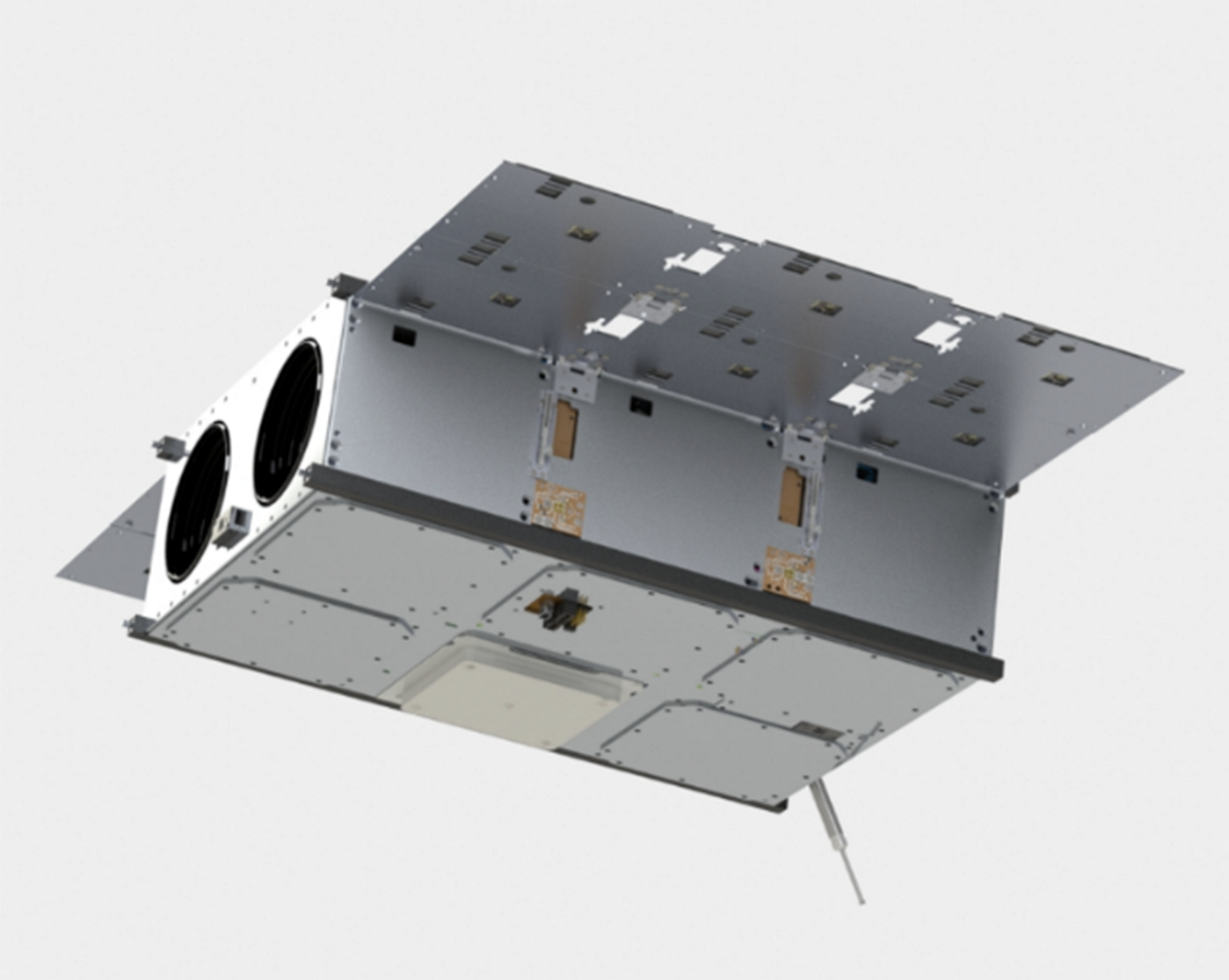
The European Space Agency (ESA) has extended a Memorandum of Intent (MoI) with the National Observatory of Athens (NOA) to include the construction of additional optical ground stations (OGS) in Greece. The extension lays the groundwork for expanded cooperation between NOA and ESA’s Optical and Quantum Communications – ScyLight programme through to the end of 2028.
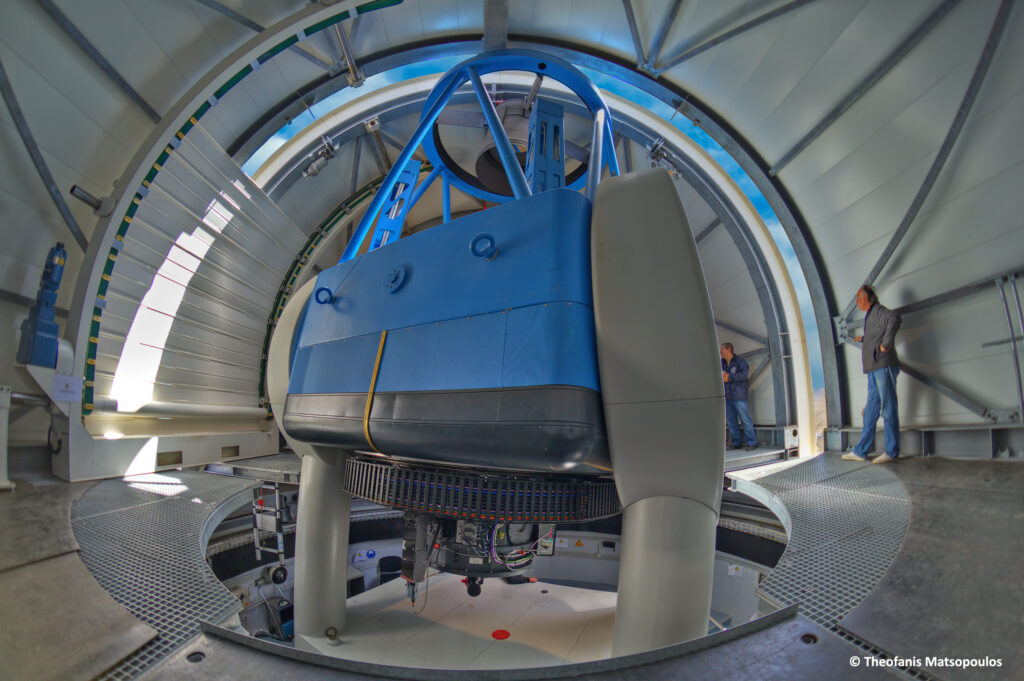
Helmos Observatory is located on mount Helmos (Aroania) in the Northern Peloponnese at an altitude of 2,340 metres. Pictured is ARISTARCHOS, a 2.3-metre instrument. Image credit: Theofanis Matsopoulos
This MoI outlines the shared interest of ESA and NOA to develop optical and quantum communication technologies crucial to the advancement of European cybersecurity. Elevating satellite communications with optical technologies will enable resilient, secure and ultra-high data transmission for institutional and commercial users alike – a strategic imperative for Europe’s sovereign and secure communications capabilities.
The original MoI details the installation, operation and maintenance of optical equipment at the Helmos and Kryoneri observatories by ESA to test cutting-edge bi-directional space-to-ground links. NOA, for its part, provides the telescope time, infrastructure and manpower necessary to the execution of agreed-upon activities. The extension includes similar implementation of optical equipment into the observatory currently planned in Chios, a new location with a strong use case for maritime applications and future for lunar communications experiments. The planned observatory at Chios will join three existing OGS sites in Skinakas, Helmos and the newly completed Holomondas.
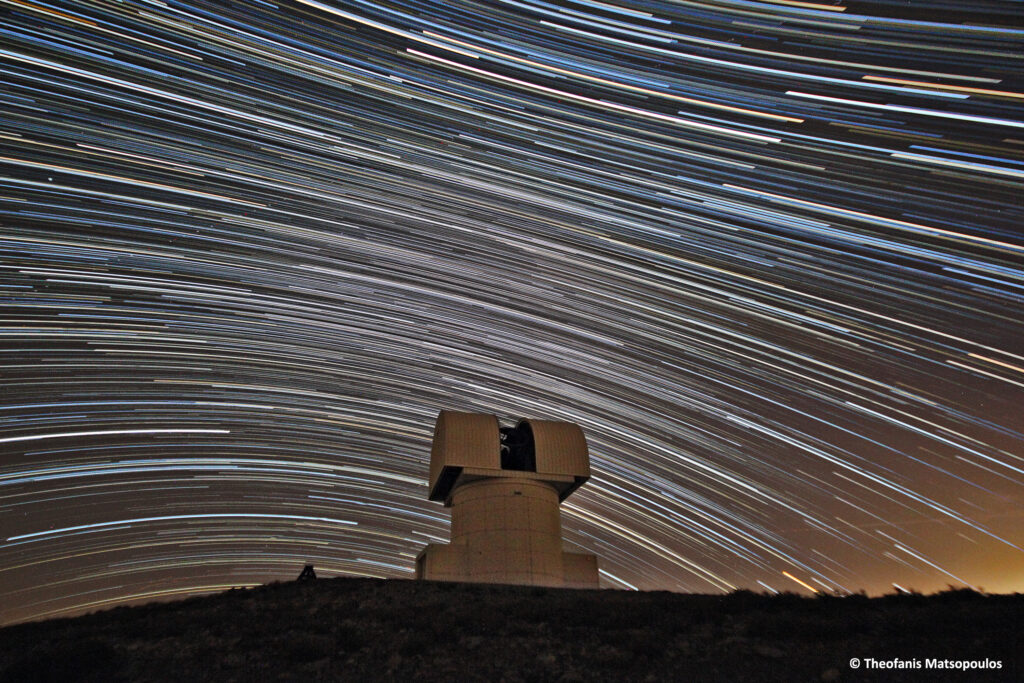
The original Memorandum of Intent (MoI) details the installation, operation and maintenance of optical equipment at the Helmos (pictured) and Kryoneri observatories by ESA to test cutting-edge bi-directional space-to-ground links. Image credit: Theofanis Matsopoulos
The extension highlights the success of another core provision to this successful agreement: the exchange of knowledge and the creation of new opportunities for collaboration. The MoI has laid a collaborative groundwork which has paved the way for Greece’s astronomy community to reach out to ESA through NOA, a development that is a testament to the strength of the partnerships and expertise cultivated between the two organisations. The collaboration marks the expansion of know-how in optical and quantum beyond the space ecosystem.
“This extension and the work planned in Chios will become a success story for our partners in Greece, building a long-term knowledgebase in Europe in optical and quantum satellite communication technologies,” said Harald Mathias Hauschildt, Head of ESA’s Optical and Quantum Programme Office. “Not only are these key capabilities at the leading edge of technology development, they are the foundation for a community understanding to enable European resilience and future Quantum Information Networks”.
Home
/ Greek satellite assembly and testing facility full...
Greek satellite assembly and testing facility fully commissioned, ready to begin operations
The Hellenic Assembly Integration and Testing Facility (HAITF) has reached operational status, opening its doors to the Greek and European space ecosystems to offer extensive assembly, integration and environmental testing capabilities for satellites. Implemented by the European Space Agency on behalf of the Hellenic Ministry of Digital Governance, the facility provides Greece with dedicated Assembly, Integration and Testing (AIT) as well as Environmental Verification and Testing (EVT) capabilities for satellites and space equipment.
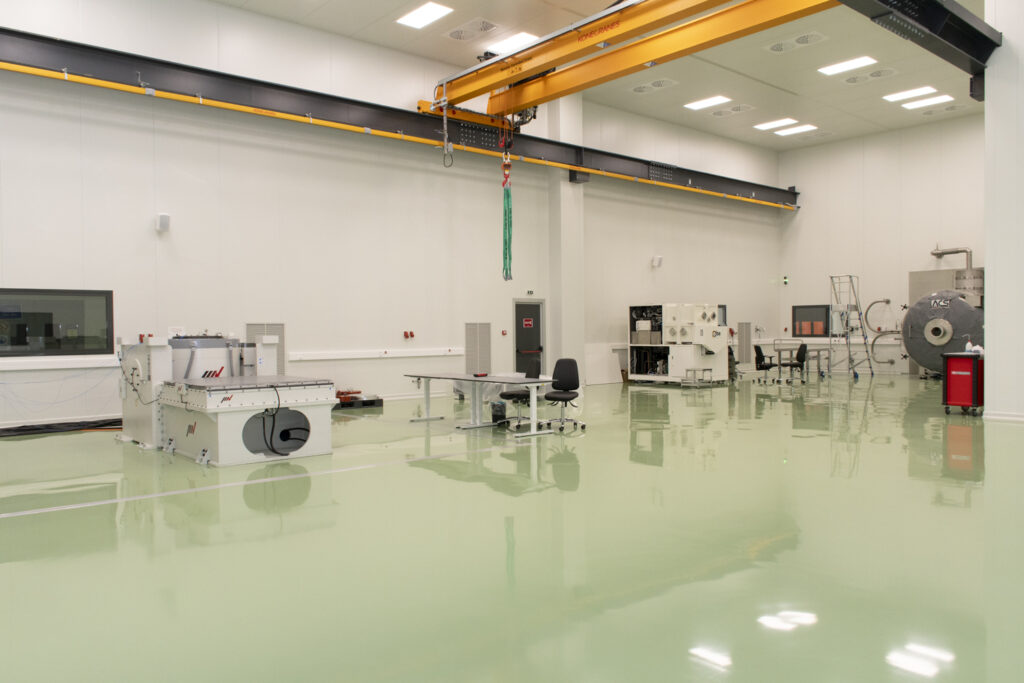
The new HAITF in Schimatari, Greece. Image credit: Hellenic Aerospace Industry S.A.
The HAITF is designed to support a wide range of space sector needs, from national satellite programmes and institutional missions to industrial and commercial activities requiring access to qualified AIT and test infrastructure. In doing so, the HAITF not only reinforces Europe’s distributed industrial capabilities, it also reduces Greece’s reliance on external facilities and gives it control of scheduling and prioritisation of space missions. What’s more, by attracting foreign missions, the HAITF constitutes a platform to cultivate national expertise and know-how by working on world-class space missions.
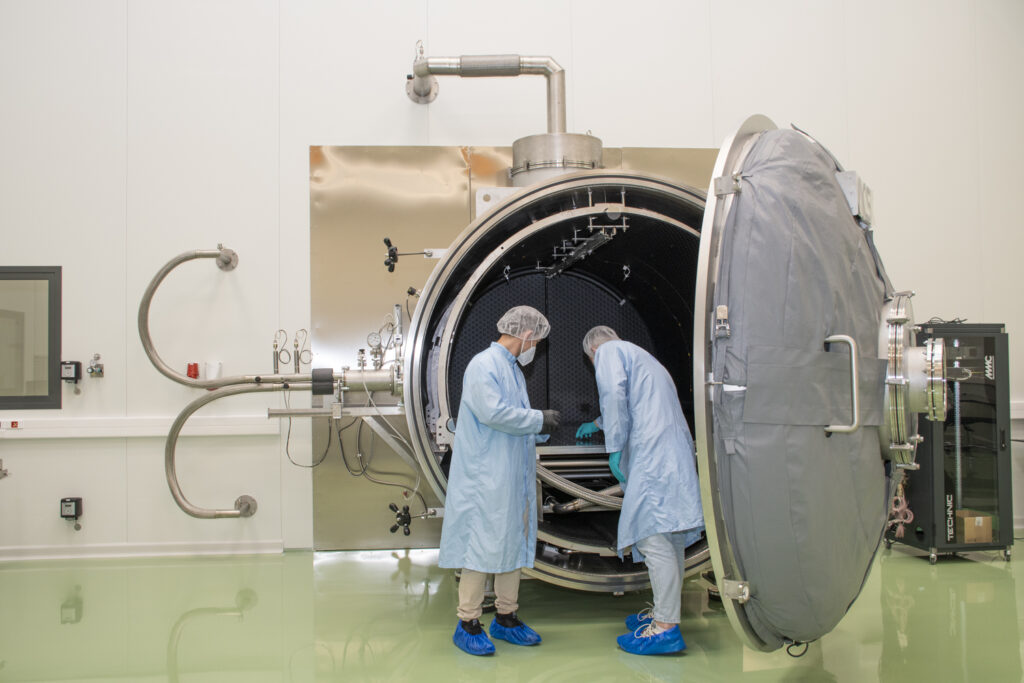
The facility includes an ISO 8 cleanroom, large and small thermal-vacuum chambers, a vibration test system with three-axis slip-table configuration, and associated control, instrumentation and data acquisition systems. Together, these assets provide the capability to perform assembly and integration activities in nearly 400 square meters of cleanroom area, plus thermal-vacuum testing, vibration testing and associated verification activities within Greece, for small satellites in the range up to 500kg and 1.5m3 volume.
The large TVAC at HAITF. Image credit: Hellenic Aerospace Industry S.A.
The HAITF is hosted in Schimatari, on the premises of Hellenic Aerospace Industry S.A. (EAB/HAI), also the prime industry collaborator, the facility’s construction called upon expertise from across Europe – including the BCT Group (GR), together with Alexopoulos & Partners (GR), for the infrastructure and cleanroom works; Angelantoni Test Technologies / ACS (IT) for the Large Thermal Vacuum Chamber and Small Thermal Vacuum Chamber; Terma (NL) for the thermal data handling system; Plugin (FR) for thermal-vacuum chamber accessories and instrumentation; IMV Europe (UK/DE) for the Vibration Test System; Siemens (NL) for the vibration control and acquisition system; and SOL (GR) for the LN2 plant installation.
Working on the HAITF equipment. Image credit: Hellenic Aerospace Industry S.A.
The completion and acceptance of all work orders for the HAITF marks the conclusion of a stringent certification process, and the acceptance of all major work packages on a project originally launched in 2023. This milestone closely follows the opening of the Holomondas Optical Ground Station in May 2026, and the final launch in the Greek Satellite Connectivity Programme into low Earth orbit. The Hellenic AIT Facility materialises the final piece in a strategy to build-up of Greece’s end-to-end ability to support independent satellite missions from conception to design, manufacturing, assembly and testing.
The small TVAC at HAITF. Image credit: Hellenic Aerospace Industry S.A.
Greece’s strategy is funded by the European Union’s Recovery and Resilience Facility (RRF), with both its ground and space segments implemented by ESA under the Agency’s Greek Connectivity Programme. This collaborative approach firmly anchors the programme in the European space ecosystem, boosting in abilities in design, manufacturing, operation and ground station communications, and accelerating knowledge exchange.
Home
/ ESA supports new Optical Ground Station in Greece ...
ESA supports new Optical Ground Station in Greece to advance Europe’s secure space connectivity
The European Space Agency (ESA), together with the Greek Ministry of Digital Governance, has supported the development and commissioning of the Holomondas Optical Ground Station (OGS) in Greece, marking another important milestone in Europe’s efforts to build next-generation optical connectivity infrastructure.
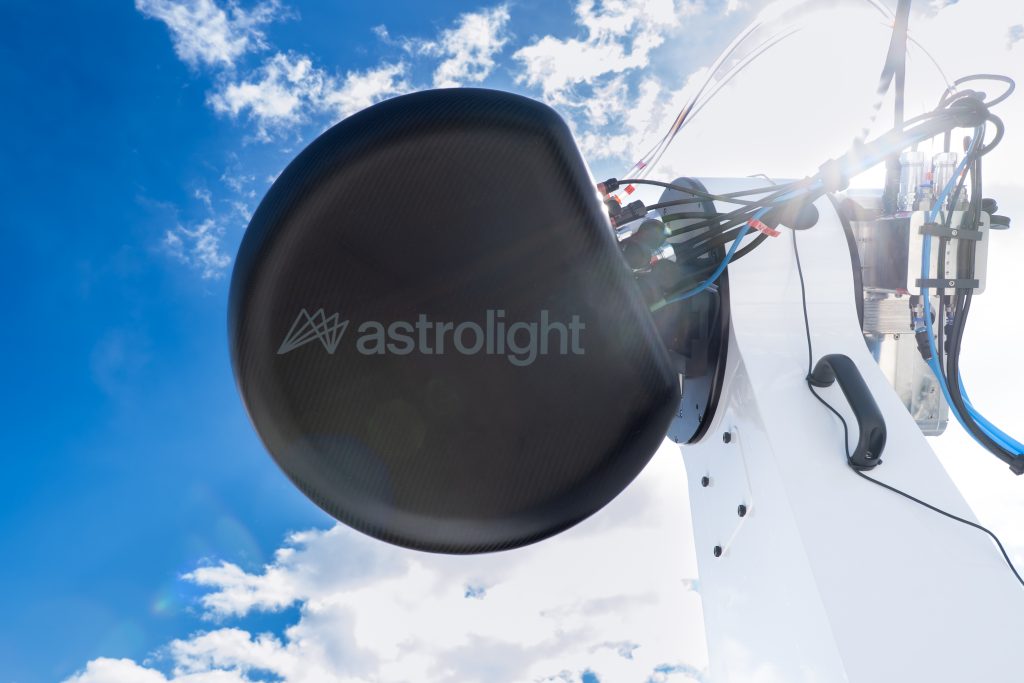
The Holomondas station is now operational and ready to support in-orbit demonstration and validation activities for Greek CubeSat missions carrying laser communication payloads. Image credit: Astrolight
Developed under the PeakSat project led by the Aristotle University of Thessaloniki, and implemented with space and defence company Astrolight, the Holomondas station is now operational and ready to support in-orbit demonstration and validation activities for Greek CubeSat missions carrying laser communication payloads.
The project forms part of ESA’s Greek Connectivity Programme, carried out on behalf of the Hellenic Ministry of Digital Governance under the Greek IOD/IOV CubeSat initiative. The programme is designed to strengthen Greece’s and Europe’s capabilities in secure, high-speed optical communications from space.
PeakSat and ERMIS-3, two Greek CubeSats supported by ESA, successfully reached orbit on 30 March 2026 as part of a wider launch campaign involving eight ESA-backed spacecraft. Both missions carry optical communication payloads that will demonstrate high-throughput laser links between satellites in orbit and the Holomondas OGS on Earth. Astrolight supplied both the ground segment and the ATLAS-1 laser communication terminals onboard the satellites, creating a complete end-to-end optical communications system for in-orbit testing.
The Holomondas station, originally an astronomical observatory, has been upgraded with advanced laser communication capabilities, including an 808-nanometre laser beacon and a compatible C-band optical receiver. These systems enable precise laser beam alignment and optical data reception at speeds of up to 2.5 Gbps under varying atmospheric and operational conditions.
The project also demonstrates how innovative engineering approaches can help reduce the size, weight and infrastructure requirements traditionally associated with optical ground stations, helping pave the way for more scalable and cost-effective deployment of optical communication networks across Europe.
Unlike traditional radio-frequency systems, optical communications use narrow infrared laser beams to transmit data at significantly higher rates of up to 100 times, while offering resilience against interference and congestion.
“ESA is proud to support the joint efforts of Astrolight and the Aristotle University of Thessaloniki in advancing Europe’s next generation of optical communication infrastructure. The commissioning of the Holomondas Optical Ground Station marks an important step towards enabling faster, more secure, and resilient connectivity, while strengthening Greece’s role within Europe’s expanding optical communications ecosystem,” said Frederic Rouesnel, Greek Connectivity RRF Project Manager at ESA. “As the Greek CubeSats move into their demonstration phase, they will help validate innovative laser communication technologies that will provide alternatives to scarce radio frequencies and shape the future of high-capacity connectivity in space.”
“We are happy to apply our technical expertise to commission the Holomondas station and support the Aristotle University of Thessaloniki’s efforts to advance Greece’s and Europe’s optical communication infrastructure,” said Laurynas Mačiulis, CEO of Astrolight. “By providing an end-to-end communication system, with ground and space segments designed to work together from the start, we helped streamline the mission’s path from integration to in-orbit testing.”
“Holomondas is moving closer to becoming an internationally recognised optical communication hub and contributing to the future global network of optical ground stations,” said Kleomenis Tsiganis. “This progress has been made possible through close collaboration between academia and industry, and our joint endeavor shows how such partnerships can accelerate the development of laser communication infrastructure.”
The initiative contributes to ESA’s broader efforts to develop secure, resilient and high-capacity communications infrastructure that will support future satellite services, Earth observation missions and Europe’s long-term connectivity ambitions.
Home
/ Final in-orbit-demonstrators launched to validate ...
Final in-orbit-demonstrators launched to validate direct to Earth optical links in close out of ESA-implemented Greek Connectivity Programme
The European Space Agency (ESA) has supported the launch of two satellites in the Hellenic Space Dawn mission, the final CubeSat mission in the Greek Connectivity Programme implemented by ESA on behalf of the Hellenic Ministry of Digital Governance. The Hellenic Space Dawn satellites were launched to low Earth orbit on a SpaceX Falcon 9 from Vandenberg Space Force Base, California, at 08:00 a.m. BST (09:00 a.m. CET) on 3 May 2026.
One of the two Hellenic Space Dawn Satellite. Image credit: EMTech Space
Hellenic Space Dawn comprises two 8U-size CubeSats, HELIOS and SELENE, managed by EMTECH SPACE and equipped with CubeCAT laser communication terminals provided by AAC Clyde Space. This mission will also carry high-resolution cameras with the intention of leveraging optical links to enable low-latency support for applications such as cartography and land-use monitoring. In addition, the satellites will support the validation of in-space data processing hardware as well as a radiofrequency inter-satellite links. Once operational, this mission will validate robust direct to Earth (DTE) optical links, offering significant improvements over conventional radio frequency systems for transmission speeds and resistance to interference.
Hellenic Space Dawn is the culmination of the space segment in the Greek Connectivity Programme, an ambitious programme initiated in 2023 to fast-track Greek In-Orbit Demonstration (IOD) missions. Implemented by ESA with funding from the European Union, the programme aims to boost the country’s space industry – from design, manufacturing, operation and ground station communications – and strengthen its place in the European space ecosystem.
Long exposure of launch vehicle carrying Hellenic Space Dawn. Image credit: SpaceX
Hellenic Space Dawn is the last of the seven IOD missions in the programme. Alongside three similarly specialised missions launched earlier this year, Hellenic Space Dawn will help to validate next-generation optical terminals in support of Greece’s expanding capabilities in resilient optical communication technologies. Altogether, the seven IOD missions in the Programme feature a total of 11 satellites launched to low Earth orbit between 2025 and 2026. Each spacecraft is currently either performing its nominal mission or progressing through its Launch and Early Operations Phase (LEOP) during which its operators meticulously check the satellites’ systems’ health in anticipation of commissioning and commencement of normal mission operations.
Together with the expected completion of the Hellenic Assembly, Integration and Testing Facility (HAITF), as well as multiple optical ground stations, the IOD missions contribute to building up the country’s end-to-end space capabilities and foster competitive European solutions.
Home
/ DUTHSat-2, inaugural satellite in ESA-supported Gr...
DUTHSat-2, inaugural satellite in ESA-supported Greek Satellite Connectivity programme, proceeds through early operations phase
The DUTHsat-2 mission, the first of seven missions implemented by the European Space Agency (ESA) on behalf of the Hellenic Ministry of Digital Governance for Greek National Small Satellite Programme is progressing through its Launch and Early Operations Phase (LEOP) in low Earth orbit. The satellite was originally launched as part of the Transporter-14 mission on Monday 23 June 2025 from Vandenberg Space Force Base in California aboard a SpaceX Falcon 9.
Launch of SpaceX Falcon 9 Transporter-14 mission from Vandenberg Space Force Base, California, on 23 June 2025. Image credit: SpaceX
DUTHSat-2 is a 6U CubeSat that will perform In Orbit validations of essential telemetry and housekeeping units as well as demonstrations for its payload, a camera designed to take pictures over the land and sea in the visible and near infrared spectrum. This mission is led by the Democritus University of Thrace, with support of the Athena Research Centre and companies Space Asics and Prisma Electronics SA.
Since its launch in mid-2025, DUTHSat-2 has been undergoing progressive activation and monitoring of onboard systems and deployable elements – a process referred to as LEOP. This phase of the mission allows teams to monitor the spacecraft’s health while configuring it for standard operations. The next milestone for the mission will be its commissioning, which will mark the start of its core in-orbit demonstration and validation missions.
DUTHSat-2 in its flight configuration. Image credit: Democritus University of Thrace
DUTHSat-2 was the inaugural launch for the Greek Connectivity Programme, followed up by the MICE-1 and PHASMA missions in late 2025. The remaining four missions in the programme are expected to launch no earlier than March 2026 and will conduct a test campaign for spaceborne optical laser terminals. The Greek National Small Satellite Programme is implemented by the Hellenic Ministry of Digital Governance, supported by the General Secretariat of Telecommunications and Posts, and overseen by the Hellenic Space Center, with ESA’s support. This initiative is part of the National Recovery and Resilience Plan ‘Greece 2.0’, which is funded by the Recovery and Resilience Facility (RRF), core programme of the European Union’s NextGenerationEU. The programme aims to build national expertise in space technologies while enabling demonstrations in areas such as Earth observation and secure connectivity.
Home
/ Greece’s Advanced Laser Satellite Communications...
Greece’s Advanced Laser Satellite Communications test campaign to launch with ESA support
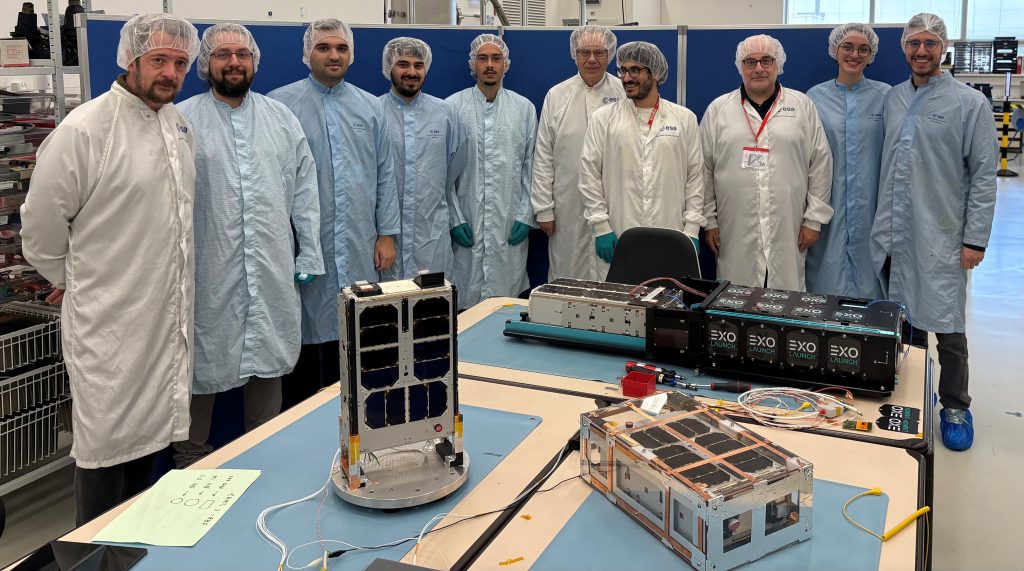
PeakSat, OptiSat and ERMIS-3 undergoing integration testing. Image credit: National and Kapodistrian University of Athens
The European Space Agency (ESA) is supporting an extensive test campaign for optical laser terminals orchestrated by a broad coalition of Greek aerospace and academic partners under the Greek Connectivity Programme. Launching with four CubeSat missions in the first half of 2026, this campaign will aim to validate next-generation laser communication terminals in support of Greece’s expanding Connectivity and Secure Communications Programme.
The missions, operated by Planetek Hellas, EMTech Space, the Aristotle University of Thessaloniki, and the National and Kapodistrian University of Athens will conduct in-orbit-demonstrations of three different laser payload designs. The optical terminals will use laser light for high-bandwidth, secure links between the satellites and ground stations, potentially exceeding 1Gbps data rates. This technology represents a step change from traditional radio frequency communications, which are vulnerable to interference, provide much lower data rates, and require licensing.
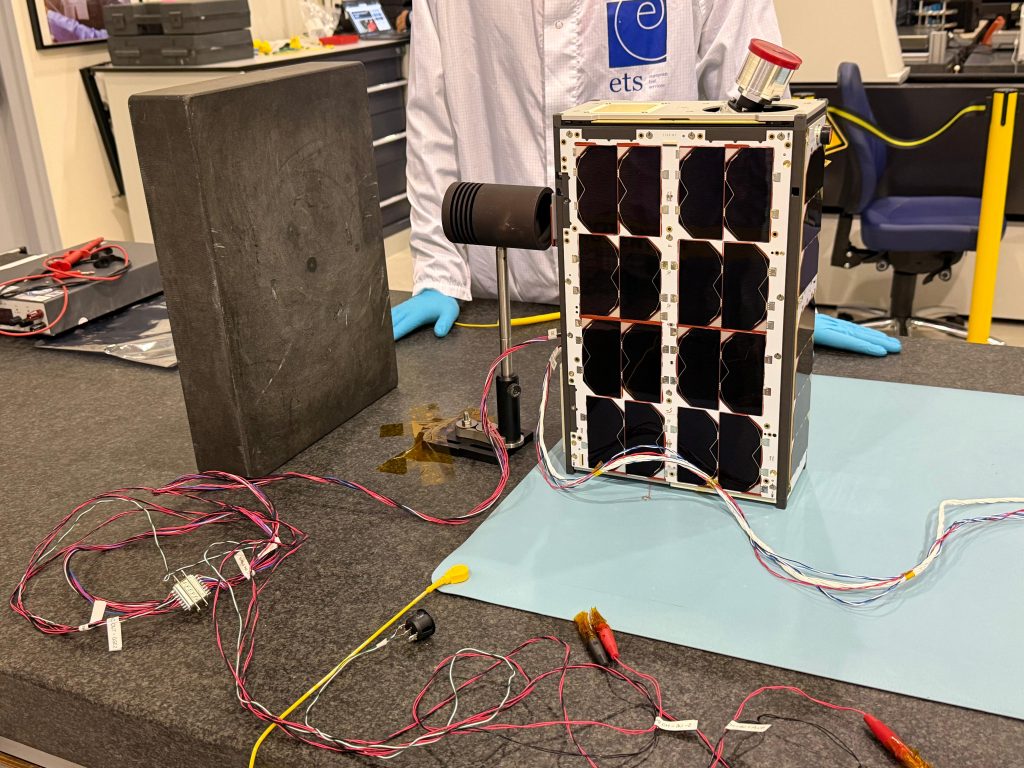
OptiSat undergoing testing of it laser communications terminal payload. Image credit: Planetek Hellas
OptiSat, led by Planetek Hellas, will host a TESAT SCOT20 laser communication terminal payload designed to demonstrate secure, high-rate laser links from small satellites in Low-Earth Orbit (LEO). It was delivered, accepted and integrated with the 6U OptiSat satellite in August 2025 ahead of testing and launch preparations.
Hellenic Space Dawn comprises of two 8U satellites, managed by EMTech Space. The satellites are equipped with CubeCAT laser communication terminals from AAC Clyde Space. The mission will validate robust optical links, offering significant improvements over conventional radio frequency systems for transmission speeds and resistance to interference. This mission will also carry high-resolution cameras with the intention of leveraging optical links to enable low-latency support for applications such as cartography and land-use monitoring.
PeakSat undergoing pre-flight tests. Image credit: Aristotle University of Thessaloniki
PeakSat is a 3U CubeSat developed by the Aristotle University of Thessaloniki. It will use the Astrolight ATLAS-1 laser communication terminal to test space-to-ground optical links with upgraded Greek optical ground stations. This will establish real-world performance metrics across a variety of atmospheric and operational conditions.
ERMIS-3 is an 8U satellite and a cornerstone mission of the Greek Connectivity Programme. It was built by the ERMIS consortium, led by the National and Kapodistrian University of Athens (NKUA), and features an Astrolight ATLAS-1laser communication terminal. While the ERMIS-1 and ERMIS-2 missions focus on 5G Internet of Things non-terrestrial-network connectivity, ERMIS-3 will focus on high-capacity and secure space-to-ground optical links. In particular, it will emphasise precise pointing, acquisition and tracking (PAT) and operational robustness. ERMIS-3 plays a key role in validating Astrolight’s technology for future operational and constellation-level applications. ERMIS-3 also features a hyperspectral camera and will aim to demonstrate rapid transmission of hyperspectral imagery from space via optical links, for applications such as precision agriculture.
The CubeSats are part the Greek Connectivity Programme, implemented by ESA on behalf on the Greek Government’s Ministry of Digital Governance. Together with recent advances in the work on the Hellenic Assembly, Integration and Testing Facility (HAITF), these missions are part of a push to build up the country’s ability to design, build, test and operate satellites.
“This test campaign is a concerted effort to deliver top-of-the-line laser communications capabilities for Greece and advance its place as a fully-fledged player in Europe’s space ecosystem,” said Frederic Rouesnel, Greek National Telecommunications Satellites Programme Manager at the European Space Agency. “Mastering laser communications on compact satellites is a bold step towards next-gen constellation applications for the Greek Connectivity Programme.”
“PeakSat’s launch with Transporter-16 marks a significant milestone for SpaceDot, Aristotle University of Thessaloniki, and Prisma Electronics. The mission will demonstrate in-orbit optical communications with the Holomondas Optical Ground Station, developed at AUTH with the Laboratory of Theoretical Mechanics and Astronomy. Delivered end-to-end by student engineers and researchers, PeakSat shows how effective industry–academia collaboration can translate ambitious research goals into flight-ready capability,” said Panagiotis Vamvakas, PeakSat Project Manager at the Aristotle University of Thessaloniki. “With Astrolight’s ATLAS-1 optical terminal and key subsystems developed in-house – including the on-board computer and the communications board – PeakSat is ready to begin its operational phase in orbit.”
The state-of-the-art laser communications testing capabilities are central to Greece’s space strategy, enabling secure connectivity and high-speed data transfer for scientific, governmental and commercial applications.
Home
/ Greek Connectivity Programme implemented by ESA pr...
Greek Connectivity Programme implemented by ESA proceeds with satellite commissioning and launches
The MICE-1 and PHASMA Greek CubeSat missions supported by the European Space Agency (ESA) have begun their in-orbit activities, a key milestone in their launch and early operations phase.
The two missions were launched into Sun Synchronous Orbit on 28 November 2025 aboard SpaceX’s Transporter-15 rideshare mission from Vandenberg Space Force Base, USA. Joining DUTHSat-2 in orbit, MICE-1 and PHASMA are part of the Greek National Small Satellite Programme implemented by ESA on behalf of the Hellenic Ministry of Digital Governance. The three missions are part of a larger endeavour to launch a total of seven Greek missions, which will culminate with four additional CubeSat missions in 2026.
The Greek IOD/IOV CubeSat programme falls under the National Recovery and Resilience Plan ‘Greece 2.0’ funded by the Recovery and Resilience Facility (RRF), a core programme of the European Union’s NextGenerationEU. The RRF aims to strengthen Greece’s technological capabilities in areas such as secure connectivity and Earth observation, while fostering the country’s presence in the global space community.
MICE-1 and PHASMA are the latest addition to this effort. The satellites are operated by PRISMA Electronics and the Libre Space Foundation respectively. During the critical launch and operations phase, both teams work to verify spacecraft health, gradually activating onboard systems. Following launch, the operators successfully established contact with all spacecrafts and verified their response to commands – enabling the teams to safely progress through the commissioning of key functions and transition towards routine operations.
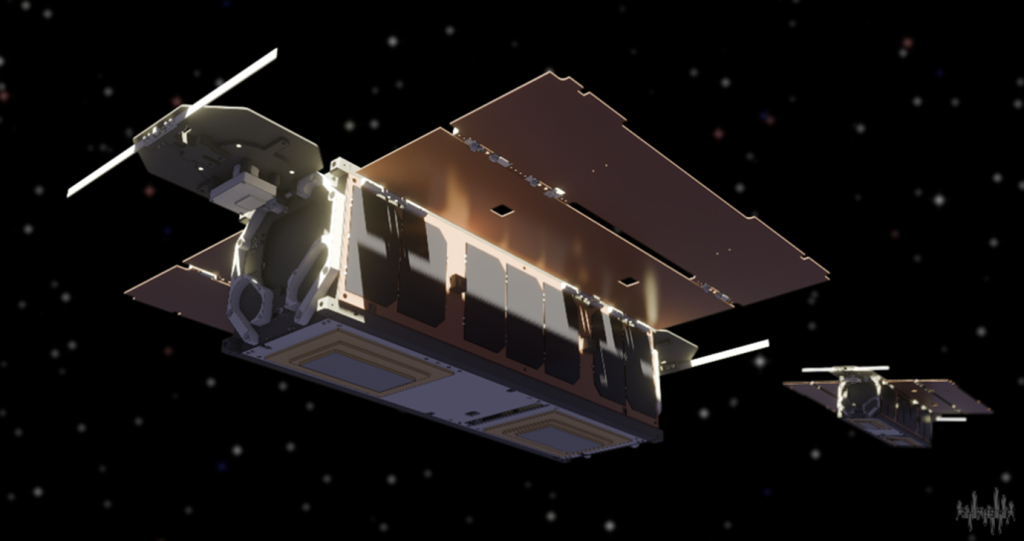
An artist’s rendering of the PHASMA spacecrafts’ in-flight configuration. Image credit: Libre Space Foundation
PHASMA is composed of two satellites, LAMARR and DIRAC, equipped with a SatNOGS-COMMS transceiver and a payload antenna used to monitor radio frequency activity in UHF and S-bands before sending the measurements to the ground stations. By combining measurements from the two satellites with their orbital positioning, operators will be able to determine the location of the signals, particularly whether they are originating from Earth or from space. With this information, the Libre Space Foundation team will be able to quantify global spectrum usage and identify potential sources of interference or violations.
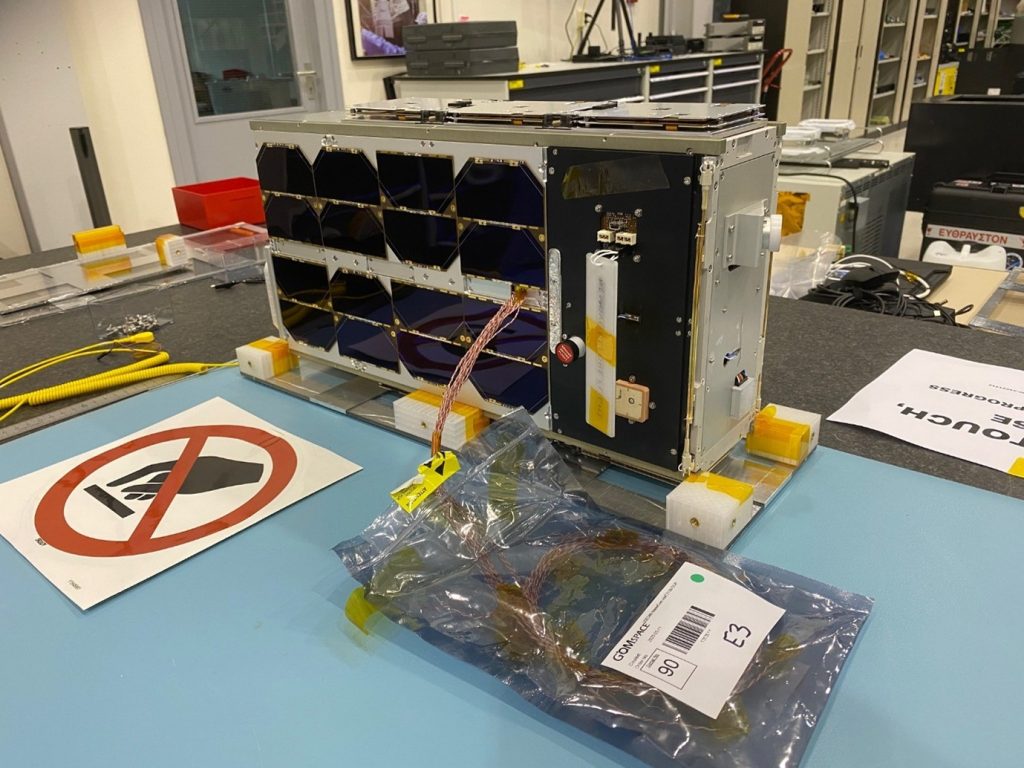
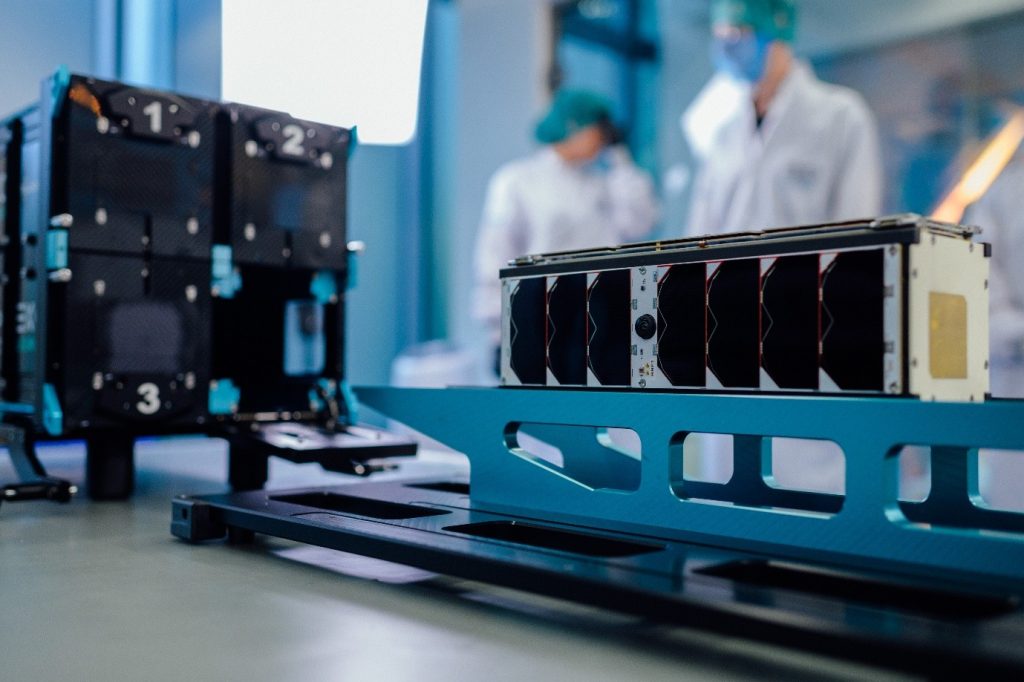
MICE-1 integrated with its deployer ahead of the launch. Image credit: Exolaunch
The Maritime Identification and Communication systEm-1 (MICE-1), developed by Prisma Electronics S.A. with the support of the Democritus University of Thrace, is a 3U CubeSat focused on enhancing maritime tracking activities in the Mediterranean Sea. MICE-1 hosts an antenna and receiver to track Automated Identification System (AIS) signals broadcast by seafaring vessels, extending maritime tracking coverage into remote areas. In addition, the mission establishes communication with ships equipped with PRISMA Electronics’ LAROS system. LAROS supports the diagnosis and early warning for structural, environmental and energy footprint assessment of maritime assets.
“ESA and the Hellenic Ministry for Digital Governance are building a bold foundation for Greece’s future in space,” said Frederic Rouesnel, Greek National Telecom Satellites Programme Manager at the European Space Agency. “Each mission in the programme is another milestone in the new space race, expanding Greece’s ability to design, assemble, test, operate and leverage satellites – both independently and in collaboration with the rest of the European space ecosystem. We will continue building up speed towards this ambitious future in space in the months to come.”
Home
/ Infrastructure and Clean Room works on Hellenic As...
Infrastructure and Clean Room works on Hellenic Assembly Integration & Testing Facility nearing completion with support from ESA
The facility’s core capabilities will be enabled by thermal vacuum chambers (TVAC), one of which is seen here during the Manufacturing Review in Italy prior to the factory acceptance test. Image credit: Hellenic Aerospace Industry S.A.
Civil and structural work has been completed on the Hellenic Assembly, Integration and Testing Facility (HAITF), implemented by ESA Connectivity and Secure Communications in collaboration with the Hellenic Aerospace Industry S.A. (HAI) on behalf of the Hellenic Government. This milestone comes after the successful launches for the Greek Satellite Connectivity Programme on Transporter-15 and puts the facility on track for its commissioning and acceptance, with operational target by the second quarter of 2026.
The infrastructure that will house the brand-new facility has been completed to the rigorous specifications of satellite Assembly, Integration and Testing (AIT) activities, with support from the main subcontractor, BCT Group. The AIT facility’s spatial configuration and structure have been designed to support the demanding operational requirements of satellite assembly, with purpose-built floors, load-bearing structures and overhead cranes. Furthermore, the room partitions, finishes, interfaces, systems & utility networks for the environmental controls constituting the ISO 8-compliant cleanroom have also been installed. In the coming weeks, installation of the remaining lighting, electrical distribution, and grounding infrastructure will proceed at pace to bring the cleanroom to operational standards.
IMV Corporation’s shaker system successfully passed the Factory Acceptance Stage in November 2025, prior to shipment to Greece. Image credit: Hellenic Aerospace Industry S.A.
This Hellenic AIT facility is being built to further support the role of Greece in the European space landscape. The HAITF will boost the design and manufacture of the next generation of Greek satellites, from subsystem integration to environmental qualification. The facility’s core capabilities will be enabled by two thermal vacuum chambers (TVAC) provided by Angelantoni Test Technologies, and a 125kN-rated Vibration Test System (shaker) provided by the IMV Corporation. Highlighting the rapid progress of development of the facility, IMV Corporation’s shaker system successfully passed its Factory Acceptance Stage in November 2025, validating its performance within HAITF’s strict specification requirements. Both TVAC and shaker components are expected to be installed in February 2026.
As part of the National Recovery and Resilience Plan “Greece 2.0”, the Hellenic AIT facility project is funded by the European Union through the Recovery and Resilience Facility (RRF) and implemented by ESA on behalf of the Greek Ministry of Digital Governance. The HAITF project was launched in November 2023 with the objective to design, build, and operate a fully functional Assembly, Integration and Testing infrastructure at HAI’s site in Schimatari. The implementation began in early 2025, targeting full installation by the first half of 2026, with site acceptance tests scheduled for no earlier than March 2026. The timeline demonstrates the momentum of the programme towards delivering modern high-performance facilities supporting advanced AIT capabilities for the Greek space industry.
“2025 has counted milestone after milestone for the Greek Connectivity Programme,” said Frédéric Rouesnel, Greek Connectivity RRF Project Manager at ESA’s Connectivity and Secure Communications. “The completion of the building housing the brand-new Hellenic AIT facility will boost Greece’s role in the European space landscape and open the doors for talent and expertise to grow locally with new jobs and projects throughout the value chain. Already, HAITF has shown Greece’s expertise to develop and produce highly rated facilities to enable its growing role in the end-to-end European industrial resilience, strategic autonomy, collaboration and know-how.”
Home
/ ESA-supported Hellenic Assembly, Integration &...
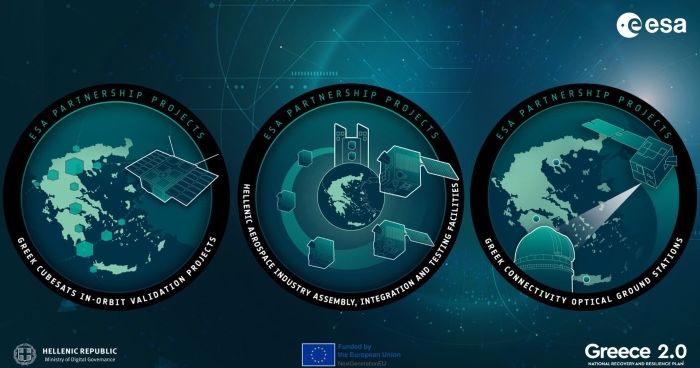
Visuals representing each project under the Greek National Satellite Space Project (GNTS), funded by the European Commission Recovery and Resilience Facility. The visual for the Hellenic Assembly, Integration & Testing Facility (HAITF) is showcased in the centre. Image credit: ESA
The European Space Agency (ESA), in collaboration with Hellenic Aerospace Industry S.A. (HAI) as prime contractor and BCT Group as main subcontractor, has officially kicked off the contract for the implementation of a cleanroom and supporting infrastructure at the Hellenic Assembly, Integration & Testing Facility (HAITF). The signature to begin the activity commenced on 20 May 2025 with a dedicated meeting held in Athens, Greece. The signatories were Alexandros Diakopoulos, CEO of the Hellenic Aerospace Industry S.A, and Stephane Lascar, former Head of Telecommunications Satellite Programmes Department within ESA’s Connectivity and Secure Communications.
This major milestone follows the successful completion of the design phase and marks the onset of the full construction and implementation phase of the HAITF project. The beginning of the contract represents a decisive step forward for the Greek National Satellite Programme and further strengthen HAI’s position within the European space ecosystem. The project is funded by the European Union through the Recovery and Resilience Facility (RRF), under the National Recovery and Resilience Plan “Greece 2.0”, and is implemented by ESA on behalf of the Greek Ministry of Digital Governance.
The HAITF project was launched in November 2023 with the objective to design, build, and operate a fully functional Assembly, Integration and Testing (AIT) infrastructure at HAI’s site in Schimatari. The facility will support the end-to-end process of satellite manufacturing, from subsystem integration to environmental qualification, with capabilities including cleanroom operations, vibration testing, and thermal vacuum testing.
This contract encompasses the execution of the facility’s critical infrastructure, including civil, architectural, mechanical, and electrical elements. A major focus of this phase is the construction and formal acceptance of a state-of-the-art cleanroom environment, essential for conducting high-precision satellite assembly, integration, and testing operations. The final phase of this activity will target the commissioning of all the test equipment within the cleanroom and related infrastructure.
“The HAIT Facility, which will serve as a cornerstone of Greece’s growing space sector,” said Frédéric Rouesnel, Greek Connectivity RRF Project Manager at ESA’s Connectivity and Secure Communications. “Once operational, it will provide the national capacity to assemble, integrate, and qualify small satellites and space systems to foster technological innovation, job creation, and long-term strategic capability in space systems manufacturing and testing.”
“This facility represents a transformative investment for the entire Greek space ecosystem and an important infrastructure for the National Space Strategy,” said Prof. Konstantinos Karantzalos, General Secretary of Telecom and Post and on behalf of the Hellenic Ministry of Digital Governance. “Our expectation is that by enabling the construction, integration, and qualification of satellites and cutting-edge space systems for dual-use applications, the facility will pave the way for new technological capabilities and international collaboration and act as an accelerator for economic growth for the dynamic Greek space sector.”
Home
/ First ESA-supported Greek In-Orbit Demonstration (...
First ESA-supported Greek In-Orbit Demonstration (IOD) CubeSat ready for launch
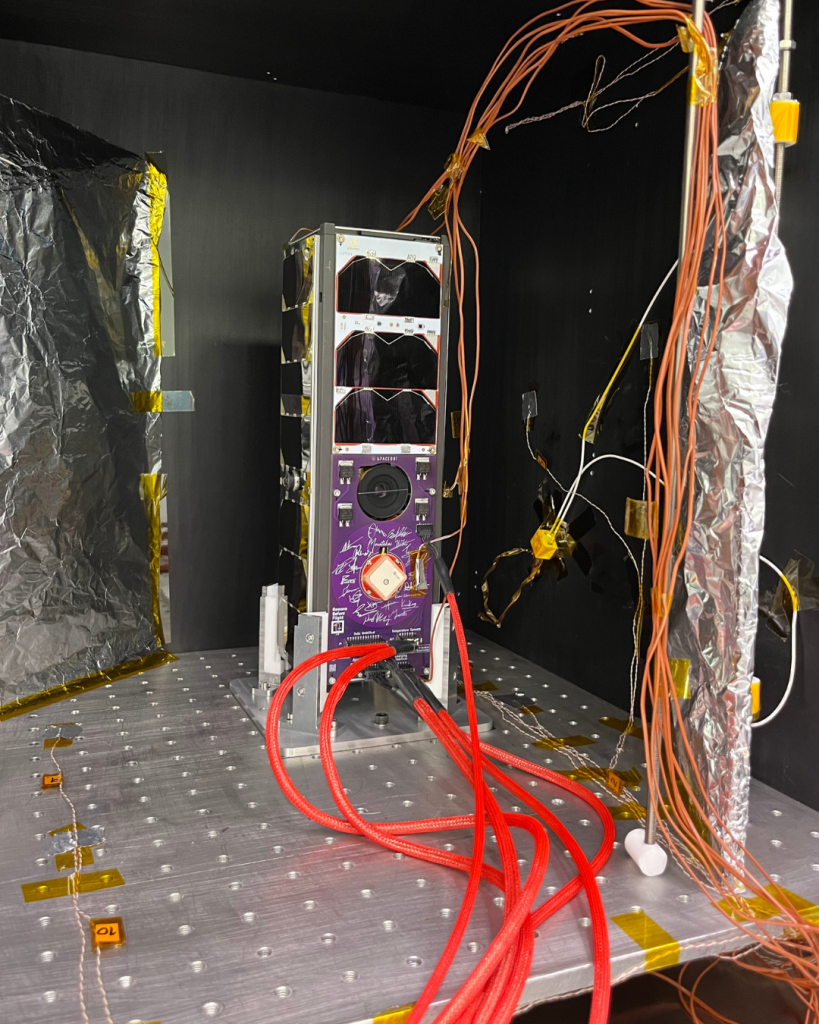
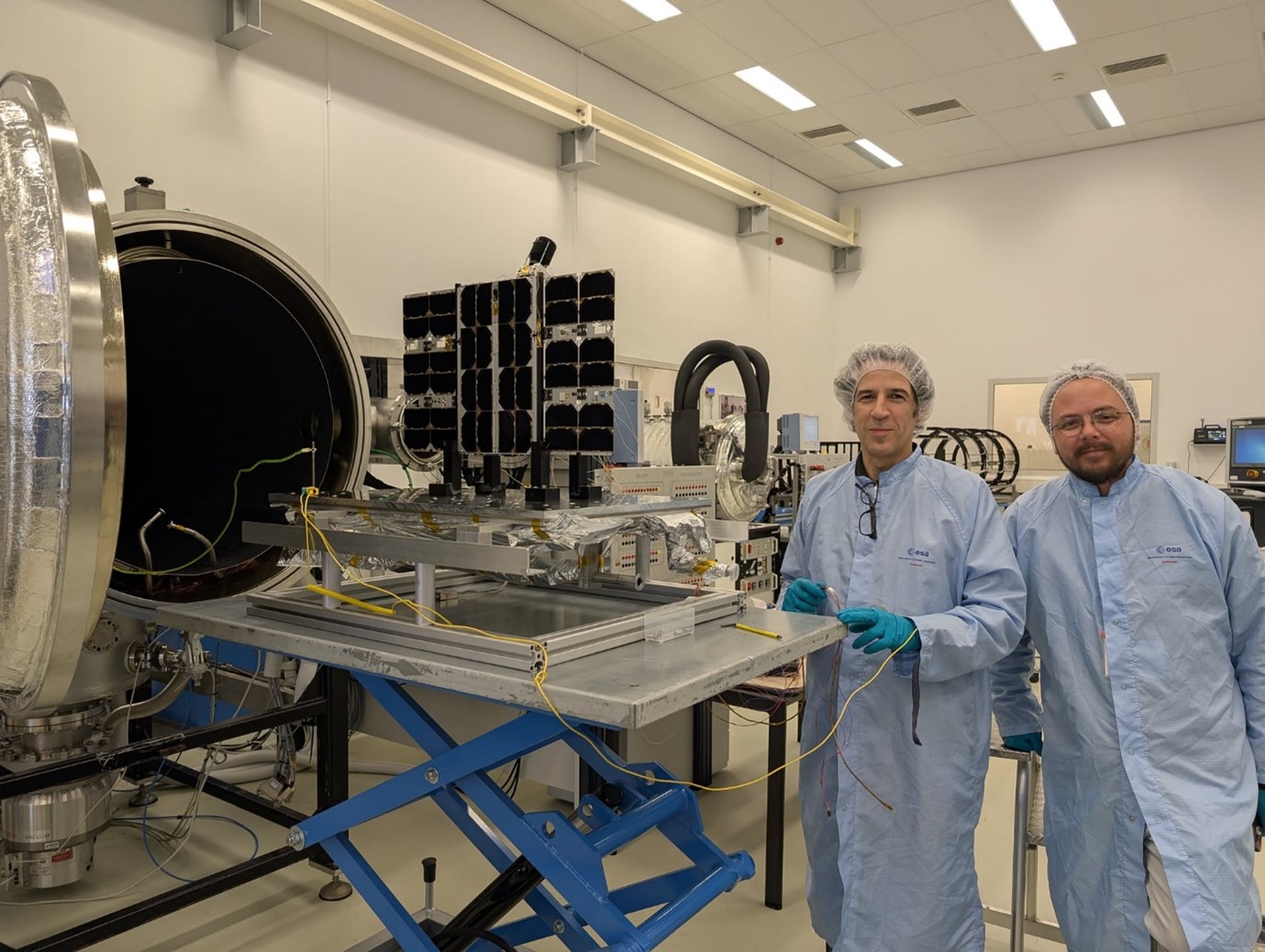
DUTHSat-2 Flight Model during preparations for the Thermal Vacuum testing campaign. Image credit: ESA
The first of the Greek In-Orbit Demonstration (IOD) CubeSat missions, DUTHSat-2, which is led by the Democritus University of Thrace, has been delivered to the launch provider ExoLaunch, and is ready for launch on the SpaceX Transporter-14 rideshare mission, scheduled for June 2025. Having successfully completed functional and environmental testing in February 2025, the 6U CubeSat mission will capture images in the visible and near infrared spectrum, over both sea and land.
DUTHSat-2 is part of the Greek National Small Satellite Programme (Measure ID 16855), and more specifically under the Greek Cubesats in-orbit Validation Projects that include a total of seven IOV CubeSat missions, managed by the European Space Agency’s (ESA) Greek Connectivity Recovery and Resilience (RRF) Project Team, as part of ESA’s Connectivity and Secure Communications directorate. The programme is executed under the auspices of the Hellenic Ministry of Digital Governance with the support of the General Secretariat of Telecommunications and Posts and is closely supervised by the Hellenic Space Center. The programme is part of the National Recovery and Resilience Plan ‘Greece 2.0’, which is funded by the Recovery and Resilience Facility (RRF), core programme of the European Union’sNextGenerationEU.
The imagery and measurements will be used to provide yield information on soil moisture, as well as marine contamination. Additionally, the imagery frequency bands and the imager resolution have been selected to be able to detect both oil spills and ship bilge water pollution.
DUTHSat-2 will also perform in-orbit demonstration of an essential telemetry and housekeeping unit. The Essential TeleMetry and housekeeping (ETM) is the spacecraft version of a “black box”, allowing operators to have visibility over the spacecraft’s health in case of failures of the main subsystems.
DUTHSat-2 rendered in the flight configuration. Image credit: Democritus University of Thrace
The DUTHSat-2 mission brings together Greek academia and industry, being led by the Democritus University of Thrace, and supported by the Athena Research Center and Greek companies Space Asics and Prisma Electronics SA. The spacecraft was assembled on site at the Democritus University of Thrace, with the design, assembly and test process guided and monitored by ESA’s Connectivity and Secure Communications.
“We are proud of this achievement, which was possible by working as one team and by sharing the same motto: Let us make this happen! We are now looking forward to the launch followed by the start of the operations,” said Frédéric Rouesnel, ESA’s Greek Connectivity RRF Project Manager.
“DUTHSat-2 is now at Vandenberg Space Launch Complex 4 with an expected launch date in a couple of weeks onboard a Falcon 9 rocket. We are excited to witness the first satellite of the Greek National Small Satellite programme delivered to the launch provider. Congratulations to both ESA and the Democritus University of Thrace and the respective teams, for managing a technicaly complex project with programmatic challenges. Greece is climbing the steep learning curve of accessing space in order to glean the benefits of the new space economy. We are all proud to be part of the endeavour and wish the best for this as well all upcoming missions,” said Prof. Konstantinos Karatzalos, Secretary General of Telecommunications and Posts.
Manage Consent
To provide the best experiences, we use technologies like cookies to store and/or access device information. Consenting to these technologies will allow us to process data such as browsing behaviour or unique IDs on this site. Not consenting or withdrawing consent, may adversely affect certain features and functions.
Functional
Always active
The technical storage or access is strictly necessary for the legitimate purpose of enabling the use of a specific service explicitly requested by the subscriber or user, or for the sole purpose of carrying out the transmission of a communication over an electronic communications network.
Preferences
The technical storage or access is necessary for the legitimate purpose of storing preferences that are not requested by the subscriber or user.
Statistics
The technical storage or access that is used exclusively for statistical purposes.The technical storage or access that is used exclusively for anonymous statistical purposes. Without a subpoena, voluntary compliance on the part of your Internet Service Provider, or additional records from a third party, information stored or retrieved for this purpose alone cannot usually be used to identify you.
Marketing
The technical storage or access is required to create user profiles to send advertising, or to track the user on a website or across several websites for similar marketing purposes.